
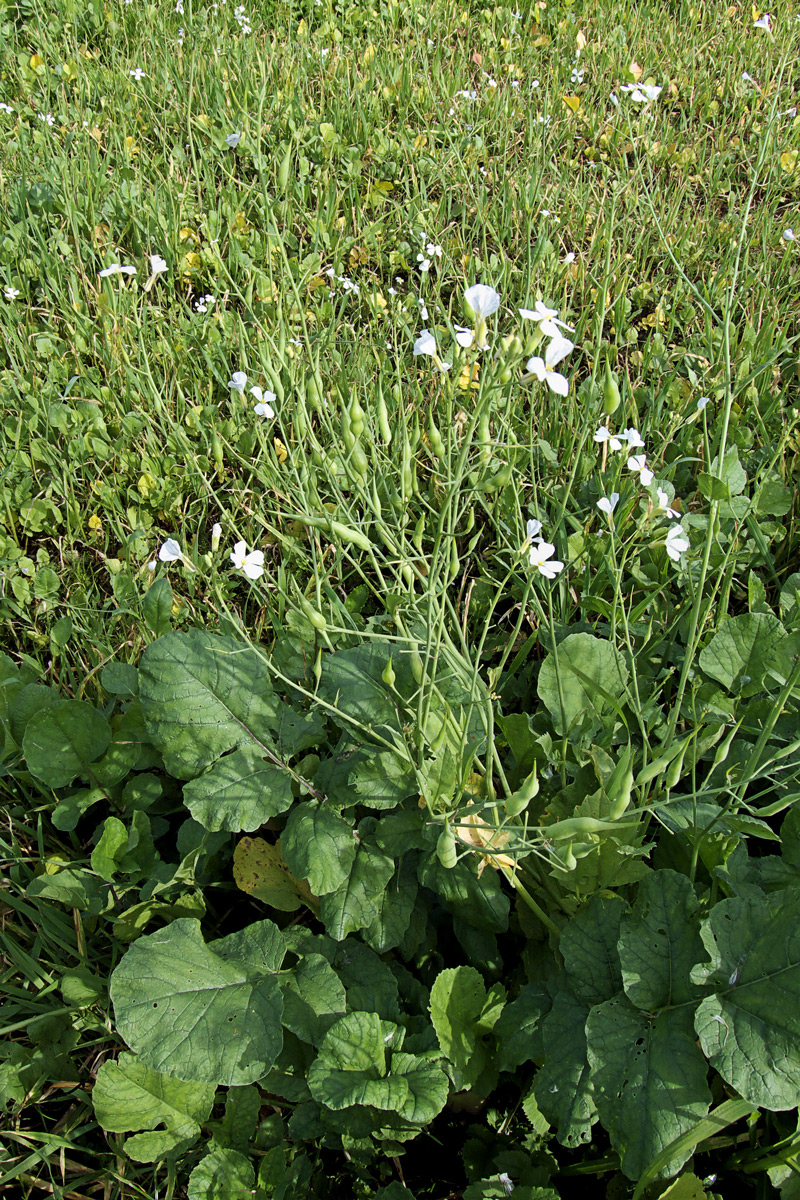
Fodder radish belongs to the brassica family and is one of the most effective soil improvers in the vegetable garden. Unlike its relative, the edible radish, it doesn't form an edible root bulb but grows a strong taproot that reaches 80 to 150 cm deep into the soil, depending on the variety. This deep-reaching root system makes it a real specialist for compacted soils.
The history of fodder radish goes back a long way. In ancient Egypt, oil was already being pressed from radish seeds, and in China and Japan that's still the case today. In Europe, the focus has shifted entirely. Here, fodder radish is grown almost exclusively as green manure and a catch crop. It grows 50 to 100 cm tall, bears alternately arranged pinnate leaves and flowers between May and October with lovely cruciform blooms in white, yellow or purple. Bees and other insects love these flowers as a nectar source.
The real strength of fodder radish lies underground. Its taproot breaks through even compacted soil layers and leaves behind fine channels after it dies off, permanently aerating the soil and improving drainage. In late autumn, it also binds excess nitrogen, preventing it from leaching into groundwater. Thanks to its rapid growth, it reliably suppresses weeds and protects the soil from erosion at the same time.
Facts and figures
Planting & harvest times of Oil radish
Direct sowing from Early July to Mid September. Incorporation takes place around Early February until Late February next year.
Sow Oil radish
Fodder radish is always sown directly into the bed — starting indoors is neither common nor necessary. The sowing window for green manuring runs from early July to mid-September. As a rule of thumb, sow about 8 to 10 weeks before the first expected frost so the plant has enough time to develop well.
Sowing depth is 2 to 4 cm. You can broadcast the seed or sow in rows 20 to 40 cm apart. The sowing rate is roughly 3 g per square metre. The seed germinates at soil temperatures as low as 2 °C and takes about two weeks to emerge, depending on the weather. This low germination temperature is a real advantage — it means sowing still works without problems in early autumn.
Location and soil
Fodder radish is remarkably undemanding. It thrives in full sun just as well as in partial shade and copes with almost any soil, as long as water and nutrient supply are reasonably adequate. Once the taproot has penetrated deep enough, it handles dry spells well too. Only during the seedling and young plant stage should you water a bit during heat and drought.
Fodder radish generally doesn't need any fertiliser. Only on very nutrient-poor ground can a moderate nitrogen application support growth.
Good and bad companions of Oil radish
Fodder radish isn't used as a classic companion plant in the vegetable garden. Its role is green manuring, so it typically occupies the bed when the main crops have already been harvested or haven't been planted yet.
In green manure mixes, fodder radish pairs brilliantly with phacelia. Phacelia forms a dense root network in the upper soil layers, while fodder radish works the deeper zones. Since phacelia isn't a brassica, there are no conflicts whatsoever. Lupins and vetches also make good partners in mixes because, as legumes, they fix nitrogen that fodder radish alone can't provide.
All brassicas make bad neighbours, so keep it away from cabbage, mustard, radishes and turnips. They share the same pests and diseases, above all the dreaded clubroot. Sunflowers shouldn't stand directly next to fodder radish either, as they can transmit the fungus Sclerotinia.
Predecessors and successors of Oil radish
As a brassica, fodder radish follows the same crop rotation rules as cabbage, oilseed rape or radishes. A gap of at least three, ideally four to five years between other brassicas on the same plot is essential. If you ignore this, you risk the build-up of clubroot in the soil, whose resting spores can survive for up to 20 years.
Fodder radish does particularly well after legumes like peas or beans that have enriched the soil with nitrogen. It also fits nicely after early potatoes, because the bed is freed up in time and it still gets enough growing time.
After fodder radish, potatoes especially benefit from the deep soil loosening. Nematode-resistant fodder radish varieties actively reduce cyst nematode populations, which directly benefits potatoes. Sweetcorn, tomatoes, courgettes, squash and runner beans also find beautifully prepared soil after a fodder radish green manure.
Varieties
With fodder radish varieties, it's worth looking closely, because the differences really matter for the intended use. The most important factor is nematode resistance. Varieties like 'Maximus', 'Defender' or 'Radetzky' are multi-resistant and actively combat various nematode species through the so-called trap crop principle.
If you don't have a nematode problem on your plot, a conventional variety like 'Litinia' will do the job just fine. It produces lovely purple-white flowers that are great for pollinators and still loosens the soil properly. When buying seed, think about whether you specifically want to tackle nematodes or whether soil improvement is your main goal.
Care and fertilising
Fodder radish is one of the lowest-maintenance plants in the garden, full stop. Water a bit during the germination phase if it stays dry, and after that the plant does everything on its own. On normal garden soil, no fertilising is needed.
For incorporating it as green manure, there are two approaches. You can chop the growth before the first frost and work it shallowly into the soil — that way nutrients become available to the following crop more quickly. The second option is to simply let the fodder radish freeze off. It dies in harder frosts and forms a natural mulch layer that protects the soil over winter. In spring, you then work the remains in shallowly. For biofumigation — targeted nematode control through mustard oils — chop the fodder radish just before flowering and work it in immediately, because the glucosinolate concentration peaks at that point.
Between incorporating and the next planting, wait about two to three weeks so the decomposition of the plant matter doesn't cause nitrogen lock-up for the following crop.
Diseases and pests
The most significant disease for fodder radish is clubroot (Plasmodiophora brassicae), which can affect all brassicas. The pathogen forms resting spores that survive in the soil for up to 20 years. Infected plants show knotty swellings on their roots and grow poorly. The best prevention is a wide crop rotation with at least three to five years between all brassicas and an alkaline soil with a pH above 7.
Flea beetles can cause trouble for young plants especially, leaving typical small holes in the leaves. On vigorously growing fodder radish, the damage is usually insignificant though.
Near sunflowers, Sclerotinia (white mould) can appear and spread to the fodder radish. Overall, with sensible crop rotation and distance from other brassicas, serious problems rarely occur.
Harvest and processing
Fodder radish isn't harvested as a green manure — it stays on the plot and gets worked in or freezes off. That's precisely the point: all the plant matter benefits the soil. If you like, you can use young leaves like cabbage greens, use the flowers as a peppery edible garnish, or cook young seed pods in a pan. The root becomes woody quickly and is only edible when very young. But these are nice little extras rather than the actual purpose.
Open the bed planner Try free for 7 days, web, iOS and Android