
Other names
yellow rocket, herb barbara, bittercress
Botanical name
Barbarea vulgaris
Family / Genus
Brassicaceae / Barbarea
Plant category
Leafy Vegetables, Herbs
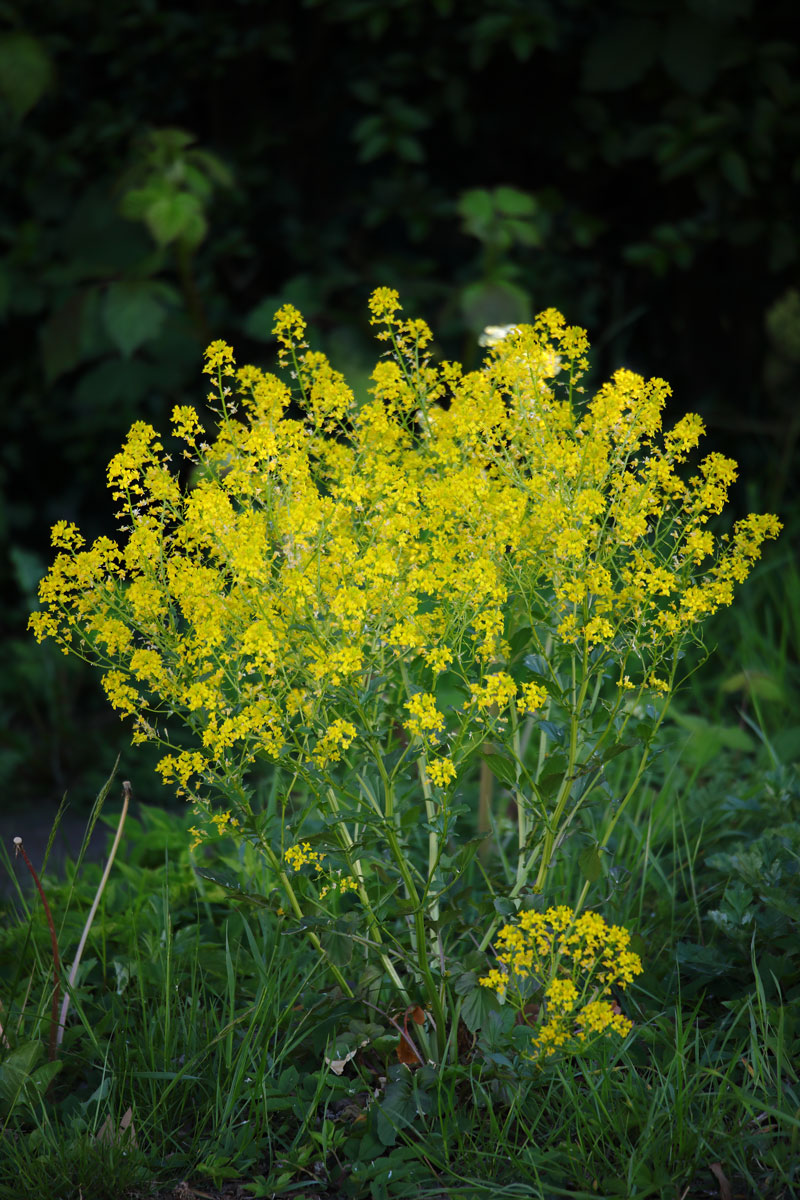
Ole Schoener/Shutterstock.com
Facts and figures
Light requirements
Sun / partial shade
Nutrient requirements
Light feeder
Difficulty level
Easy
Culture (according to Gertrud Franck)
A - tall or wide crops, almost year-round
Growing period
45 days
Row spacing
15 cm
Plant spacing
10 cm
Growth height
30 - 90 cm
Sowing depth
1 cm
Germination temperature (minimum)
3 °C
Germination temperature (optimal)
12 - 22 °C
Germination type
Light
Planting & harvest times of Winter cress
1
2
3
4
5
6
7
8
9
10
11
12
Direct sowing
Harvest
Harvest (next year)
SummerDirect sowing from Early March to Late March. After a growing period of 45 days, harvest can begin around Mid April and continues until Late August.
WinterDirect sowing from Early June to Late September. After a growing period of 45 days, harvest can begin around Mid July and continues until Late July next year.
Good and bad companions of Winter cress
Good neighbours
Bad neighbours
Mustard
Both are brassicas. Clubroot resting spores survive up to 20 years in the soil, so a 4 to 5 year break is needed.
Predecessors and successors of Winter cress
Bad predecessors
Black kale
Rotation break: 3 years
Black radish
Rotation break: 3 years
Broccoli
Land cress is also a brassica and shares clubroot and cabbage root fly with broccoli. Keep four years apart.
Rotation break: 4 years
Evidence quality: good
Evidence: Advisory service, research institute, Specialist book
Reasons:
- Shared soil-borne pathogen
Brussels sprouts
Rotation break: 3 years
Carrot
Rotation break: 3 years
Cauliflower
Land cress is also a brassica and shares clubroot and cabbage root fly with cauliflower. Keep four years apart.
Rotation break: 4 years
Evidence quality: good
Evidence: Advisory service, research institute, Specialist book
Reasons:
- Shared soil-borne pathogen
Chinese cabbage
Rotation break: 3 years
Flower Sprouts
Rotation break: 3 years
Horseradish
Rotation break: 3 years
Kale
Land cress is also a brassica and shares clubroot and cabbage root fly with kale. Keep four years apart.
Rotation break: 4 years
Evidence quality: good
Evidence: Advisory service, research institute, Specialist book
Reasons:
- Shared soil-borne pathogen
Kohlrabi
Rotation break: 3 years
Mizuna (Asian greens)
Rotation break: 3 years
Pak choi
Rotation break: 3 years
Pointed cabbage
Rotation break: 3 years
Radish
Rotation break: 3 years
Red cabbage
Rotation break: 3 years
Rocket
important for large-scale cultivation.
negligible for strip cultivation of rocket.
Rotation break: 3 years
Romanesco
Rotation break: 3 years
Savoy cabbage
Rotation break: 3 years
Swede
Rotation break: 3 years
White cabbage
Rotation break: 3 years
Winter cress
Rotation break: 3 years
Very bad predecessors
Mustard
Both are brassicas. Clubroot resting spores survive up to 20 years in the soil, so a 4 to 5 year break is needed.
Rotation break: 4 years
Oil radish
Both are brassicas. Clubroot resting spores survive up to 20 years in the soil, so a 4 to 5 year break is needed.
Rotation break: 4 years
Bad successors
Batavia lettuce
Rotation break: 3 years
Black kale
Rotation break: 3 years
Black radish
Rotation break: 3 years
Broccoli
Land cress is also a brassica and shares clubroot and cabbage root fly with broccoli. Keep four years apart.
Rotation break: 4 years
Evidence quality: good
Evidence: Advisory service, research institute, Specialist book
Reasons:
- Shared soil-borne pathogen
Brussels sprouts
Rotation break: 3 years
Butterhead lettuce
Rotation break: 3 years
Carrot
Rotation break: 3 years
Cauliflower
Land cress is also a brassica and shares clubroot and cabbage root fly with cauliflower. Keep four years apart.
Rotation break: 4 years
Evidence quality: good
Evidence: Advisory service, research institute, Specialist book
Reasons:
- Shared soil-borne pathogen
Chinese cabbage
Rotation break: 3 years
Flower Sprouts
Rotation break: 3 years
Garden cress
Rotation break: 3 years
Horseradish
Rotation break: 3 years
Iceberg lettuce
Rotation break: 3 years
Kale
Land cress is also a brassica and shares clubroot and cabbage root fly with kale. Keep four years apart.
Rotation break: 4 years
Evidence quality: good
Evidence: Advisory service, research institute, Specialist book
Reasons:
- Shared soil-borne pathogen
Kohlrabi
Rotation break: 3 years
Lollo biando / Lollo rosso
Rotation break: 3 years
Mizuna (Asian greens)
Rotation break: 3 years
Oak leaf lettuce
Rotation break: 3 years
Pak choi
Rotation break: 3 years
Pointed cabbage
Rotation break: 3 years
Radish
After cabbages and other brassicas, clubroot and cabbage root fly pupae remain in the soil. Wait four years before sowing radishes there again.
Rotation break: 4 years
Evidence quality: good
Evidence: Advisory service, research institute, Specialist book
Reasons:
- Shared soil-borne pathogen
Radish
Rotation break: 3 years
Red cabbage
Rotation break: 3 years
Rocket
important for large-scale cultivation.
negligible for strip cultivation.
Rotation break: 3 years
Romaine lettuce
Rotation break: 3 years
Romanesco
Rotation break: 3 years
Savoy cabbage
Rotation break: 3 years
White cabbage
Rotation break: 3 years
Winter cress
Rotation break: 3 years
Very bad successors
Mustard
Both are brassicas. Clubroot resting spores survive up to 20 years in the soil, so a 4 to 5 year break is needed.
Rotation break: 4 years
Oil radish
Both are brassicas. Clubroot resting spores survive up to 20 years in the soil, so a 4 to 5 year break is needed.
Rotation break: 4 years
Diseases and pests
Susceptible to
Cabbage root fly
Clubroot
Flea beetles
Harvest and processing
The seeds and leaves are also edible.
Open the bed planner Try free for 7 days, web, iOS and Android