
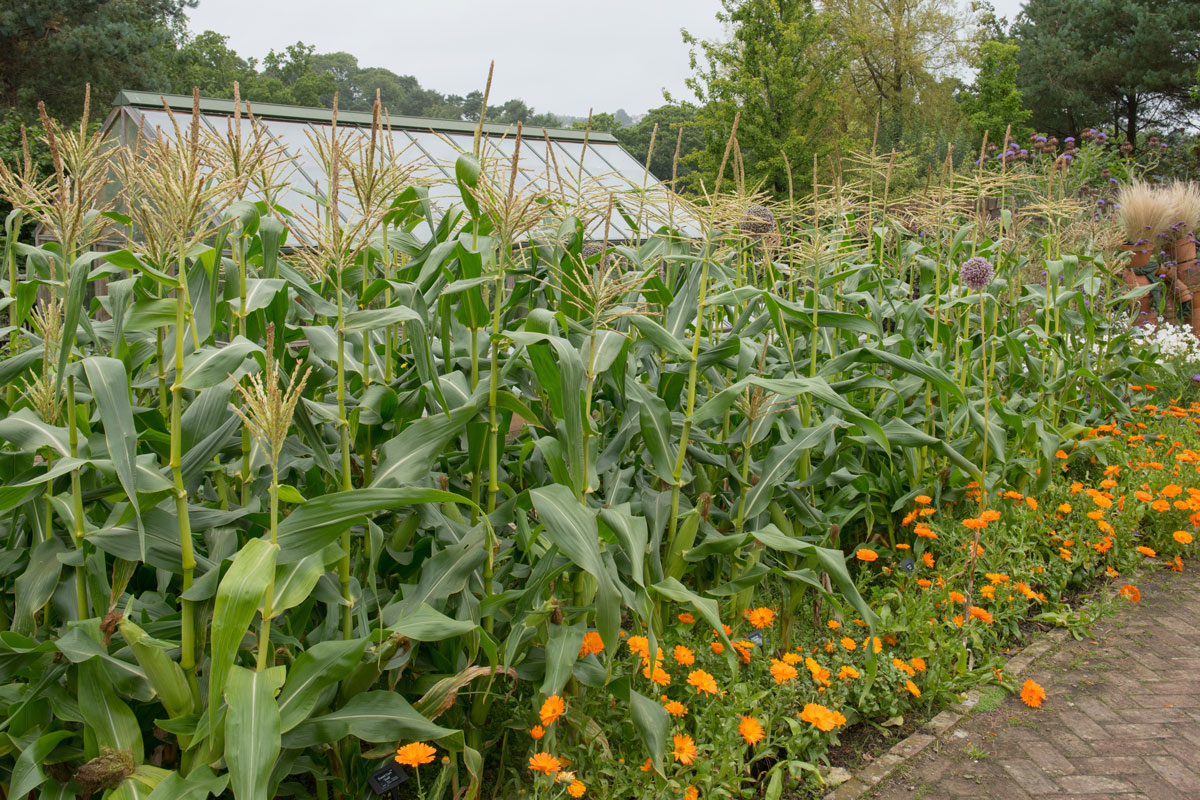
Maize originates from Mexico, where it has been the most important crop for as long as anyone can remember. Since the discovery of the Americas it has spread across the entire world and is a staple food in Africa and South America. In the Mediterranean region it also enriches the cuisine in many dishes.
Facts and figures
Planting & harvest times of Maize
Direct sowing from Mid April to Mid May. Transplant to bed from Mid May to Late May. Pre-grow about 30 days before transplanting, approximately between Mid April and Late April. After a growing period of 100 days, harvest can begin around Late July and continues until Late September.
Sow and plant Maize
In the home garden it is best to sow in several short rows, arranged in a block, so that wind pollination works more effectively and plenty of kernels develop. Place the kernels 3 cm deep and 15 cm apart, then thin them out to 30 cm later on. Leave 45 cm between rows.
Location and soil
It needs a sunny spot with deep, humus-rich, fertile soil. Bear in mind that the plants can grow up to 3 m tall and will shade out anything nearby. Prepare the soil with plenty of compost and a handful of organic fertiliser per square metre.
Good and bad companions of Maize
Lettuces, beans, cucumbers and tomatoes make good neighbours, for example, while peas, radishes and celery are poor companions.
- Trap or decoy plant
- Practical tip for this pair
- Practical tip for this pair
- Shade, wind shelter, ground cover
- Practical tip for this pair
- Practical tip for this pair
- Shade, wind shelter, ground cover
- Shade, wind shelter, ground cover
- Practical tip for this pair
- Practical tip for this pair
- Practical tip for this pair
- Practical tip for this pair
- Trap or decoy plant
- Practical tip for this pair
- Practical tip for this pair
- Shade, wind shelter, ground cover
Predecessors and successors of Maize
- Nitrogen release
- Loosens soil, improves soil structure
- Weed suppression for the next crop
- Uptake of residual nitrogen
Varieties
Sweet corn, polenta maize and popcorn maize are all available as seed. In terms of cultivation, they differ very little from one another.
Care and fertilising
The most important thing is to keep the young seedlings free of weeds. When they reach about 30 cm in height, earth them up so they can develop more support roots and stand more firmly. Give them another feed by July. Mulching, for example with grass clippings, helps keep weeds down and retains moisture in the soil. Water during dry spells.
Diseases and pests
Harvest and processing
Sweet corn is ready to harvest when the silk threads have dried out and turned brown. You can use it straight away — boil or grill the cobs and enjoy them spread with butter or herb butter. If you have grown polenta or popcorn maize, you need to be patient and wait until the kernels have hardened and can no longer be scored with a fingernail. After that, they need to dry out for a few more weeks under a dry roof overhang or in an attic. For polenta maize, you will need a good mill. Grind first on the coarsest setting, then on whichever fineness you prefer. For popcorn maize, simply rub the kernels off the cob and pop them in a large covered pot with oil, butter and sugar — or go savoury with salt for a change. Always pop just a small quantity of kernels at a time.
Open the bed planner Try free for 7 days, web, iOS and Android