
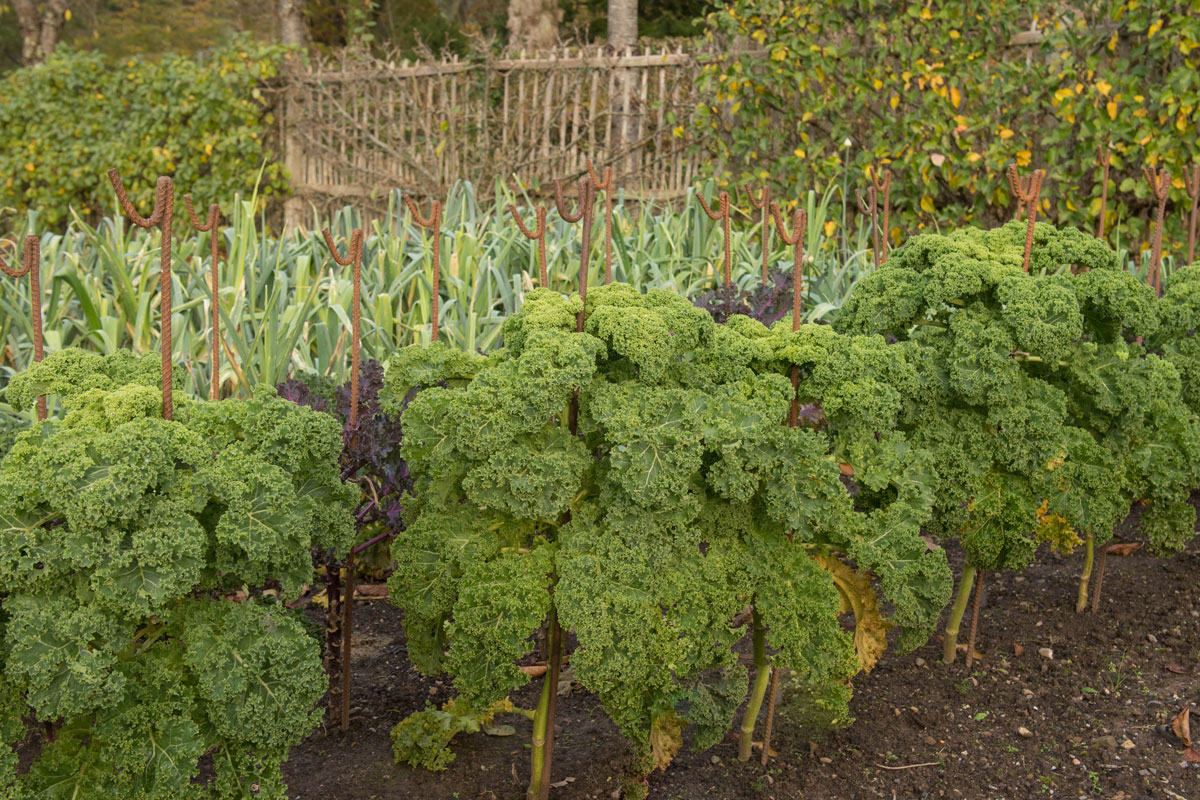
Kale is a leafy cabbage without a head that forms strongly curled leaves on a tall stem. It is one of the oldest forms of cabbage and still looks much like wild cabbage. In northern Germany kale is the winter vegetable, and in the south too you harvest it fresh from the bed all winter long. There are low, compact varieties of 40 cm and old landraces such as Ostfriesische Palme that grow almost 2 m tall. Red varieties like Redbor or Roter Krauser also look really good in the bed. Kale is biennial: leave it standing over winter and it flowers yellow in spring.
Facts and figures
Planting & harvest times of Kale
Direct sowing from Mid May to Late June. Transplant to bed from Early June to Late July. Pre-grow about 60 days before transplanting, approximately between Early April and Late May. Harvest begins around Early September and continues until Late March next year.
Sow and plant Kale
Sow kale in May or June into a seed furrow or into pots, tall varieties from mid-April. After three to four weeks the young plants have three to four leaves and go to their final place from June until the end of July, after beans or peas even up to early August. Set the kale a little deeper than it stood in the pot, then it stands firmer later on. Low varieties need about 50 × 50 cm, tall ones 75 × 50 cm. Because it is planted so late, kale fits perfectly after early potatoes, peas, lettuce or garlic.
Location and soil
Kale likes a sunny spot, but it copes with a little shade as well. Deep, rather heavy loam soils with plenty of humus and enough lime are ideal. A pH around 7 or slightly above protects against clubroot. On sandy soils kale does fine too, as long as you add plenty of compost. It is less demanding than cauliflower and grows in a container from 10 litres upwards.
Good and bad companions of Kale
Kale only goes into the bed in early summer and then stands until spring. Until it fills out, you have plenty of room between the rows for quick companions. Sow or plant lettuce, radishes, carrots or beetroot between the young kale rows; they are harvested before the cabbage needs the space. In late summer endive and lamb's lettuce fit alongside, and lamb's lettuce even overwinters together with the kale.
Celery is a particularly good partner, as its scent is said to keep the cabbage white away. Tomatoes are also said to deter cabbage pests, and beans and peas get on well with kale too. Gertrud Franck likes to set late brassicas next to early potatoes, which are harvested while the cabbage is growing. Dill, borage, pot marigold and marigolds along the edge attract beneficial insects.
Strawberries, on the other hand, count as bad neighbours in many countries, and garden cress is better sown on its own. Nasturtium is itself a food plant for cabbage white caterpillars, and nobody knows for sure whether it takes pressure off the kale or draws the butterflies in first. Other brassicas next to kale are no problem, as long as you keep them apart in the rotation.
- Pest control through scent or camouflage
- Pest control through scent or camouflage
- Pest control through scent or camouflage
- Practical tip for this pair
- Pest control through scent or camouflage
- Practical tip for this pair
- Practical tip for this pair
- Practical tip for this pair
- Attracts beneficial insects
- Practical tip for this pair
- Practical tip for this pair
- Practical tip for this pair
- Practical tip for this pair
- Practical tip for this pair
- Practical tip for this pair
- Practical tip for this pair
- Practical tip for this pair
- Practical tip for this pair
- Pest control through scent or camouflage
- Practical tip for this pair
- Pest control through scent or camouflage
- Pest control through scent or camouflage
- Allelopathy, growth inhibition
Predecessors and successors of Kale
Like all brassicas, kale should return to a bed that carried crucifers only in the fourth year. That keeps clubroot in check, since its resting spores survive many years in the soil. The best preceding crops are peas and beans, whose nitrogen the hungry kale puts to good use. As it is not planted until June or July, it can even follow early potatoes, peas, dwarf beans or lettuce in the same year. It also grows well after onions, garlic, shallots, courgettes or sweetcorn, because these share no diseases with it.
After beetroot and chard, leave four years, because all three suffer from the beet cyst nematode, and leek and spinach multiply this eelworm as well.
After kale, parsnips or leek work well the following year. Carrots, salsify and lettuce grow less well after cabbage, and onions turn soft after all the crop residues. Pull the stems out after the spring harvest so that diseases and whiteflies do not stay in the bed.
- Nitrogen release
- Nitrogen release
- Nitrogen release
- Nitrogen release
- Nitrogen release
- Nitrogen release
- Loosens soil, improves soil structure
- Nitrogen release
- Nitrogen release
- Both host the same nematode species
- Shared soil-borne pathogen
- Shared soil-borne pathogen
- Shared soil-borne pathogen
- Shared soil-borne pathogen
- Shared soil-borne pathogen
- Both host the same nematode species
- Shared soil-borne pathogen
- Shared soil-borne pathogen
- Self-incompatibility
- Shared soil-borne pathogen
- Self-incompatibility
- Shared soil-borne pathogen
- Self-incompatibility
- Shared soil-borne pathogen
- Self-incompatibility
- Shared soil-borne pathogen
- Shared soil-borne pathogen
- Self-incompatibility
- Shared soil-borne pathogen
- Self-incompatibility
- Shared soil-borne pathogen
- Self-incompatibility
- Shared soil-borne pathogen
- Shared soil-borne pathogen
- Shared soil-borne pathogen
- Self-incompatibility
- Shared soil-borne pathogen
- Self-incompatibility
- Shared soil-borne pathogen
- Self-incompatibility
- Shared soil-borne pathogen
- Self-incompatibility
- Shared soil-borne pathogen
- Shared soil-borne pathogen
- Shared soil-borne pathogen
- Self-incompatibility
- Loosens soil, improves soil structure
- Weed suppression for the next crop
- Shared soil-borne pathogen
- Shared soil-borne pathogen
- Shared soil-borne pathogen
- Too much nitrogen for a sensitive successor
- Shared soil-borne pathogen
- Shared soil-borne pathogen
- Shared soil-borne pathogen
- Too much nitrogen for a sensitive successor
- Both host the same nematode species
- Shared soil-borne pathogen
- Shared soil-borne pathogen
- Self-incompatibility
- Shared soil-borne pathogen
- Self-incompatibility
- Shared soil-borne pathogen
- Self-incompatibility
- Shared soil-borne pathogen
- Self-incompatibility
- Shared soil-borne pathogen
- Shared soil-borne pathogen
- Self-incompatibility
- Shared soil-borne pathogen
- Self-incompatibility
- Shared soil-borne pathogen
- Self-incompatibility
- Shared soil-borne pathogen
- Shared soil-borne pathogen
- Shared soil-borne pathogen
- Self-incompatibility
- Shared soil-borne pathogen
- Self-incompatibility
- Shared soil-borne pathogen
- Self-incompatibility
- Shared soil-borne pathogen
- Self-incompatibility
- Shared soil-borne pathogen
- Shared soil-borne pathogen
- Shared soil-borne pathogen
- Self-incompatibility
Varieties
With kale you can choose between low, compact varieties such as Westerländer Winter or Niedriger Grüner Krauser, which hide under the snow and are especially hardy, and tall landraces such as Ostfriesische Palme or Lippische Palme. Red varieties like Redbor, Roter Krauser or Rote Palme are decorative and taste mild. Red Russian has flat, serrated leaves and works raw in winter salads too.
Care and fertilising
Kale is a hungry feeder. Work in ripe compost before planting; it does not take fresh manure, because that attracts the cabbage root fly. Keep the soil loose and weed-free until August, and young plants in particular need water in dry spells. Insect-proof netting put on right after planting keeps cabbage root fly, flea beetles and caterpillars away. Tie tall varieties to a stake before winter so snow and wind do not push them over. Kale takes frost down to about minus 8 °C, and more under snow or fleece.
Diseases and pests
Kale is tougher than most brassicas, but it is not spared completely. On soils with clubroot it fails just like other brassicas, even if some gardeners think it more resistant. So keep four years between it and other crucifers, and make sure there is enough lime in the soil.
The main pest on kale is the cabbage whitefly, a tiny white fly that sits in huge numbers on the undersides of the leaves in a warm late summer and autumn. Its sticky honeydew turns black with fungi. Netting from planting onwards and clearing away old cabbage stems help most, and you can also wash the flies off with a strong jet of water.
Caterpillars of the cabbage white, the diamondback moth and the cabbage moth eat holes in the leaves, the cabbage root fly lays its eggs at the root collar of young plants, and flea beetles riddle the leaves in summer. Here too, insect-proof netting gives reliable protection.
In cool, wet autumn weather white pustules sometimes appear on the undersides of the leaves, which is white blister. Red varieties are often attacked less by pests than green ones.
Harvest and processing
It is best to harvest kale only once the plants have had a few cool weeks behind them, usually from November. In the cold the kale builds up sugar in the leaves and then tastes milder. Freezing is no substitute, because only the growing plant forms that sugar. Snap off the young and middle leaves as you need them, working from the bottom upwards, and leave the heart standing; then it keeps producing new growth until spring. The lowest, tough leaves go on the compost or to the chickens. In March kale pushes out tender flowering shoots that you can eat like broccoli.
Open the bed planner Try free for 7 days, web, iOS and Android