
Other names
romanesco broccoli, roman cauliflower, broccoflower
Botanical name
Brassica oleracea convar. botrytis var. botrytis
Family / Genus
Brassicaceae / Brassica
Plant category
Cabbage vegetables
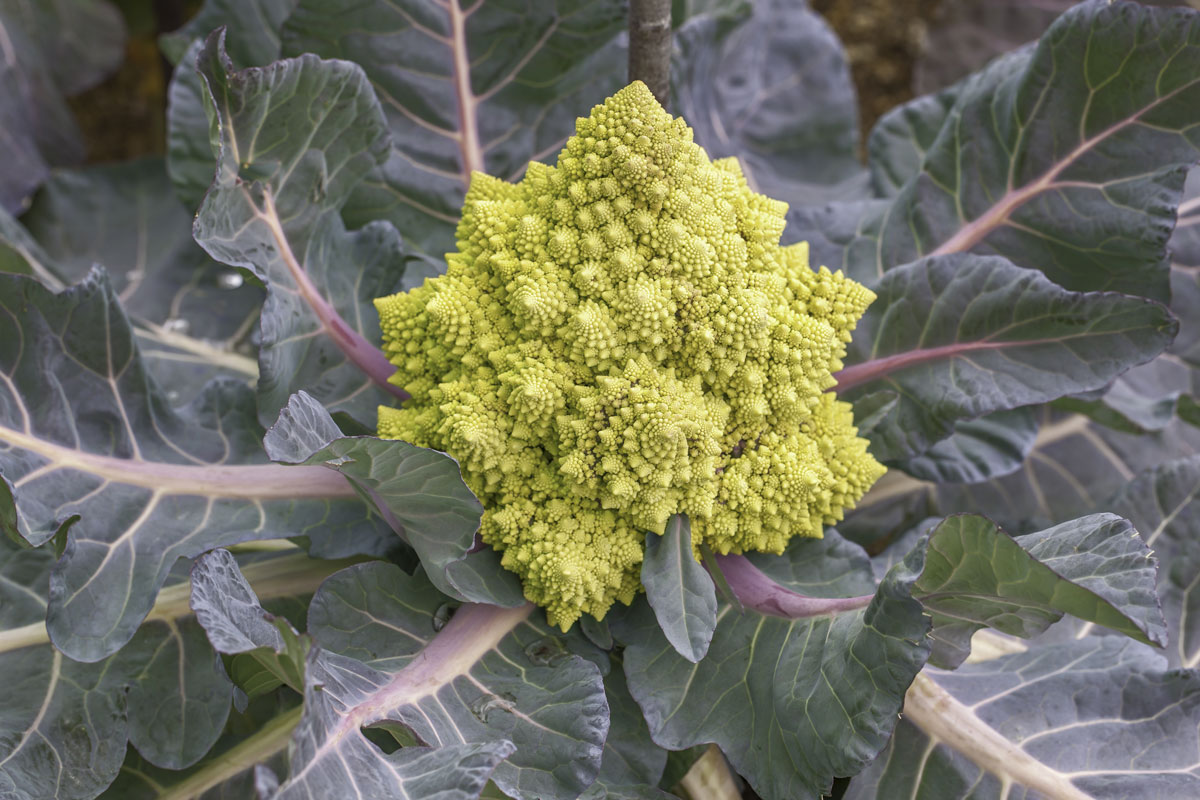
EvergreenPlanet/Shutterstock.com
Facts and figures
Light requirements
Sun / partial shade
Nutrient requirements
Heavy feeder
Difficulty level
Intermediate
Culture (according to Gertrud Franck)
A - tall or wide crops, almost year-round
Culture (according to Sister C. Weinrich)
Main crop
Growing period
80 - 290 days
Row spacing
50 cm
Plant spacing
50 cm
Growth height
60 - 100 cm
Sowing depth
1 cm
Germination temperature (minimum)
8 °C
Germination temperature (optimal)
18 - 22 °C
Germination type
Light and dark
Pre-growing period
30 days
Planting & harvest times of Romanesco
1
2
3
4
5
6
7
8
9
10
11
12
Direct sowing
Pre-grow
Transplant
Harvest
Harvest (next year)
SummerDirect sowing from Mid April to Late June. Transplant to bed from Early April to Late July. Pre-grow about 30 days before transplanting, approximately between Early March and Late June. After a growing period of 80 days, harvest can begin around Early June and continues until Late October.
WinterDirect sowing from Mid July to Mid August. Transplant to bed from Mid August to Mid September. Pre-grow about 30 days before transplanting, approximately between Mid July and Mid August. After a growing period of 290 days, harvest can begin around Early May and continues until Late May next year.
Good and bad companions of Romanesco
Very good neighbours
Subterranean clover
Subterranean clover as an undersowing cut flea beetle damage by 66 percent in trials.
Good neighbours
Crimson clover
The clover's scent disrupts the orientation of cabbage root fly and cabbage white.
Cucumber
Evidence quality: good
Evidence: Long-standing companion planting practice (e.g. Gertrud Franck, Schwester C. Weinrich), Guidebooks, companion planting charts, tradition
Lamb's lettuce
I have read conflicting information about companion planting with brassicas. Share your experiences.
Radish
Young cabbage plants leave room at first for a ring of radishes. They are harvested before the cabbage needs the space.
Evidence quality: good
Evidence: Advisory service, research institute, Specialist book, Derived from plant family or pathogen, pair not directly documented
Reasons:
- Practical tip for this pair
White clover
Flowering white clover undersowing confuses the cabbage white and reduces egg laying.
Bad neighbours
Courgette
Cabbage and courgettes are considered poor neighbours, though no reason is known. Next to cucumbers, on the other hand, cabbage has proved its worth.
Evidence quality: moderate
Evidence: Advisory service, research institute, Tradition agrees across several language regions
Nasturtium
Nasturtiums attract cabbage white butterflies
Predecessors and successors of Romanesco
Good predecessors
Alfalfa
Lasting effect: 3 years
Batavia lettuce
Lasting effect: 3 years
Berseem clover
Lasting effect: 3 years
Broad bean
Lasting effect: 3 years
Buckwheat
Lasting effect: 3 years
Bush bean
Lasting effect: 3 years
Butterhead lettuce
Lasting effect: 3 years
Celeriac
Lasting effect: 3 years
Celery
Lasting effect: 3 years
Chickpea
Lasting effect: 3 years
Common vetch
Lasting effect: 3 years
Crimson clover
Lasting effect: 3 years
Cutting celery
Lasting effect: 3 years
Endive
Lasting effect: 3 years
Hairy vetch
Lasting effect: 3 years
Iceberg lettuce
Lasting effect: 3 years
Lamb's lettuce
Lasting effect: 3 years
Lentils
Lasting effect: 3 years
Lollo biando / Lollo rosso
Lasting effect: 3 years
Lupin
Lasting effect: 3 years
Oak leaf lettuce
Lasting effect: 3 years
Oats
Lasting effect: 3 years
Pea
Lasting effect: 3 years
Persian clover
Lasting effect: 3 years
Phacelia
Lasting effect: 3 years
Pole bean
Lasting effect: 3 years
Radish
Radishes are a popular early crop before cabbage. As brassicas, though, they can pass on cabbage root fly and clubroot, so opinions differ.
Lasting effect: 1 year
Evidence quality: moderate
Evidence: Long-standing companion planting practice (e.g. Gertrud Franck, Schwester C. Weinrich)
We found conflicting sources. This is our current assessment.
Red clover
Lasting effect: 3 years
Runner bean
Lasting effect: 3 years
Sainfoin
Lasting effect: 3 years
Soya bean
Lasting effect: 3 years
Subterranean clover
Lasting effect: 3 years
Sunflower
Cabbage benefits from the deep loosening but also hosts white mould. Avoid where the disease is known on the plot.
Lasting effect: 3 years
White clover
Lasting effect: 3 years
Winter rye
Heavy feeders thrive in loose, nutrient-rich soil
Lasting effect: 2 years
Bad predecessors
Black radish
Rotation break: 3 years
Garden cress
Rotation break: 3 years
Horseradish
Rotation break: 3 years
Mizuna (Asian greens)
Rotation break: 3 years
Orache
Rotation break: 3 years
Radish
Rotation break: 3 years
Rocket
important for large-scale cultivation.
negligible for strip cultivation of rocket.
Rotation break: 3 years
Spinach
Rotation break: 3 years
Swede
Rotation break: 3 years
Turnip
Rotation break: 3 years
Winter cress
Rotation break: 3 years
Very bad predecessors
Black kale
if disease has occurred, a 6-year break is preferable
Rotation break: 4 years
Broccoli
Broccoli and romanesco are closely related brassicas and share clubroot, cabbage root fly and swede midge. Wait four years before using the same bed again.
Rotation break: 4 years
Evidence quality: good
Evidence: Advisory service, research institute, Specialist book
Reasons:
- Shared soil-borne pathogen
- Self-incompatibility
Brussels sprouts
if disease has occurred, a 6-year break is preferable
Rotation break: 4 years
Cauliflower
Cauliflower and romanesco are closely related brassicas and share clubroot, cabbage root fly and black rot. Wait four years before using the same bed again.
Rotation break: 4 years
Evidence quality: good
Evidence: Advisory service, research institute, Specialist book
Reasons:
- Shared soil-borne pathogen
- Self-incompatibility
Chinese cabbage
if disease has occurred, a 6-year break is preferable
Rotation break: 4 years
Flower Sprouts
if disease has occurred, a 6-year break is preferable
Rotation break: 4 years
Kale
Kale and romanesco are closely related brassicas and share clubroot, cabbage root fly and black rot. Wait four years before using the same bed again.
Rotation break: 4 years
Evidence quality: good
Evidence: Advisory service, research institute, Specialist book
Reasons:
- Shared soil-borne pathogen
- Self-incompatibility
Kohlrabi
if disease has occurred, a 6-year break is preferable
Rotation break: 4 years
Mustard
Both are brassicas. Clubroot resting spores survive up to 20 years in the soil, so a 4 to 5 year break is needed.
Rotation break: 4 years
Oil radish
Rotation break: 3 years
Pak choi
if disease has occurred, a 6-year break is preferable
Rotation break: 4 years
Pointed cabbage
if disease has occurred, a 6-year break is preferable
Rotation break: 4 years
Red cabbage
if disease has occurred, a 6-year break is preferable
Rotation break: 4 years
Romanesco
Rotation break: 4 years
Savoy cabbage
if disease has occurred, a 6-year break is preferable
Rotation break: 4 years
White cabbage
if disease has occurred, a 6-year break is preferable
Rotation break: 4 years
Good successors
Alfalfa
Lasting effect: 3 years
Berseem clover
Lasting effect: 3 years
Common vetch
Lasting effect: 3 years
Crimson clover
Lasting effect: 3 years
Hairy vetch
Lasting effect: 3 years
Lamb's lettuce
Lasting effect: 3 years
Leek
Cabbage leaves a lot of crop residue whose nitrogen is released late. Leeks, as heavy feeders, make good use of it.
Lasting effect: 1 year
Evidence quality: good
Evidence: Specialist book
Parsnip
Lasting effect: 3 years
Persian clover
Lasting effect: 3 years
Phacelia
Lasting effect: 3 years
Red clover
Lasting effect: 3 years
Subterranean clover
Lasting effect: 3 years
White clover
Lasting effect: 3 years
Winter rye
Winter rye helps to fix residual nitrogen, making it ideal for heavy feeders
Lasting effect: 1 year
Bad successors
Batavia lettuce
Rotation break: 3 years
Butterhead lettuce
Rotation break: 3 years
Carrot
Rotation break: 3 years
Cucumber
Cabbage is considered a poor preceding crop for cucumbers. Legumes, leeks, celery or a green manure suit them better.
Rotation break: 1 year
Evidence quality: good
Evidence: Specialist book
Garden cress
Rotation break: 3 years
Honeydew melon
Cabbage is considered a poor preceding crop for honeydew melons. Legumes, leeks, celery or a green manure with clover suit them better.
Rotation break: 1 year
Evidence quality: good
Evidence: Specialist book
Horseradish
Rotation break: 3 years
Iceberg lettuce
Rotation break: 3 years
Lollo biando / Lollo rosso
Rotation break: 3 years
Melothria
Cabbage, tomatoes and sweet peppers are heavy feeders and are considered a poor previous crop for Melothria. Legumes, leeks, celery or lettuce suit it better.
Rotation break: 1 year
Evidence quality: good
Evidence: Specialist book
Mizuna (Asian greens)
Rotation break: 3 years
Oak leaf lettuce
Rotation break: 3 years
Onion
Cabbage leaves a lot of crop residue and nitrogen. Onions grown afterwards turn soft and store poorly.
Rotation break: 1 year
Evidence quality: good
Evidence: Advisory service, research institute, Specialist book
Reasons:
- Too much nitrogen for a sensitive successor
Radish
After cabbages and other brassicas, clubroot and cabbage root fly pupae remain in the soil. Wait four years before sowing radishes there again.
Rotation break: 4 years
Evidence quality: good
Evidence: Advisory service, research institute, Specialist book
Reasons:
- Shared soil-borne pathogen
Rocket
important for large-scale cultivation.
negligible for strip cultivation of rocket.
Rotation break: 3 years
Romaine lettuce
Rotation break: 3 years
Sainfoin
High residual nitrogen suppresses nodulation. Weak-competing sainfoin is then overgrown by weeds.
Rotation break: 3 years
Shallot
Cabbage leaves a lot of crop residue and nitrogen. Shallots grown afterwards turn soft and store poorly.
Rotation break: 1 year
Evidence quality: moderate
Evidence: Advisory service, research institute, Specialist book, Derived from plant family or pathogen, pair not directly documented
Reasons:
- Too much nitrogen for a sensitive successor
Swede
Rotation break: 3 years
Turnip
Rotation break: 3 years
Watermelon
Cabbage is considered a poor preceding crop for watermelons. Legumes, leeks, celery or a green manure with clover suit them better.
Rotation break: 1 year
Evidence quality: good
Evidence: Specialist book
Winter cress
Rotation break: 3 years
Very bad successors
Black kale
if disease has occurred, a 6-year break is preferable
Rotation break: 4 years
Broccoli
Broccoli and romanesco are closely related brassicas and share clubroot, cabbage root fly and swede midge. Wait four years before using the same bed again.
Rotation break: 4 years
Evidence quality: good
Evidence: Advisory service, research institute, Specialist book
Reasons:
- Shared soil-borne pathogen
- Self-incompatibility
Brussels sprouts
if disease has occurred, a 6-year break is preferable
Rotation break: 4 years
Cauliflower
Cauliflower and romanesco are closely related brassicas and share clubroot, cabbage root fly and black rot. Wait four years before using the same bed again.
Rotation break: 4 years
Evidence quality: good
Evidence: Advisory service, research institute, Specialist book
Reasons:
- Shared soil-borne pathogen
- Self-incompatibility
Chinese cabbage
if disease has occurred, a 6-year break is preferable
Rotation break: 4 years
Flower Sprouts
if disease has occurred, a 6-year break is preferable
Rotation break: 4 years
Kale
Kale and romanesco are closely related brassicas and share clubroot, cabbage root fly and black rot. Wait four years before using the same bed again.
Rotation break: 4 years
Evidence quality: good
Evidence: Advisory service, research institute, Specialist book
Reasons:
- Shared soil-borne pathogen
- Self-incompatibility
Kohlrabi
if disease has occurred, a 6-year break is preferable
Rotation break: 4 years
Mustard
Both are brassicas. Clubroot resting spores survive up to 20 years in the soil, so a 4 to 5 year break is needed.
Rotation break: 4 years
Oil radish
Rotation break: 3 years
Pak choi
if disease has occurred, a 6-year break is preferable
Rotation break: 4 years
Pointed cabbage
if disease has occurred, a 6-year break is preferable
Rotation break: 4 years
Red cabbage
if disease has occurred, a 6-year break is preferable
Rotation break: 4 years
Romanesco
Rotation break: 4 years
Savoy cabbage
if disease has occurred, a 6-year break is preferable
Rotation break: 4 years
White cabbage
if disease has occurred, a 6-year break is preferable
Rotation break: 4 years
Diseases and pests
Susceptible to
Alternaria leaf spot of brassicas
Black rot(high susceptibility)
Cabbage aphid
Cabbage moth
Cabbage root fly
Cabbage whitefly
Cabbage whites
Clubroot
Diamondback moth
Downy mildew of brassicas
Flea beetles
Swede midge
White rust
Open the bed planner Try free for 7 days, web, iOS and Android