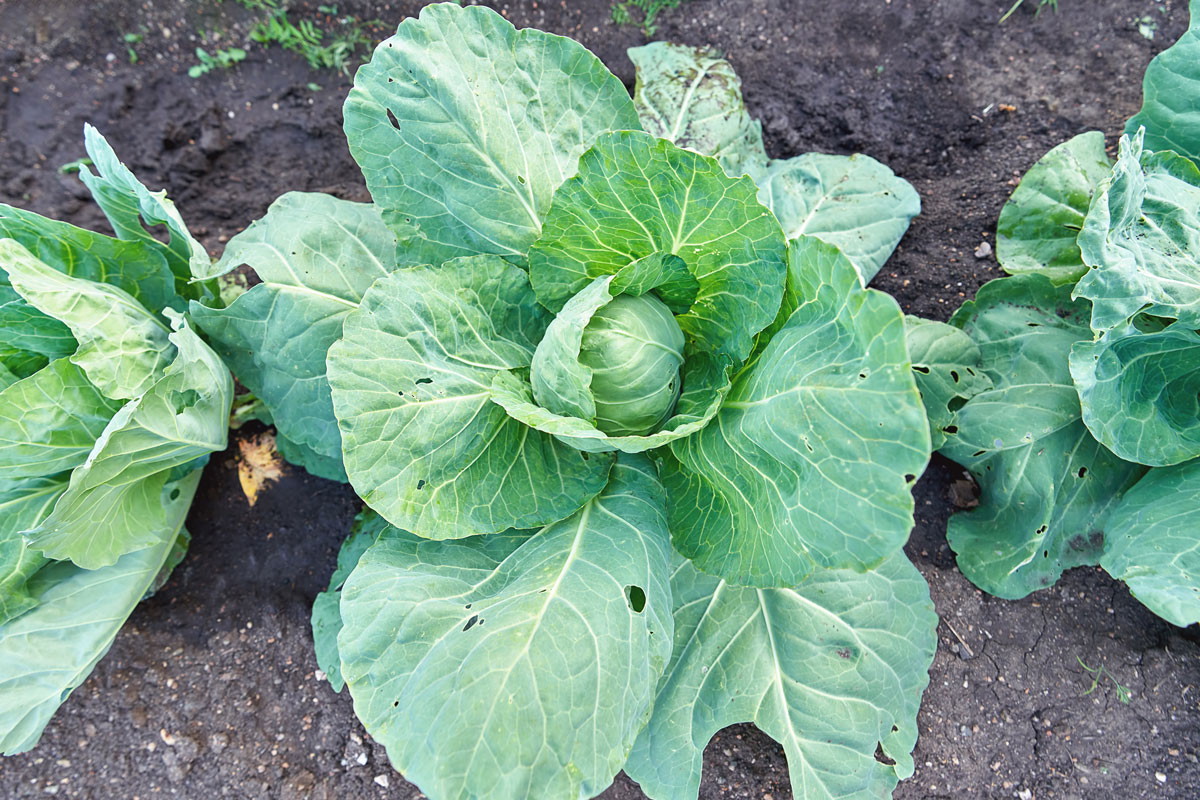
Growing White cabbage

Brassica oleracea convar. capitata var. alba Dutch white cabbage, drumhead cabbage
Other names
Dutch white cabbage, drumhead cabbage
Botanical name
Brassica oleracea convar. capitata var. alba
Family / Genus
Brassicaceae / Brassica
Plant category
Cabbage vegetables
White cabbage
ZARIN ANDREY/Shutterstock.com

Facts and figures

Light requirements
Sun / partial shade
Nutrient requirements
Heavy feeder
Difficulty level
Intermediate
Culture (according to Gertrud Franck)
A - tall or wide crops, almost year-round
Culture (according to Sister C. Weinrich)
Main crop
Growing period
90 - 160 days
Row spacing
50 cm
Plant spacing
50 cm
Growth height
40 - 120 cm
Sowing depth
1 cm
Germination temperature (minimum)
3 °C
Germination temperature (optimal)
18 - 22 °C
Germination type
Light and dark
Pre-growing period
40 days

Planting & harvest times of White cabbage

1
2
3
4
5
6
7
8
9
10
11
12
Direct sowing
Pre-grow
Transplant
Harvest

Planting 1Direct sowing from Early March to Late May. Transplant to bed from Mid March to Late July. Pre-grow about 40 days before transplanting, approximately between Late January and Mid June. After a growing period of 90 days, harvest can begin around Early June and continues until Late October.

Planting 2Direct sowing from Early April to Late April. Transplant to bed from Mid May to Early June. Pre-grow about 40 days before transplanting, approximately between Late March and Mid April. After a growing period of 160 days, harvest can begin around Mid September and continues until Mid November.

Sow and plant White cabbage

Planting 1: Early cabbage

Planting 2: Storage cabbage

According to Gertrud Franck, you can grow early cabbage in spring on the B row. Later varieties are best grown on the A row.

Good and bad companions of White cabbage

Very good neighbours
Subterranean clover
Good neighbours
Crimson clover
Cucumber
Dill
Lamb's lettuce
Radish
White clover
Bad neighbours
Courgette
Nasturtium

Predecessors and successors of White cabbage

Very good predecessors
Lupin
Good predecessors
Alfalfa
Batavia lettuce
Berseem clover
Broad bean
Buckwheat
Bush bean
Butterhead lettuce
Celeriac
Celery
Chickpea
Common vetch
Crimson clover
Cutting celery
Endive
Hairy vetch
Iceberg lettuce
Lentils
Lollo biando / Lollo rosso
Oak leaf lettuce
Oats
Pea
Persian clover
Phacelia
Pole bean
Radish
Red clover
Runner bean
Sainfoin
Soya bean
Subterranean clover
Sunflower
White clover
Winter rye
Bad predecessors
Black radish
Garden cress
Horseradish
Mizuna (Asian greens)
Orache
Radish
Red cabbage
Rocket
Spinach
Swede
Turnip
Winter cress
Very bad predecessors
Black kale
Broccoli
Brussels sprouts
Cauliflower
Chinese cabbage
Flower Sprouts
Kale
Kohlrabi
Mustard
Oil radish
Pak choi
Pointed cabbage
Romanesco
Savoy cabbage
White cabbage
Good successors
Alfalfa
Berseem clover
Common vetch
Crimson clover
Hairy vetch
Lamb's lettuce
Leek
Parsnip
Persian clover
Phacelia
Red clover
Subterranean clover
White clover
Winter rye
Bad successors
Carrot
Cucumber
Garden cress
Honeydew melon
Horseradish
Iceberg lettuce
Melothria
Mizuna (Asian greens)
Onion
Radish
Rocket
Romaine lettuce
Sainfoin
Salsify
Scorzonera
Shallot
Swede
Turnip
Watermelon
Winter cress
Very bad successors
Black kale
Broccoli
Brussels sprouts
Cauliflower
Chinese cabbage
Flower Sprouts
Kale
Kohlrabi
Mustard
Oil radish
Pak choi
Pointed cabbage
Red cabbage
Romanesco
Savoy cabbage
White cabbage

Diseases and pests

Susceptible to
Alternaria leaf spot of brassicas
Black rot(high susceptibility)
Cabbage aphid
Cabbage moth
Cabbage root fly
Cabbage whitefly
Cabbage whites
Clubroot(high susceptibility)
Diamondback moth
Downy mildew of brassicas
Flea beetles
Onion thrips
Swede midge
White rust

Open the bed planner Try free for 7 days, web, iOS and Android