
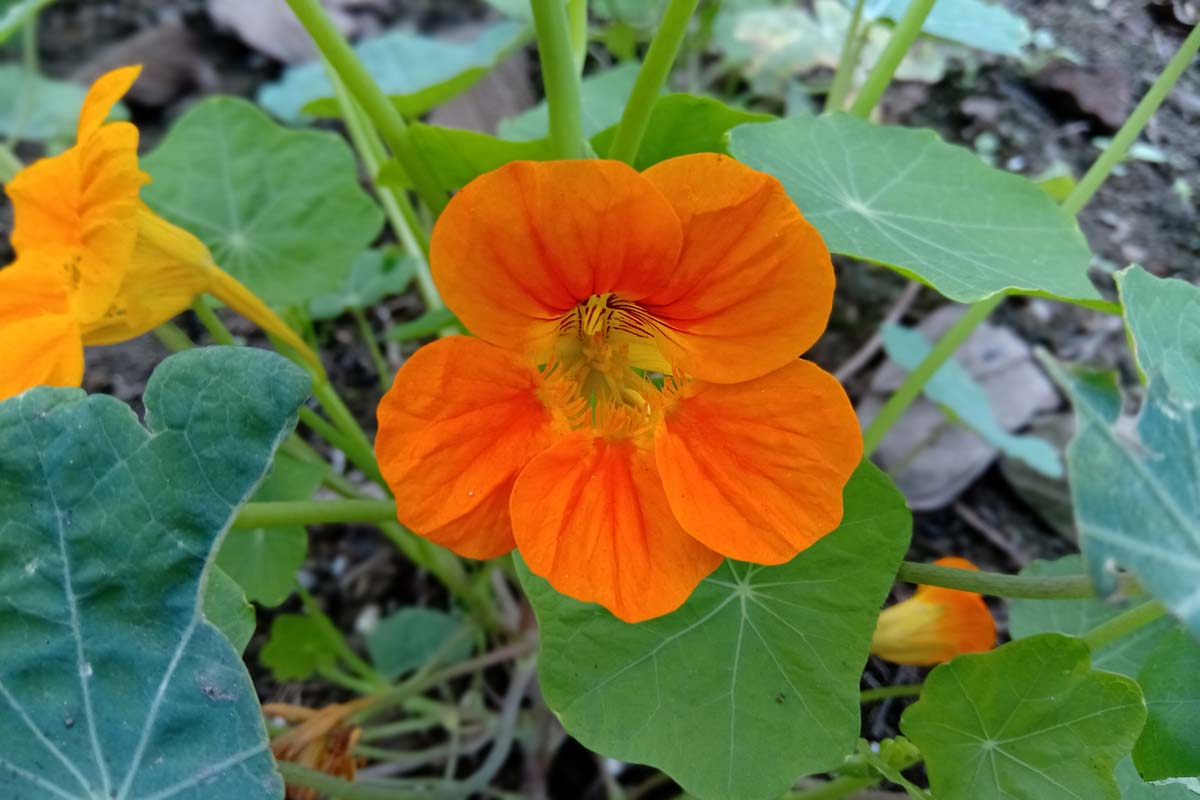
Nasturtium (Tropaeolum majus) originates from South America, where it grows as a perennial. In our climate it lacks frost hardiness, so we grow it as an annual. It forms its own plant family, the Tropaeolaceae, which includes no other common vegetable garden crop. That makes it refreshingly uncomplicated in crop rotation.
Depending on the variety, nasturtium either grows bushy and compact at 20 to 30 cm tall or climbs and trails up to 3 metres high. The shield-shaped leaves are strikingly water-repellent, and from July until the first frost, bright funnel-shaped flowers appear in yellow, orange, red and even creamy white. Its secret lies in the mustard oil glycosides, which have antibacterial and antiviral properties. It was named medicinal plant of the year in 2013 for good reason.
The best part: all parts of the plant are edible. Leaves, flowers, stems and even the unripe seeds taste spicy and peppery, similar to cress. In the garden, nasturtium takes on several jobs at once. It attracts aphids like a magnet, protecting valuable neighbouring crops. It serves as a living mulch layer and suppresses weeds. And on top of that, its flowers draw in wild bees and bumblebees. It is also completely non-toxic to pets.
Facts and figures
Planting & harvest times of Nasturtium
Direct sowing from Mid May to Mid July. Transplant to bed from Mid May to Mid June. Pre-grow about 45 days before transplanting, approximately between Early April and Late April. After a growing period of 60 days, harvest can begin around Mid June and continues until Late October.
Sow and plant Nasturtium
You can either start nasturtium indoors or sow it directly outside. For indoor sowing, start from late March to mid-April on a windowsill. Place two to three seeds per pot about 0.5 to 1 cm deep in the soil. At 18 to 21 °C they germinate within 7 to 14 days. If several seedlings come up in the same pot, prick them out at the cotyledon stage. From mid-May, after the last frosts, the young plants can move outdoors.
For direct sowing, wait until after the last frosts as well, because nasturtium cannot tolerate frost. Place the seeds 1 to 2 cm deep in the soil. As dark germinators, they need to be covered with soil. Keep the soil evenly moist, and the seedlings will appear after about a week.
Trailing varieties appreciate a climbing support on fences or bamboo canes.
Location and soil
Nasturtium likes it sunny to partially shaded. The more sun it gets, the more profusely it flowers, but it will also need considerably more water. In shadier spots it produces more leaves and fewer flowers instead.
The soil should be loose, well-drained and not too rich in nutrients. A loamy-humus garden soil is perfect. Loosen heavy soils with some sand, and improve very sandy soils with a portion of well-rotted compost. Waterlogging is a real problem and quickly leads to root rot.
Nasturtium gets along perfectly well with few nutrients. Too much nitrogen is actually counterproductive, because the foliage shoots up at the expense of flowers.
Good and bad companions of Nasturtium
Nasturtium is one of the most versatile companion planting partners you can find. It works particularly well next to tomatoes, because it lures aphids and whitefly away from the tomato plants while acting as ground cover to keep the soil moist. It also does a brilliant job next to potatoes: its dense foliage shades the soil between the rows, and the pungent scent is said to confuse the Colorado beetle.
With cucumbers, courgettes and pumpkins, nasturtium fulfils a very practical role. These shallow-rooted plants don't like hoeing, and nasturtium as an undersowing makes it unnecessary by simply suppressing weeds. Next to carrots, it is said to keep carrot fly at bay.
Be careful around brassicas, especially large-leaved types like white cabbage, red cabbage, cauliflower, broccoli, Brussels sprouts or kale. The mustard oil compounds in nasturtium attract the large white butterfly, and its caterpillars won't stop at the neighbouring cabbages. Kohlrabi is reportedly unaffected. Rocket, dill, chervil, coriander, parsley and chives are also considered poor companions.
- Trap or decoy plant
- Attracts beneficial insects
Predecessors and successors of Nasturtium
Since nasturtium is the only common garden crop from the Tropaeolaceae family, no typical problems with family-related diseases or soil-borne pests arise in crop rotation. As a light feeder, it leaves behind soil that is barely depleted, and the dead plants can simply be left on the bed as mulch in autumn.
Nasturtium really shows its strength not in crop rotation, though, but during the growing season itself: as a companion plant that protects, diverts pests and attracts beneficial insects in the same bed.
Varieties
There are two main groups of varieties. Trailing types like 'Jewel Mix' or 'Glorious Gleam' grow up to 2 metres long and are perfect for fences, trellises or hanging baskets. If you want something even more vigorous, try canary creeper (Tropaeolum peregrinum), which climbs up to 4 metres and stands out with its fringed yellow flowers.
For companion planting in the vegetable bed, bushy varieties are the better choice, as they won't smother your vegetables. 'Empress of India' only reaches about 30 cm tall, has dark foliage and bright crimson flowers. 'Alaska' catches the eye with its white and green variegated leaves and looks striking too.
All varieties of Tropaeolum majus are edible. If you want to do something good for bees and bumblebees, go for single-flowered varieties, because double flowers offer less nectar.
Care and fertilising
With its large leaf mass, nasturtium is quite thirsty. In sunny positions and on hot days, water close to the soil rather than over the plant. In containers, you may even need to water twice a day during the height of summer. Waterlogging is the only thing you really need to avoid.
In the garden bed, nasturtium needs no extra fertilising. Overfeeding with nitrogen is the most common mistake and leads to masses of leaves but hardly any flowers. In containers, a single dose of slow-release fertiliser at planting time is enough.
Remove faded flowers regularly, as this significantly encourages further blooming. If the plant gets too vigorous and threatens to smother neighbouring crops, cut it back boldly. It handles this without any trouble. For container growing, allow at least 13 to 15 litres of pot volume and a drainage layer of expanded clay at the bottom.
Diseases and pests
The best-known trait of nasturtium in the garden is its use as a trap crop for aphids (Aphidoidea). Black bean aphids feel almost magically drawn to the mustard oil compounds. Nasturtium hardly suffers from the infestation. Instead, the affected plants attract beneficial insects like ladybirds, hoverflies and lacewings, which keep things in natural balance. Aphid pressure is strongest in early summer.
The large white butterfly (Pieris brassicae) likes to lay eggs on the leaves, which can become a problem if brassicas are planted too close by. Pick off egg clusters and caterpillars by hand.
Thanks to its mustard oil glycosides, nasturtium deters slugs, ants and mice. Whitefly (Trialeurodes vaporariorum) is also kept away from neighbouring crops. The only serious disease is root rot caused by waterlogging, which shows itself through yellowing leaves. Otherwise the plant is pleasingly tough.
Harvest and processing
You can start harvesting nasturtium leaves four to six weeks after sowing, then throughout the entire season. Younger leaves taste milder, older ones have a stronger kick. Pick the flowers from June or July until the first frosts. Give the flowers a quick check for insects. In the kitchen, the leaves make a spicy, peppery salad addition and work well in pesto, herb butter or herb quark. Flowers stuffed with cream cheese are a special delicacy and look stunning too. You can brew a tea from the leaves that is said to support the immune system. The plant is considered one of the most effective herbal antibiotics. Everything tastes best freshly picked. For preserving, pickling in vinegar or infusing as herb oil works best.
Open the bed planner Try free for 7 days, web, iOS and Android