
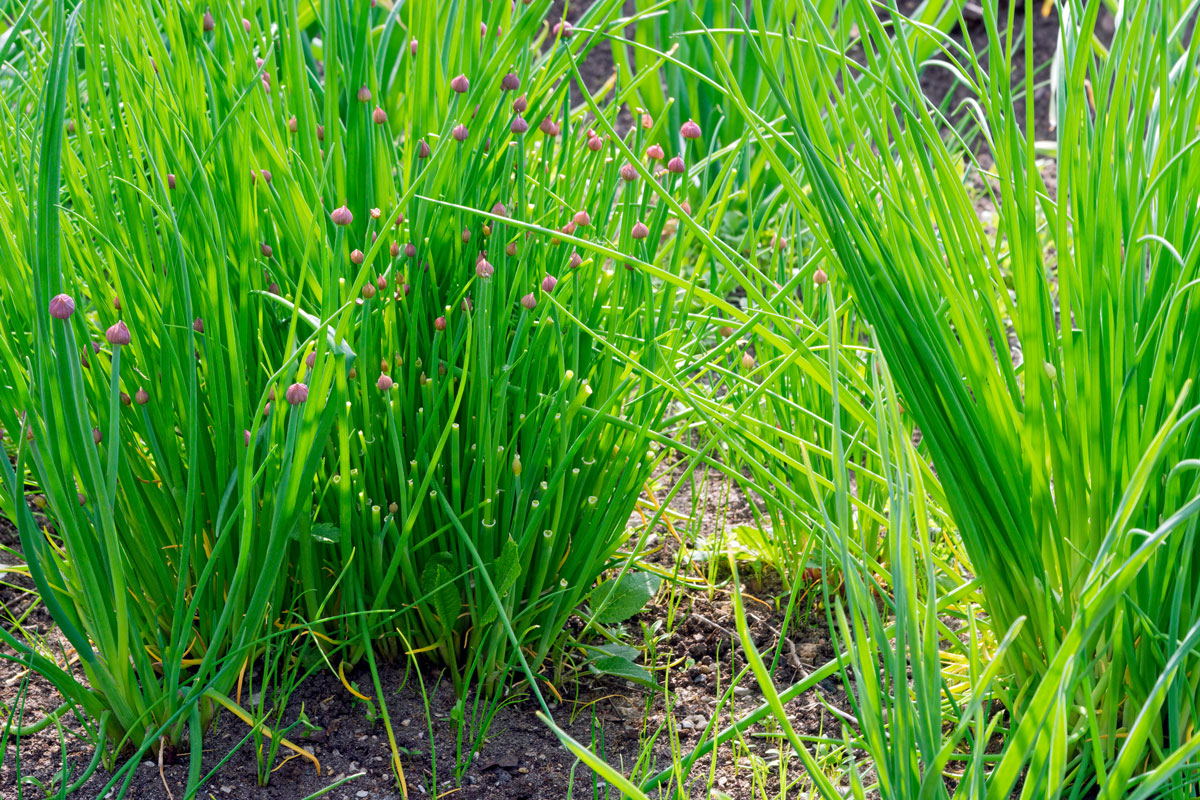
Chives are one of the most popular herbs. They're perennial, so you don't need to replant them every year. A well-established clump is sometimes enough to supply a family of four.
Because chives are helpful to other plants and their pretty flowers attract bees and other insects, they're a popular choice for bed edging in monastery gardens.
Facts and figures
Planting & harvest times of Chives
Direct sowing from Early March to Late July. Transplant to bed from Early April to Late July. Pre-grow about 30 days before transplanting, approximately between Early March and Late June. In the first year, harvest can begin and continues until Late November. From the second year on, harvest can begin as early as around Early May.
Sow and plant Chives
You can sow chives in pots or straight outdoors. In a 12 cm pot, spread around 20 to 30 seeds across the whole surface. Outdoors, scatter a few more over roughly the same area, since more seeds fail there. Chives are perennial, so you usually don't put them in the vegetable bed. Over the years they form dense clumps that you can divide now and then. In theory, one clump of chives is enough for a family of four.
Location and soil
Chives like it sunny, nutrient-rich and not too dry.
Good and bad companions of Chives
Chives go well with carrots, tomatoes, cucumbers, lettuce, beetroot and strawberries. Planted along the edge of your carrot rows, they are said to keep the carrot fly away, though a net gives you more reliable protection. Chives grow poorly next to beans, and you are better off keeping them away from other alliums, leeks above all, because they share pests and rust.
- Pest control through scent or camouflage
- Practical tip for this pair
- Shared pest is attracted or multiplies
- Shared pest is attracted or multiplies
- Shared pathogen, spreads through proximity
- Shared pest is attracted or multiplies
- Shared pest is attracted or multiplies
- Shared pest is attracted or multiplies
- Shared pathogen, spreads through proximity
- Shared pest is attracted or multiplies
- Shared pest is attracted or multiplies
Predecessors and successors of Chives
Move your chives to a new bed every two to three years, one where no alliums have grown for four years. A bed that previously held tomatoes, May turnips or a green manure such as phacelia, which dies back over winter, works well. The soil is then loose and almost free of weeds, and chives need that because they grow slowly when young. Keep a two-year gap from peas and beans.
- Weed suppression for the next crop
- Weed suppression for the next crop
- Loosens soil, improves soil structure
- Weed suppression for the next crop
- Weed suppression for the next crop
- Weed suppression for the next crop
- Both host the same nematode species
- Both host the same nematode species
- Shared soil-borne pathogen
- Both host the same nematode species
- Self-incompatibility
- Shared soil-borne pathogen
- Both host the same nematode species
- Shared soil-borne pathogen
- Both host the same nematode species
- Shared soil-borne pathogen
- Both host the same nematode species
- Shared soil-borne pathogen
- Both host the same nematode species
- Both host the same nematode species
- Both host the same nematode species
- Both host the same nematode species
- Shared soil-borne pathogen
- Both host the same nematode species
- Shared soil-borne pathogen
- Both host the same nematode species
- Shared soil-borne pathogen
- Both host the same nematode species
- Both host the same nematode species
- Both host the same nematode species
- Shared soil-borne pathogen
- Both host the same nematode species
- Self-incompatibility
- Shared soil-borne pathogen
- Both host the same nematode species
- Shared soil-borne pathogen
- Both host the same nematode species
- Shared soil-borne pathogen
- Both host the same nematode species
- Shared soil-borne pathogen
- Both host the same nematode species
- Both host the same nematode species
- Both host the same nematode species
- Both host the same nematode species
- Shared soil-borne pathogen
- Both host the same nematode species
- Shared soil-borne pathogen
- Both host the same nematode species
- Shared soil-borne pathogen
- Both host the same nematode species
Varieties
There are different varieties, some with fine and others with coarser stems. Flower colour also varies, from white through red to the well-known violet.
Care and fertilising
Unlike most other herbs, chives need an occasional feed and a helping of mature compost in spring before new growth starts. Since they constantly have to produce new leaves when you harvest them regularly, that's no surprise.
They don't cope well with drought either. The stems turn tough, or the plant dies off altogether.
Diseases and pests
Harvest and processing
You can happily eat the beautiful flowers too. They have a delicate flavour and look lovely in a salad.
Open the bed planner Try free for 7 days, web, iOS and Android