
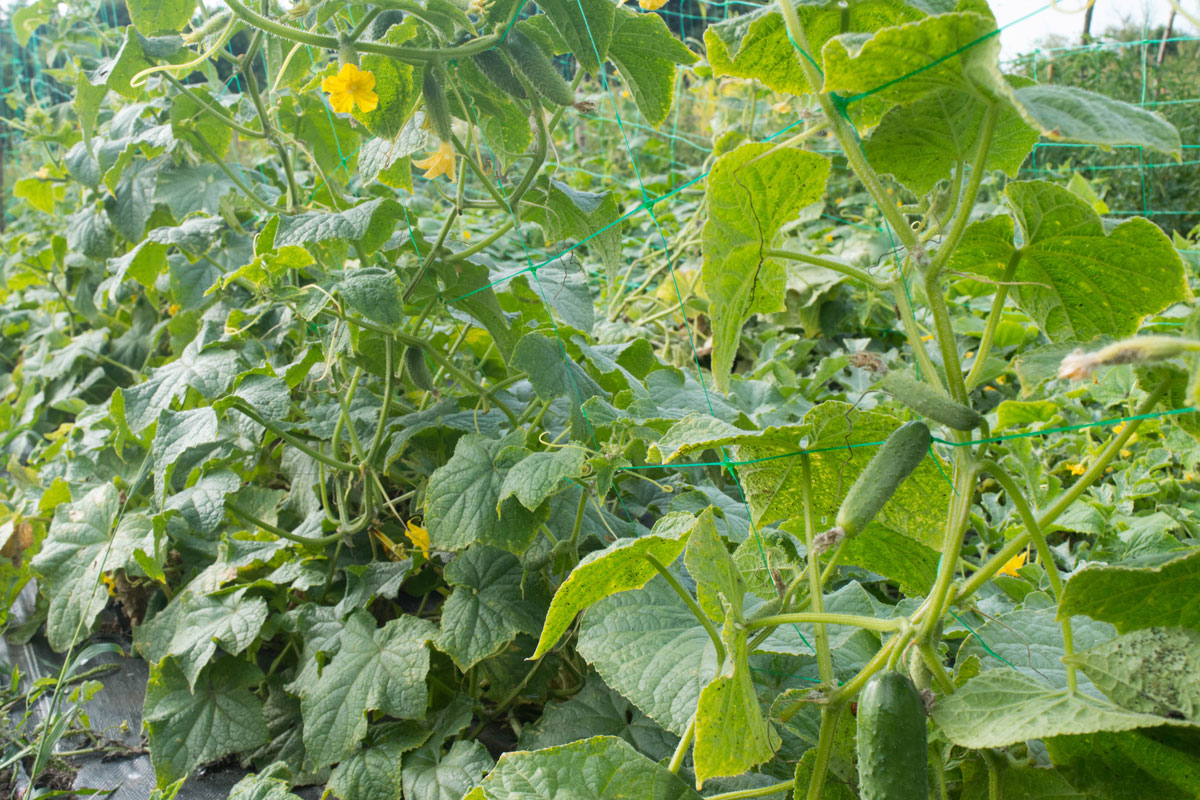
The cucumber belongs to the cucurbit family and has been grown for more than 3000 years. Like the aubergine, it comes from India. That explains its need for warmth.
Some cucumber varieties only do well in a greenhouse, and that covers most long salad cucumbers. These are the typical long, smooth cucumbers you find in the shops.
Then there are field cucumbers and gherkins, which you grow outdoors lying on the ground. A few long salad cucumber varieties cope outdoors too, but out there they need a support to climb up.
Facts and figures
Planting & harvest times of Cucumber
OutdoorsDirect sowing from Mid May to Early July. Transplant to bed from Mid May to Mid July. Pre-grow about 25 days before transplanting, approximately between Mid April and Mid June. After a growing period of 60 days, harvest can begin around Late June and continues until Mid October.
GreenhouseDirect sowing from Mid April to Early July. Transplant to bed from Mid April to Early July. Pre-grow about 25 days before transplanting, approximately between Mid March and Early June. After a growing period of 60 days, harvest can begin around Mid June and continues until Mid October.
Sow and plant Cucumber
Field cucumbers, gherkins and some outdoor-suited long salad cucumbers can go straight into the bed from the second half of May, as soon as the soil feels warm. Cucumbers only germinate from about 13 degrees, and they get going quickly at a soil temperature of 20 to 30 degrees. Sow the seeds 2 to 2.5 centimetres deep. Plant out raised seedlings only after the last frosts, so towards the end of May, once they have two strong seed leaves and the first proper leaf. Don't set them deeper than they sat in the pot, as a buried root collar rots easily. Outdoors the cucumbers need about 100 centimetres between the rows and 40 centimetres within the row, so a bed 1.20 metres wide has space for one row.
In a heated greenhouse you can start a month earlier. Spacings there are more generous, about 130 x 45 centimetres, and the cucumbers climb up strings or nets. That works outdoors too, for example on a frame where you fix a wide-mesh grid at an angle. The space underneath then stays free for lettuce, which is grateful for a bit of shade in high summer. Find the cucumbers a sunny, sheltered spot and work in plenty of compost or half-rotted manure beforehand.
Good and bad companions of Cucumber
Cucumbers like company, as long as they get enough sun and their leaves dry off quickly after rain. Dill works well sown straight into the cucumber row, and basil between the plants draws bees to the flowers.
Radishes, lettuce, kohlrabi and early-sown spinach use the space until the cucumbers spread their shoots. Harvest the spinach in good time, because like the cucumber it can pick up cucumber mosaic virus.
Cucumbers need shelter from wind. Runner beans or sweetcorn keep it off, and in hot summers the sweetcorn gives the cucumbers light shade. Leave enough distance though, or it gets too dark for them. Celery, fennel, peas and cabbage also count as good neighbours.
Winter radish is better kept away from the cucumber, as it is said to make the flowers sterile in hot early summers. Many gardeners also advise against potatoes and sage next to cucumbers. Pumpkin, courgette and melon share mildew and viruses with the cucumber, so don't put them right beside each other.
- Supports pollination
- Practical tip for this pair
- Supports pollination
- Practical tip for this pair
- Shade, wind shelter, ground cover
- Practical tip for this pair
- Trap or decoy plant
- Attracts beneficial insects
- Shade, wind shelter, ground cover
- Shade, wind shelter, ground cover
- Practical tip for this pair
- Practical tip for this pair
- Practical tip for this pair
- Supports pollination
- Allelopathy, growth inhibition
- Shared pathogen, spreads through proximity
- Shared pathogen, spreads through proximity
- Shared pathogen, spreads through proximity
- Allelopathy, growth inhibition
- Shared pathogen, spreads through proximity
- Shared pathogen, spreads through proximity
Predecessors and successors of Cucumber
Cucumbers should only go back into the same bed after four years at the earliest, and the same goes for pumpkin, courgette and melon. They share diseases such as angular leaf spot, which survive on plant debris in the soil.
As a hungry feeder, the cucumber is happy with a bed that previously held peas, beans or a green manure with clover. It also grows well after leeks and celery. Better not to plant cucumbers after cabbage and sweetcorn.
Until mid-May you can still harvest lettuce or radishes on the cucumber bed, and a pre-crop of broad beans adds nitrogen as well. Garden cress as a pre-crop, on the other hand, is something the cucumber cannot stand at all.
After the cucumber harvest, lamb's lettuce, spinach or a green manure fit well. In autumn you can also plant winter onions or garlic, as alliums grow well after cucumbers. The following year, beetroot and chard do well in the bed. If sunflowers grew there, wait three years before planting cucumbers, because both fall ill with white mould.
- Nitrogen release
- Nitrogen release
- Nitrogen release
- Nitrogen release
- Nitrogen release
- Nitrogen release
- Nitrogen release
- Nitrogen release
- Shared soil-borne pathogen
- Shared soil-borne pathogen
- Self-incompatibility
- Shared soil-borne pathogen
- Shared soil-borne pathogen
- Shared soil-borne pathogen
- Shared soil-borne pathogen
- Shared soil-borne pathogen
- Allelopathy, growth inhibition
- Shared soil-borne pathogen
- Shared soil-borne pathogen
- Self-incompatibility
- Shared soil-borne pathogen
- Shared soil-borne pathogen
- Shared soil-borne pathogen
- Shared soil-borne pathogen
Care and fertilising
Cucumbers are hungry feeders and even like coarse compost and half-rotted farmyard manure spread before planting. An occasional drink of comfrey liquid feed or comfrey tea does them good too.
Above all, though, a steady water supply matters. Cucumber plants don't like cold water. If they run short of water, the fruits turn bitter and no longer taste good.
Diseases and pests
The most common cucumber disease in the garden is downy mildew. From July onwards, after cool, dewy nights, yellow, sharply defined spots appear on the leaves and soon turn brown. So water only at the base of the plants, and early enough that the leaves go into the night dry. Train the cucumbers up a frame or mulch the soil.
Powdery mildew, with its white coating that wipes off, shows up more in dry warmth and in the greenhouse. Young leaves mottled light and dark green, along with deformed fruits, point to cucumber mosaic virus, which aphids pass on. Pull those plants out; a protective net until flowering keeps the aphids away.
Angular yellow-brown leaf spots or sunken dark patches on the fruits come from bacteria and fungi that arrive with the seed and survive on plant debris. Clear diseased plants away completely and leave four years before any cucurbit returns to that spot. In the greenhouse, spider mites cause trouble in heat and dry air, and predatory mites help against them. Slugs love young cucumbers, so protect the young plants well.
If your cucumbers suddenly wilt in August even though the soil is moist and the leaves are green, black root rot is often behind it. The fungus sits in the soil and survives there for several years. Only put cucumbers back on the same bed after four years, and not after squash, courgettes or melons either.
Harvest and processing
You pick the first cucumbers about eight to nine weeks after sowing, outdoors usually from July until the first frost. Pick regularly every two to three days, then the plant keeps setting new fruits. Cucumbers that have grown too big cost it a lot of energy and slow the yield. Freshly picked cucumbers stay nicely crisp if you put them in cold water for a short while. They keep longest at 10 to 12 degrees and high humidity, about one to two weeks. Don't put them next to apples or tomatoes, as their ripening gas turns cucumbers yellow quickly. Cucumbers that have turned bitter taste unpleasant, so better throw those away. Funny video on how to use cucumbers: https://www.youtube.com/watch?v=SdL0CsZLieo
Open the bed planner Try free for 7 days, web, iOS and Android