
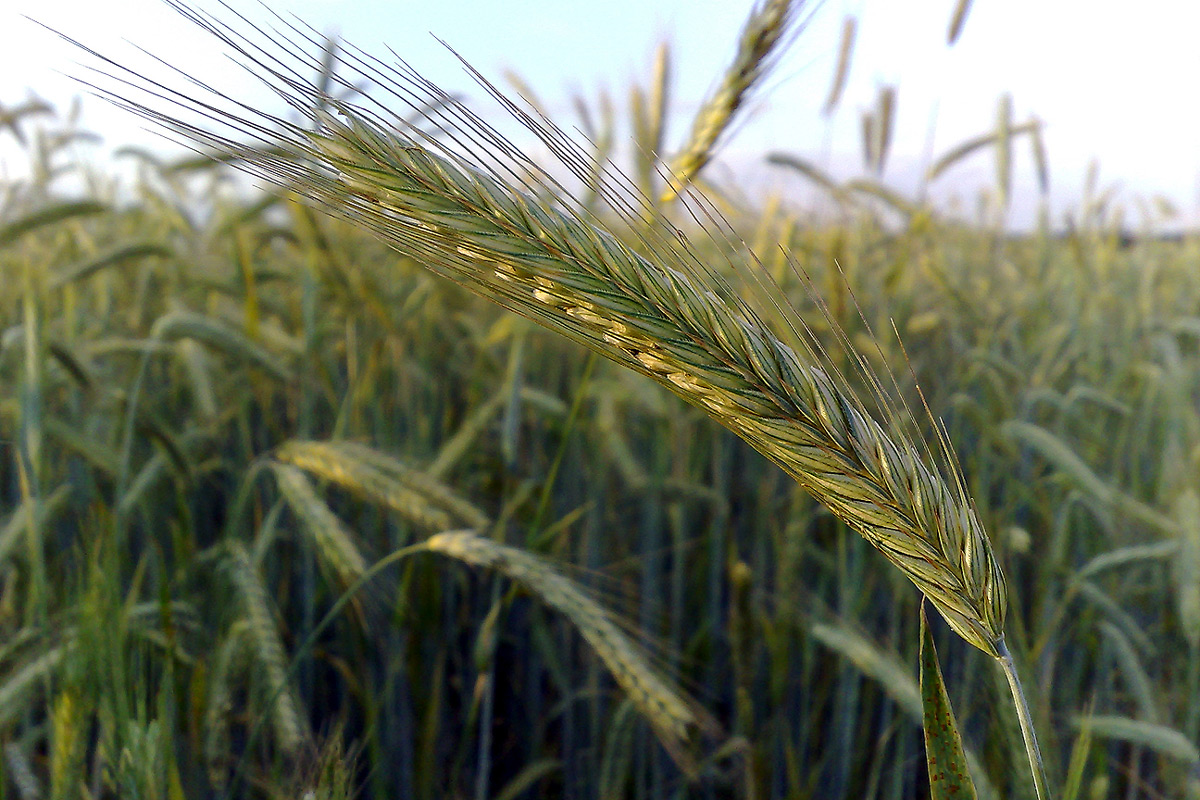
Rye belongs to the grass family and is one of the oldest cultivated plants in Europe. In the vegetable garden, it's used almost exclusively as a green manure — and in that role, it's hard to beat. Botanically, winter rye and spring rye are the same species (Secale cereale); they only differ in their growing cycle: winter rye goes in during autumn and easily withstands temperatures down to minus 25 °C, while spring rye is sown in spring. In central Europe, winter rye is by far the more common variety and the first choice for green manuring.
What makes rye so valuable for the garden is its intensive root system. The roots reach up to a metre deep and loosen the soil in a way no spade can match. After incorporation, fine channels remain that store water and improve aeration. At the same time, rye takes up residual nitrogen left in the soil after the vegetable harvest and protects it from leaching over winter. In spring, that nitrogen is then available for the next crop.
A big plus in companion planting is that rye isn't related to virtually any vegetable. The only exception in the home garden is sweetcorn, which also belongs to the grass family. You can therefore sow rye on any bed without disrupting the crop rotation.
Facts and figures
Planting & harvest times of Winter rye
Green manureDirect sowing from Late August to Mid October. Incorporation takes place around Early March until Late April next year.
WinterDirect sowing from Mid July to Mid October. After a growing period of 345 days, harvest can begin around Early July and continues until Late August next year.
SummerDirect sowing from Late February to Mid April. After a growing period of 128 days, harvest can begin around Early July and continues until Late August.
Sow Winter rye
Winter rye is sown directly onto the cleared bed in autumn. The best window is between late August and mid-October, with September being ideal because the plants can root in well before the first frost. Late sowings up to the end of October or even early November still work, as rye is the most late-sowing-tolerant of all green manure plants.
Place the seeds 2 to 3 cm deep, ideally as a broadcast sowing. Then press them in lightly to ensure good soil contact. You need roughly 15 to 20 g of seed per square metre. A handy tip: rye grains from the food shop generally germinate just as well as specialist green manure seed. It saves money and works perfectly.
Rye germinates from as low as 1 to 2 °C and makes use of every mild spell during winter to keep growing. On freshly loosened beds, firm the soil a little before sowing. If it stays dry after sowing, one good watering helps.
Good to know: winter rye is only suitable for beds that won't be replanted until late April or May. The growth must be incorporated or mown before replanting, and the soil then needs another 3 to 4 weeks of rest.
Spring rye can alternatively be sown from late February to early April and is then incorporated in summer as green manure. In practice, though, this variant is rarely used.
Location and soil
Rye is the most undemanding of all cereals and still grows on sandy, nutrient-poor soils where other crops have long given up. Cooler locations don't bother it either. As a light feeder, it needs no fertilising at all — quite the opposite: the whole point is for it to take up and conserve the existing nitrogen in the soil.
Rye prefers a sunny spot; in partial shade it produces less growth. What it really can't tolerate is waterlogging. On permanently wet, compacted soils the seed germinates poorly and the roots rot. As long as drainage is adequate, rye copes with almost any garden site.
Good and bad companions of Winter rye
Since rye as green manure always occupies a free bed on its own, the classic companion planting concept works a bit differently here. The best-proven partners are other green manure plants: winter vetch and rye together make one of the finest green manure mixes around, because the rye loosens the soil while the vetch fixes nitrogen. Crimson clover complements rye beautifully on the same principle.
Phacelia can be combined well with rye if sown in early autumn — it dies off before winter, leaving the rye to grow on alone.
Be careful with sweetcorn, as both belong to the same plant family. They shouldn't follow each other directly on the same bed.
A special feature of rye is its allelopathic root exudates. These inhibit the growth of other plants nearby. That's a blessing for weed suppression, but it's exactly why you should never sow rye among existing vegetable crops — always on an empty bed.
Predecessors and successors of Winter rye
Rye is one of the most rotation-neutral green manures in the garden. As a grass, it isn't related to any common vegetable family, so it can follow practically any crop. It makes particularly good sense after heavy feeders like cabbage, tomatoes, cucumbers or potatoes, because it secures their residual nitrogen over winter and doesn't carry over any family-specific diseases.
As a follow-on crop, heavy feeders work best in turn: cabbage, tomatoes, cucumbers, courgettes and squash all benefit from the loose, nutrient-rich soil rye leaves behind. In principle, any non-related vegetable can follow a rye green manure.
Avoid a direct succession with sweetcorn, since both are grasses. Repeated rye growing on the same patch is also unfavourable, as stem eelworm can build up. After rye, be cautious with broad beans, because rye can host certain nematodes that attack broad beans.
Varieties
For straightforward green manuring in the garden, the choice of variety doesn't really matter. You can even use rye grains from the organic shop or supermarket, as long as they haven't been heat-treated. If you specifically want to produce green mass, go for forage rye varieties bred for particularly high leaf growth. The old variety 'Schlägler' from the Arche Noah seed conservation programme is especially resistant to snow mould, making it interesting for harsh locations.
Care and fertilising
It barely gets more low-maintenance than this: after the autumn sowing and emergence, rye needs zero attention until spring. It grows by itself, suppresses weeds and protects the soil. Only if it stays dry for a prolonged period after sowing is a single watering worthwhile to ensure even germination.
In spring you have two options: either mow the growth and use it as mulch between freshly planted young plants like lettuce or cabbage, or incorporate the plants shallowly — no more than 10 cm deep — into the soil. In both cases, wait 3 to 4 weeks before replanting, because nutrients are temporarily locked up during decomposition.
This is crucial: remove the rye before it flowers, at the latest when ears start to appear. Otherwise it self-seeds and becomes a stubborn weed. May is usually the right time to incorporate it. When pulling it out, grab it in clumps with the roots and shake off the soil — this gives you a wonderfully fine, well-worked soil structure.
Diseases and pests
As a green manure that gets incorporated before flowering, rye rarely causes problems in the garden. The dreaded ergot (Claviceps purpurea), where toxic fungal sclerotia form in the ear instead of grains, is only relevant if you let the rye reach seed maturity. When used as green manure, there's no danger.
Snow mould (Microdochium nivale) can appear after prolonged snow cover and shows up after the thaw as a whitish fungal mat on the plants. In normal winters this isn't an issue. Brown rust (Puccinia triticina) forms reddish-brown pustules on the leaves but plays virtually no role in green manure use.
Stem eelworm (Ditylenchus dipsaci) deserves special attention. Rye can host these nematodes, which persist in the soil for a long time. On plots with a known nematode problem, don't grow rye too frequently and avoid following it directly with broad beans or other susceptible legumes. Some sources describe rye as nematode-reducing, which probably applies to other nematode species. In a normal home garden without a known nematode issue, there's no reason to worry.
Harvest and processing
As a green manure, rye isn't harvested in the traditional sense. Instead, you use the spring growth to improve the soil. Mown down, it makes an excellent mulch layer that retains moisture, suppresses weeds and slowly releases nutrients. You can also pull it out in clumps with the roots — that loosens the top layer of soil at the same time. If you actually want to bring rye to grain maturity, harvest in July or August when the grains are hard and dry. Rye flour makes robust bread when baked with sourdough. Rye needs sourdough rather than yeast alone, because its high pentosan content affects its baking properties.
Open the bed planner Try free for 7 days, web, iOS and Android