
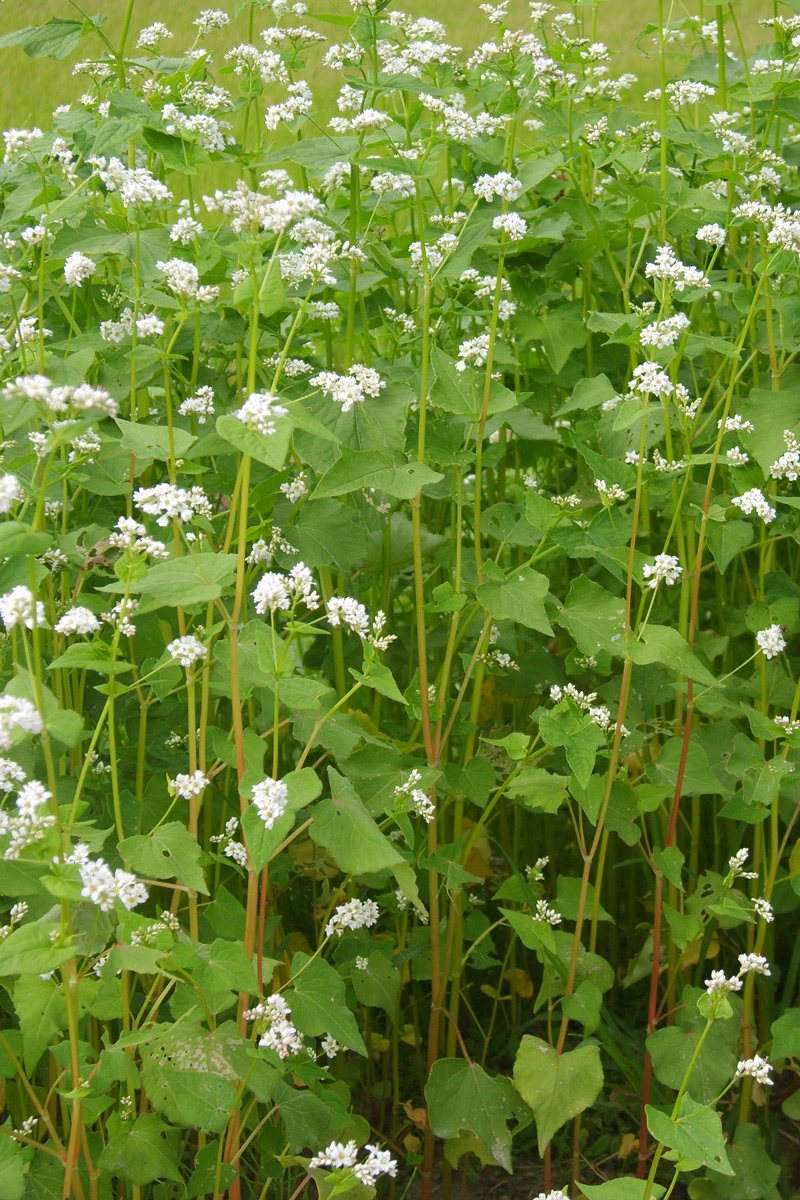
Despite its name, buckwheat is neither related to beech trees nor to wheat. It actually belongs to the knotweed family, making it a relative of rhubarb and sorrel. In the garden, it serves several purposes at once: it's an excellent green manure, a valuable nectar source for bees, and on top of that you can use it as a gluten-free pseudo-cereal.
Buckwheat originally comes from Central Asia, where it was already cultivated around 6,000 years ago. It reached Europe via trade routes in the 13th century and became an important food crop, particularly on the poor heathland and moorland soils of northern Germany. The triangular seeds resemble beechnuts, which is how it got its name. Regionally, it's also known as beech wheat or Saracen corn.
In the garden, buckwheat is mainly used as green manure today. It grows quickly, germinates after just five to eight days and forms a dense stand of 50 to 120 cm height within a few weeks. Its white to pale pink flowers appear over roughly six weeks, filling an important gap in the nectar supply for bees, bumblebees and hoverflies. The hoverfly larvae in turn feed on aphids, so buckwheat indirectly helps with biological pest control too.
Thanks to its high content of rutin, a flavonoid that strengthens blood vessels, buckwheat herb was even named medicinal plant of the year in 1999. The hulled grains contain all eight essential amino acids and work well as groats, flour or flakes.
Facts and figures
Planting & harvest times of Buckwheat
Green manureDirect sowing from Early May to Late August.
SummerDirect sowing from Early May to Late August. After a growing period of 80 days, harvest can begin around Early August and continues until Late October.
Sow Buckwheat
Buckwheat is always sown directly into the bed — starting it indoors makes no sense. Since the plant is extremely frost-sensitive, you should sow no earlier than mid-May, after the last frosts. The latest sowing date is the end of August, so that enough biomass can build up before the first frost.
You can either broadcast sow or sow in rows about 25 cm apart. The sowing rate is roughly 5 g per square metre. Buckwheat is a dark germinator and needs a soil covering of about 1 to 4 cm to germinate. The minimum germination temperature is 8 to 10 °C, with 15 to 20 °C being optimal.
Germination is surprisingly quick — the first seed leaves appear after just five to eight days. During this phase the soil needs enough moisture, as dryness right after sowing can seriously hinder emergence. Once the seedlings are established, they cope well with dry spells.
Location and soil
Buckwheat loves sun and warmth. Sheltered spots are ideal. It has very few demands when it comes to soil: light, sandy to moderately moist soils are perfect, and even acidic heath or peat soils cause it no trouble at all. What it really can't handle, though, is waterlogging or compacted soil.
As a light feeder, buckwheat needs no extra fertiliser. On very nitrogen-rich soils it puts all its energy into leaf growth and produces fewer grains. If you're growing it as green manure, you don't need to worry about nutrients at all.
Good and bad companions of Buckwheat
Buckwheat is a very easy-going companion in mixed plantings. As a member of the knotweed family, it's barely related to any vegetable crop, so conflicts are rare.
It pairs especially well with phacelia. Both die off in autumn frosts, both attract pollinators, and together they make an excellent green manure mix for ground cover. This combination is one of the most popular green manure blends around.
Buckwheat also gets on brilliantly with legumes like peas, vetches or clover. The legumes fix nitrogen from the air, while buckwheat mobilises potassium and phosphorus from the soil. The two groups complement each other perfectly. Pot marigolds and French marigolds fit in nicely too, since together they attract a wide range of pollinators.
The few bad neighbours are its own relatives. Rhubarb and the various sorrel species shouldn't stand directly next to buckwheat. Since they all belong to the knotweed family, shared diseases can become an issue, and the crop rotation benefit is lost.
Predecessors and successors of Buckwheat
Buckwheat is a real ace in crop rotation because it's barely related to any vegetable and is considered exceptionally rotation-neutral. You could even theoretically grow it several times in a row on the same patch without running into problems.
It works particularly well as a follow-on crop after early-cleared beds. After early potatoes, lettuce or radishes, there's still enough time to sow it as green manure. It's also a good choice as green manure after sweetcorn or peas.
As a preceding crop, buckwheat leaves the soil in noticeably better condition. Its deep root system loosens the ground, it mobilises phosphorus and potassium, and it reduces nematodes. Strawberries benefit especially from a buckwheat predecessor, as it leaves behind a clean, weed-free bed. Heavy feeders like tomatoes, courgettes, squash or cabbage make the best use of the released nutrients. Root vegetables like carrots, beetroot and parsnips appreciate the loose soil structure too.
The only crop you shouldn't plant buckwheat directly before is rhubarb and sorrel species, as the family relationship within the knotweed family can cause problems here.
- Weed suppression for the next crop
- Weed suppression for the next crop
- Weed suppression for the next crop
- Weed suppression for the next crop
- Weed suppression for the next crop
Varieties
There are two species of buckwheat. Common buckwheat (Fagopyrum esculentum) is the right choice for grain production. It produces larger seeds that are easy to hull, but as a cross-pollinator it needs insect pollination. Tartary buckwheat (Fagopyrum tataricum) is somewhat more cold-tolerant and produces more leaf mass. Its grains taste bitter and are difficult to hull, though, so it's mainly suited as a green manure plant.
In seed catalogues, you'll often find green manure seed simply labelled 'buckwheat' with no variety name. If you specifically want grains for the kitchen, look for seed that's clearly marked as common buckwheat. There are some named varieties like Billy with good hullability or Bamby for both grain and green manure use.
Care and fertilising
Buckwheat is one of the lowest-maintenance plants in the garden. After sowing, you can practically sit back and relax. Fertilising isn't necessary and is actually counterproductive for grain production, since too much nitrogen makes the plant put all its energy into foliage rather than setting seed.
You only need to water during the germination phase. After that, buckwheat handles drought without any problem, while waterlogging does it harm. Hoeing and weeding aren't needed either, because the dense stand shades the ground so thoroughly that weeds barely get a look in.
If you're using buckwheat as green manure, you have two options: either dig it in just before flowering, when the lush biomass decomposes especially quickly, or leave the plants standing until the first frost. The frost-killed material forms a protective mulch layer over winter and is easy to work into the soil in spring. If you don't want buckwheat spreading by self-seeding, mow it down before the seeds ripen.
Diseases and pests
Buckwheat is an extremely tough plant. Diseases and pests play virtually no role in the garden. Since it's botanically quite isolated as a knotweed family member, the specialised pests that plague other crops simply aren't there.
In very wet weather with dense stands, buckwheat powdery mildew (Ramularia fagopyri) can occasionally appear. It shows up as greyish-white spots on the leaves but is rarely a serious problem in the home garden and doesn't need treating.
One word of caution: the seed coat contains the phototoxic substance fagopyrin. Sensitive individuals may experience skin reactions from contact with flowering or fruiting plants in strong sunlight. Wearing gloves during harvest is no bad idea.
Harvest and processing
Harvesting buckwheat for grain takes a bit of patience and skill. The plant flowers and sets fruit simultaneously at different points, so the grains never all ripen at once. The best time to harvest is when roughly two-thirds of the grains have turned dark brown. To harvest, cut the plants and stand them in small bundles to dry further. After about a week you can thresh out the grains. Freshly harvested grains need to be dried promptly, as they spoil quickly otherwise. Stored somewhere dry and cool, they keep for several months. Before eating, the grains need to be hulled since the shells contain fagopyrin. Hulled buckwheat can be ground into flour, cooked as groats (known as kasha in Eastern Europe) or processed into flakes. Buckwheat is gluten-free and provides high-quality protein with all essential amino acids. If you're growing buckwheat purely as green manure, there's no harvest to worry about. All the plant material stays on the bed and gets worked into the soil after it's been killed by frost or deliberately cut down before the seeds ripen.
Open the bed planner Try free for 7 days, web, iOS and Android