
The onion is a true all-rounder in the kitchen and garden. With its sweet yet pungent flavour, it enhances countless dishes and is not only delicious but also healthy. It belongs to the amaryllis family and is one of the oldest cultivated plants known to humanity. The onion is perennial but is usually grown as an annual crop, as it forms its edible bulbs in the first year. The variety of onions is vast: from mild spring onions to classic summer onions and hardy winter onions, there are numerous types that differ in shape, colour and taste. In the garden, the onion is a valuable plant that not only tastes great but also acts as a companion plant against pests. It loves sunny, warm spots and humus-rich, well-drained soil. The onion is relatively undemanding but needs careful attention, especially in the early stages when it struggles to compete with weeds. It also has a long history as a medicinal plant, particularly for colds and earache. As an emergency home remedy for bee and wasp stings, cut an onion in half and rub it on the sting. It works – even our daughter confirms this. Sulphur compounds in the onion juice break down the venom and ease the pain.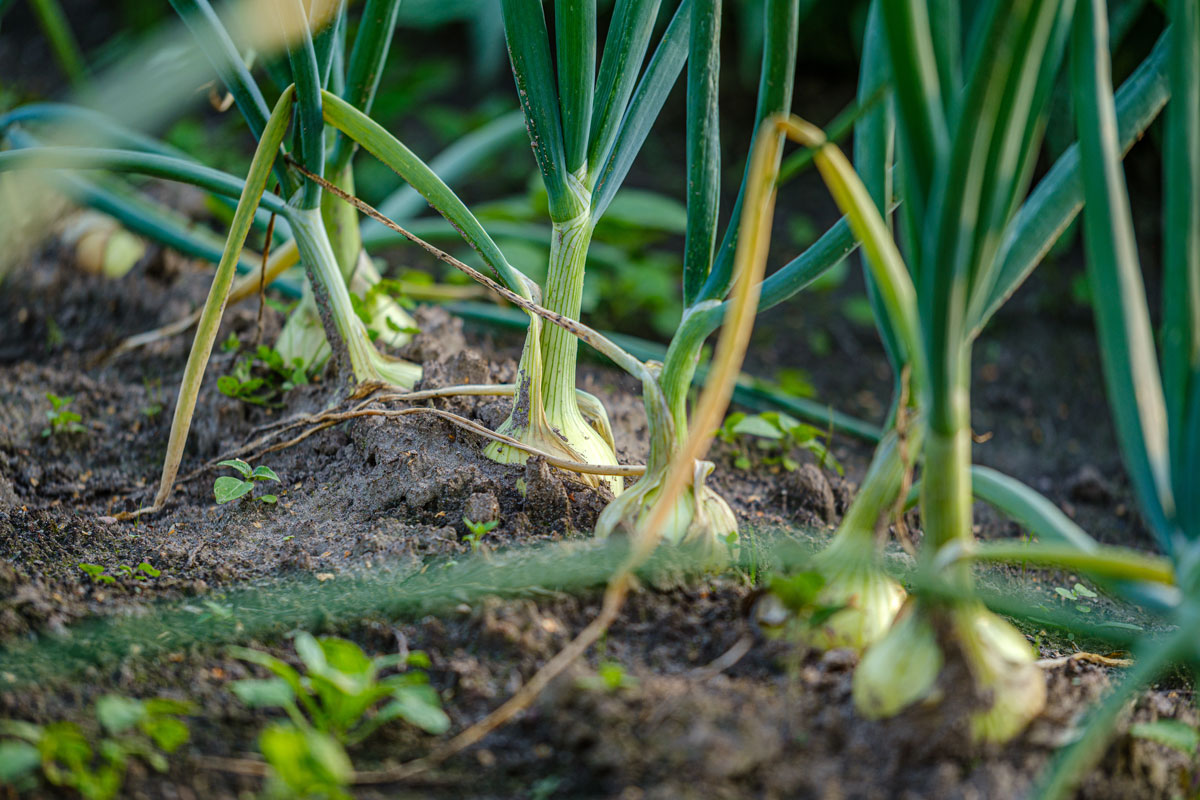
Martins Vanags/Shutterstock.com
Facts and figures
Planting & harvest times of Onion
SpringDirect sowing from Early March to Late April. Transplant to bed from Early April to Mid June. Pre-grow about 60 days before planting out, approximately between Early February and Mid April. After a growing period of 120 days, harvest can begin around Mid August and continues until Late September.
WinterDirect sowing from Early August to Late August. Transplant to bed from Early August to Mid September. Pre-grow about 60 days before planting out, approximately between Early June and Mid July. After a growing period of 120 days, harvest can begin around Mid June and continues until Late August next year.
Spring 2Direct sowing from Early April to Late May. After a growing period of 120 days, harvest can begin around Mid June and continues until Early August.
Winter 2Direct sowing from Mid September to Late October. After a growing period of 120 days, harvest can begin around Mid May and continues until Mid July next year.
Sow and plant Onion
Spring and Winter: show the times for growing from seed
Spring 2 and Winter 2: show the times for growing from sets
You can grow onions in several ways: by direct sowing, starting indoors, or planting sets.
For direct sowing, sow from early March to late April, depending on your region and the weather. Sow the seeds shallowly, about 2 cm deep, in rows 25 cm apart. Thin the plants to 5 to 10 cm apart once they're big enough.
Cultivation indoors or in a greenhouse often begins in mid-February to early April in order to obtain young plants for planting in mid-April to mid-May. Sow the seeds across the surface in pots or trays and germinate them at an ideal temperature of 15 to 20 °C. Plant the seedlings out carefully – don't set them too deep. The bulbs should sit on the soil surface with only the roots in the ground.
Onion sets are a handy alternative, especially at higher altitudes or if you're sowing late. Plant them from late March to May, spacing them about 10 cm apart, with the tip just poking out of the soil. Sets grow faster, but they're more prone to disease and offer less variety choice.
Spring onions can be sown from March to August for a continuous harvest. Sow them shallowly (about 1.5 cm) with a row spacing of 20 to 25 cm.
To produce your own sets, sow onion seeds in spring (March–April) about 2 cm apart. Harvest them after roughly 8 to 12 weeks, once they're the size of a hazelnut. In Gertrud Franck's method, this is done in the C-rows.
Location and soil
Onions love sunny, warm spots with good air circulation. An open, breezy location is ideal so the foliage dries quickly and diseases are kept at bay. Onions don't cope well with shade, as they produce less bulb mass and become more prone to disease.
The soil should be loose, rich in humus and nutrients, with good water retention. Medium-heavy soils with some clay content are optimal. Pure sandy or heavy clay soils are less suitable, as they either dry out too quickly or stay too wet. Before sowing, thorough soil loosening and working in compost is recommended.
In the early growth stage, onions are sensitive to waterlogging and soil compaction. Good soil preparation and care are therefore essential.
Good and bad companions of Onion
Onions are excellent companion planting partners and protect neighbouring plants from pests. They pair particularly well with tomatoes, lettuces, cucumbers, parsnips, chard and beetroot. These combinations promote growth and reduce pest pressure.
Less suitable neighbours include beans, peas, potatoes and cabbage, as these can hinder onion growth. Celery and tomatoes should also not be planted directly next to onions to avoid competition and disease risks.
Planted next to carrots, the onion scent repels the carrot fly, and in turn, the carrot repels the onion fly. If onion fly infestation is severe, a fine-mesh crop protection net can help.
Predecessors and successors of Onion
Crop rotation is particularly important for onions to prevent diseases and pests. Cabbage shows growth delays where alliums previously grew, and vice versa. Onions should not be grown directly after other alliums or legumes. A gap of at least four years is recommended; if diseases like nematodes or downy mildew have occurred, even up to six years.
Ideal preceding crops are those that leave few harvest residues and keep the bed weed-free, such as turnips or tomatoes. A winter-killed green manure the previous year can further improve the soil and reduce weeds.
Onions leave behind a well-rooted, loose soil that benefits following crops. A varied crop rotation supports soil fertility and plant health.
Varieties
The variety of onion cultivars is vast, ranging from mild spring onions to classic summer onions, hardy winter onions and bunching onions. Colours vary from white through yellow to red and violet.
Summer onions generally store well and come in a wide range of shapes, from flat-round to pear-shaped. Winter onions are cold-resistant and suited for autumn and winter growing. Bunching onions form small bulbs with long stems and are eaten fresh.
Shallots are closely related but differ in their elongated shape and growth in clusters. They have a milder flavour and are often used raw.
Care and fertilising
Onions are relatively undemanding but need careful weeding in the first few weeks, as they struggle to compete during this phase.
Water moderately and in the morning, so the plants can dry off by evening. This reduces the risk of fungal diseases like downy mildew.
Too much water, especially just before harvest, can lead to glassy onions. Once the tops have bent over, stop watering altogether.
Fertilising is usually unnecessary if the soil has been well supplied with compost. Onions are light to moderate feeders. Too much nitrogen promotes leaf growth at the expense of bulb formation and storage life.
Diseases and pests
Onions are susceptible to various diseases and pests that require special attention in organic gardening. The most common fungal disease is downy mildew (Peronospora destructor), which spreads rapidly in cool, damp weather. Symptoms include pale spots on the tubular leaves, followed later by a grey-violet coating.
Preventive measures include open, breezy locations, keeping the bed weed-free, watering only in the morning, and spraying with horsetail tea. Fusarium basal rot (Fusarium oxysporum) leads to small, weak onions with poor root systems and yellowing leaves. Affected onions continue to rot in storage.
Pests such as the onion fly lay their eggs on the leaves; the larvae bore tunnels and damage the bulb. You can prevent this through companion planting with carrots or by using crop protection nets. The leek leaf miner can also cause damage.
Stress from drought, late sowing or overwatering can lead to yellow tips, thick necks or bolting.
Harvest and processing
Harvesting can begin once most of the tops have bent over and the neck is dry. Bending them over by hand offers no advantage. In wet summers, an early harvest is advisable to protect against storage diseases. Loosen the soil just beside the onions with a digging fork. This makes it easy to pull them out. After harvesting, lay the onions on the bed to dry for a few days in dry weather, turning them regularly. Alternatively, they can cure in an airy, covered spot, such as an attic or greenhouse. For storage, choose cool, dark and well-ventilated rooms with temperatures between 1 and 10 °C. Onions can be stored in shallow crates, onion nets or plaited into strings. Bunching onions should be eaten as fresh as possible – they only keep for a few days in the fridge. In the kitchen, onions are incredibly versatile: raw, cooked, fried or caramelised. They contain valuable nutrients and have antiviral and immune-boosting properties. Fermented onion products are also growing in popularity.