
The artichoke belongs to the thistle family. You eat the flower base and the tender 'flesh' at the lower end of the bracts. You need to catch the right moment for harvesting, before the flowers open too far. That said, the bloom is also spectacular and gorgeous — huge and in a brilliant blue. So if you've missed the harvest window, you can still enjoy the flowers. Because of this, and because of its imposing size, interesting leaves and silhouette, it's also grown as an ornamental plant and as a medicinal herb. Extracts from the plant improve cholesterol levels and can noticeably help with disrupted liver-bile secretion. This may also contribute to the liver-protecting effect that this medicinal plant is known for.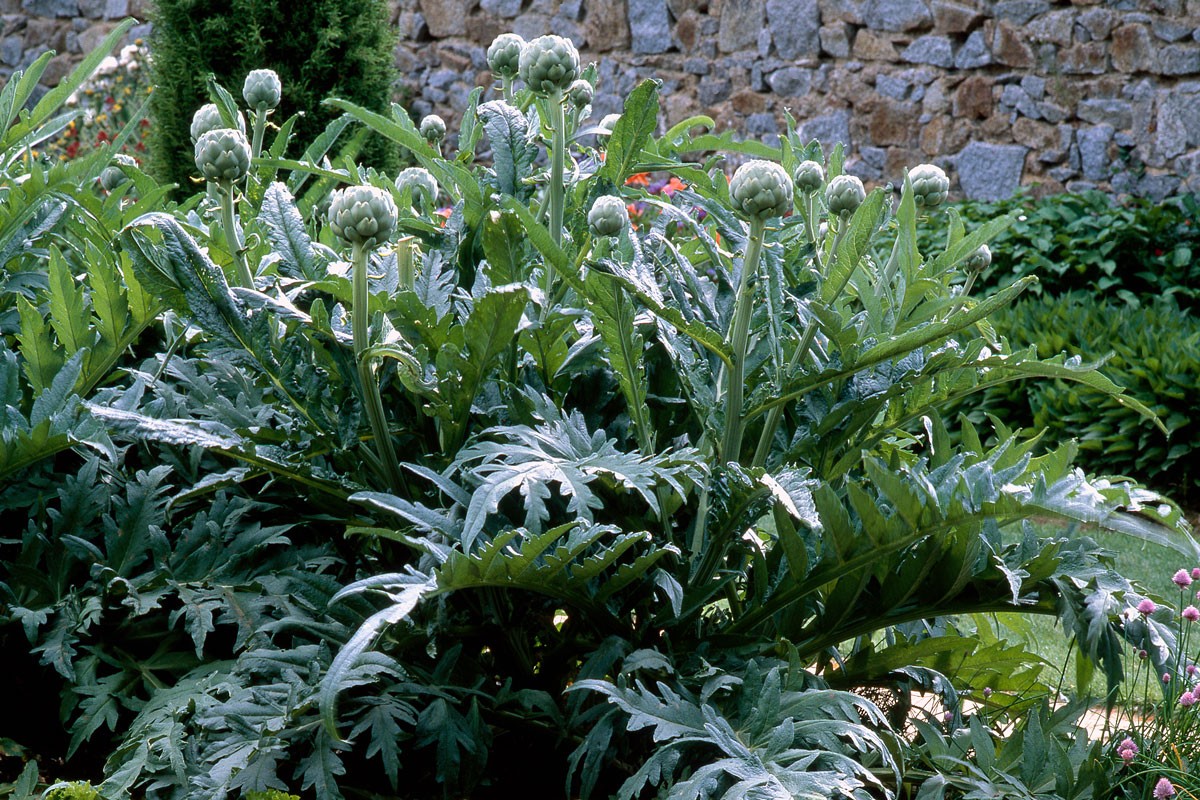
COULANGES/Shutterstock.com
Facts and figures
Planting & harvest times of Artichoke
SpringTransplant to bed from Mid April to Late April. Pre-grow about 40 days before planting out, approximately between Early March and Mid March. After a growing period of 120 days, harvest can begin around Early July and continues until Late October.
SpringAfter a growing period of 120 days, harvest can begin around Mid June and continues until Late October next year.
Plant Artichoke
Sow 3 seeds per pot about 6 cm deep and then keep only the strongest plant. Once it has about 3 to 5 true leaves in April, you can plant it out.
Normally you start them indoors from early to mid-March to plant them out from mid to late April. The timing given here refers to perennial cultivation. The artichoke usually flowers in its first year too, but in July and with far fewer buds. To get a richer harvest you need to overwinter the plants. The plant reaches the peak of its flowering abundance around its 4th year. After that it declines noticeably. Over the years you can also take offsets from the mother plant, grow them on in a pot until they're ready to plant out, and propagate them that way.
You can try to get a rich harvest from the artichoke in its very first year. For that you need to start them indoors from early to late January and then plant them out in mid to late April. They'll flower as early as June and with more buds. That's how it's done in commercial annual cultivation.
Location and soil
The artichoke needs a warm, fully sunny and sheltered spot with deep, nutrient-rich soil. Prepare the soil with a generous amount of compost or well-rotted manure. And it needs space — about one square metre.
Good and bad companions of Artichoke
Predecessors and successors of Artichoke
Care and fertilising
The artichoke likes a warm, humid climate. You can't do much about the weather. So keep the plants consistently moist but without waterlogging, and maybe mist the leaves now and then. One or two feeds before flowering in June/July will also be appreciated.
You can of course also overwinter artichokes that were started in January. To overwinter outdoors you need a mild, wine-growing climate. Either cut back the leaves without touching the heart leaves, or tie them loosely together at the top. Then mound up soil around the base and cover with a layer of leaves on the outside. With this method you need to uncover the plants again in mid to late April. Alternatively, dig up the plant, trim the leaves and overwinter it in a box with damp sand in a cool cellar, garage or greenhouse with frost protection. Don't let it dry out.
You can even try growing it in a pot. But it needs to be a really large and tall pot, since the artichoke develops a long taproot. So at least 50 litres. Then you can overwinter it, pot and all, in damp sand. The artichoke can handle down to -5°C. But young seedlings can't take that yet.
Harvest and processing
Harvest begins with early sowing at the end of June, with the main harvest in July/August. With later sowing it starts at the end of July, with the main harvest in August/September. In the following years it'll be somewhere in between. Harvest the topmost buds of the artichoke first. Pick them when the bracts are still closed but the tips are starting to turn brown. Further down, the buds get a bit smaller. But you can collect them all. The buds keep in the fridge for about 2 weeks. Cook the buds for about half an hour in salted water and serve with all kinds of dips. Pull off the individual bracts, which come away easily after cooking, dip the fleshy lower part into the dip of your choice, and scrape it off with your teeth. You don't eat the tough upper part of the bract. At the end, when you reach the fibres — the so-called choke — remove them. Underneath is the artichoke heart. Cut it into pieces depending on size and eat it with dip as well. Enjoy!