
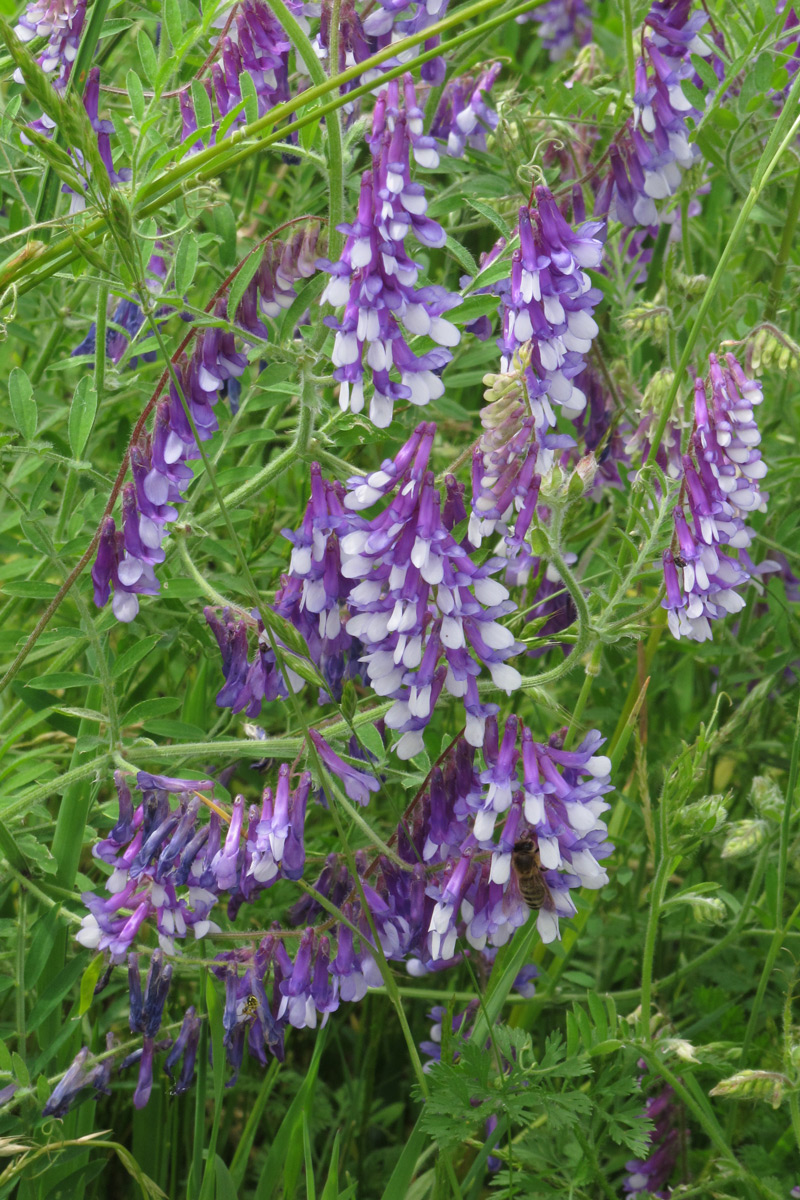
Hairy vetch is one of the most valuable green manure plants in organic gardening. This annual to biennial legume from the pea family (Fabaceae) originally comes from southern Europe and western Asia, where it grows wild along roadsides and in fields. In the garden, it has one clear job: getting the soil into shape for the next season.
The secret of hairy vetch lies in its roots. Like other legumes, they host nodule bacteria of the genus Rhizobium, which capture nitrogen directly from the air and convert it into a form that plants can use. After a crop of hairy vetch, you can often skip nitrogen fertilisation entirely for the following crop.
Then there's its impressive root system. With taproots reaching down to 80 cm, hairy vetch breaks through compacted soil layers and leaves behind fine channels that let water and air penetrate the soil more easily. Its densely hairy stems and leaves form a lush ground cover that suppresses weeds effectively and protects the soil from wind and rain. During mild spells, it keeps growing even through winter and can reach up to 200 cm tall in spring.
A nice bonus: the violet-blue butterfly-shaped flowers are a real feast for insects. Honeybees, bumblebees and especially solitary bees like Osmia acuticornis are drawn to them. If you leave the hairy vetch standing until just before it flowers, you're doing the pollinators a favour too.
Facts and figures
Planting & harvest times of Hairy vetch
Direct sowing from Early August to Late September.
Sow Hairy vetch
Hairy vetch is always direct-sown — starting it indoors isn't necessary and doesn't make sense. The classic sowing window is between mid-August and the end of September. This gives the plants enough growing time to root in well before winter. If you sow as late as October, you risk the plants going into winter too weak. Sowing from July for summer ground cover or from April as a spring cover crop is also possible, but its main use remains as a winter catch crop.
For sowing, loosen the soil and roughly clear away any plant debris. The seeds go 2 to 5 cm deep and need good soil contact to germinate. The simplest method in the garden is broadcasting: spread about 6 to 8 g of seed per square metre evenly and rake it in lightly. After sowing, keep the soil moist until germination is complete. Germination works down to about 8 °C soil temperature.
Hairy vetch likes to climb and in a pure stand often flops flat on the ground. For upright growth, it helps to have a support plant. The classic combination is the vetch-rye mix: hairy vetch and winter rye in a ratio of roughly 3:1. The rye gives the vetch something to hold onto, and both complement each other in the soil perfectly. Ready-made organic mixes are available in shops.
Location and soil
Hairy vetch has remarkably low demands when it comes to its growing spot. It thrives equally well on sandy, loamy and medium-heavy soils. Avoid waterlogging — it feels most at home in loose, well-drained soil. The nitrogen-fixing nodule bacteria work most efficiently in slightly acidic to neutral conditions.
When it comes to light, hairy vetch is easy-going: sunny to partially shaded positions are perfectly fine. It's also tolerant of varying moisture levels. Once established, it manages well without extra watering. On nutrient-poor or exhausted soils where other plants struggle, hairy vetch really comes into its own and brings nitrogen back into the ground.
Good and bad companions of Hairy vetch
Hairy vetch isn't a plant you tuck in individually between tomatoes or lettuce. As a green manure, it usually takes over the whole bed. Still, there are plants it gets along with brilliantly and others that really don't suit it at all.
The best partner for hairy vetch is winter rye. In this classic combination — the vetch-rye mix — the upright-growing rye gives the scrambling vetch a natural climbing support. In return, the rye benefits from the nitrogen that the vetch provides through its nodule bacteria. This partnership works particularly well on light, sandy soils.
All other legumes make poor neighbours. Peas, beans and field beans use the same nodule bacteria but are susceptible to the same fungal diseases like sclerotinia or anthracnose. If you grow several legumes on the same patch, disease pressure rises noticeably.
Predecessors and successors of Hairy vetch
In crop rotation, hairy vetch has a clear role: it sits between two growing years and prepares the soil for the next crop. You sow it after the summer or early autumn harvest, it overwinters, and you work it into the soil in spring.
It's ideal after heavy feeders that have depleted the soil. Tomatoes, peppers, all types of cabbage, squash, courgettes and potatoes often leave nutrient-poor beds behind — exactly the right situation for hairy vetch. It also makes sense after radishes or lettuces if you're planning to grow a heavy feeder the following year.
As a follow-on crop after incorporated hairy vetch, nutrient-hungry plants benefit the most. Tomatoes, squash, courgettes, cucumbers and all brassicas find an optimally prepared bed after vetch. Sweetcorn also shows notably better yields after hairy vetch — that's even well documented scientifically. Potatoes, celeriac and leeks also appreciate the nitrogen-enriched soil.
No other legumes should follow hairy vetch: no peas, no beans, no field beans. The gap between legume crops should be at least three to four years. The same applies in reverse — don't sow hairy vetch on a bed where peas or beans have just been growing.
Varieties
For home gardeners, hairy vetch is usually sold as straightforward species seed without a specific variety name. For agricultural use, there are bred varieties like Hungvillosa, which is mainly used in the Landsberg mixture, or Welta with a particularly high dry matter yield. These varieties aren't necessary for the home garden, and they're not easy to find either.
What's worth looking at is ready-mixed vetch-rye seed, which several suppliers offer. These blends of hairy vetch and winter rye save you the hassle of measuring out the individual components and are especially handy for beginners.
Care and fertilising
Hairy vetch is basically a plant you sow and then leave alone. After germination, it needs no fertilising. You don't usually need to water it after it's established either.
The only thing that really matters is working it into the soil in spring. The best time for this is just before or at the start of flowering, usually in April or May. By then the plant has built up maximum biomass and the fixed nitrogen is optimally available. This naturally depends on when you need to sow or plant the actual crop on the bed. Cut or chop the plants down, shred them (a lawnmower helps on small areas) and work the material shallowly into the top 5 to 10 cm of soil. Burying it too deeply leads to rotting rather than clean decomposition.
After incorporation, the bed should rest for at least two weeks — longer in cool temperatures. During this time, nitrogen is gradually released and becomes available for the following crop. Alternatively, you can simply leave the mown material as a mulch layer and push it aside when planting.
Make sure you work the hairy vetch in well before the seeds ripen. Otherwise it self-sows and pops up everywhere you don't want it the following year.
Diseases and pests
Hairy vetch is a robust plant overall, and you don't need to worry much about diseases. Since it's used as green manure, a mild infestation isn't a big deal anyway.
Aphids can appear in unfavourable weather, but they don't cause any real damage on a green manure crop. Ladybirds and hoverflies take care of most of it on their own. The leaf weevil nibbles typical semi-circular patterns along the leaf edges — again, nothing to worry about with green manure.
Fungal diseases are more serious, especially when the legume rotation is too tight. Vetch rust and anthracnose (Ascochyta) are encouraged by short breaks between legume crops. Sclerotinia (Sclerotinia sclerotiorum), also known as white mould, deserves particular attention: hairy vetch is a host plant for this fungus. If your crop rotation includes plants that are also susceptible to sclerotinia (certain brassicas, lettuce), keep an eye on how much vetch you're growing.
The best prevention against all these problems is a consistent crop rotation with at least three years between legume crops.
Harvest and processing
Hairy vetch isn't harvested or eaten. It's purely a green manure plant, and all its biomass goes back into the soil. The seeds are mildly toxic when raw (they contain cyanogenic glycosides and lectins) and aren't suitable for consumption.