
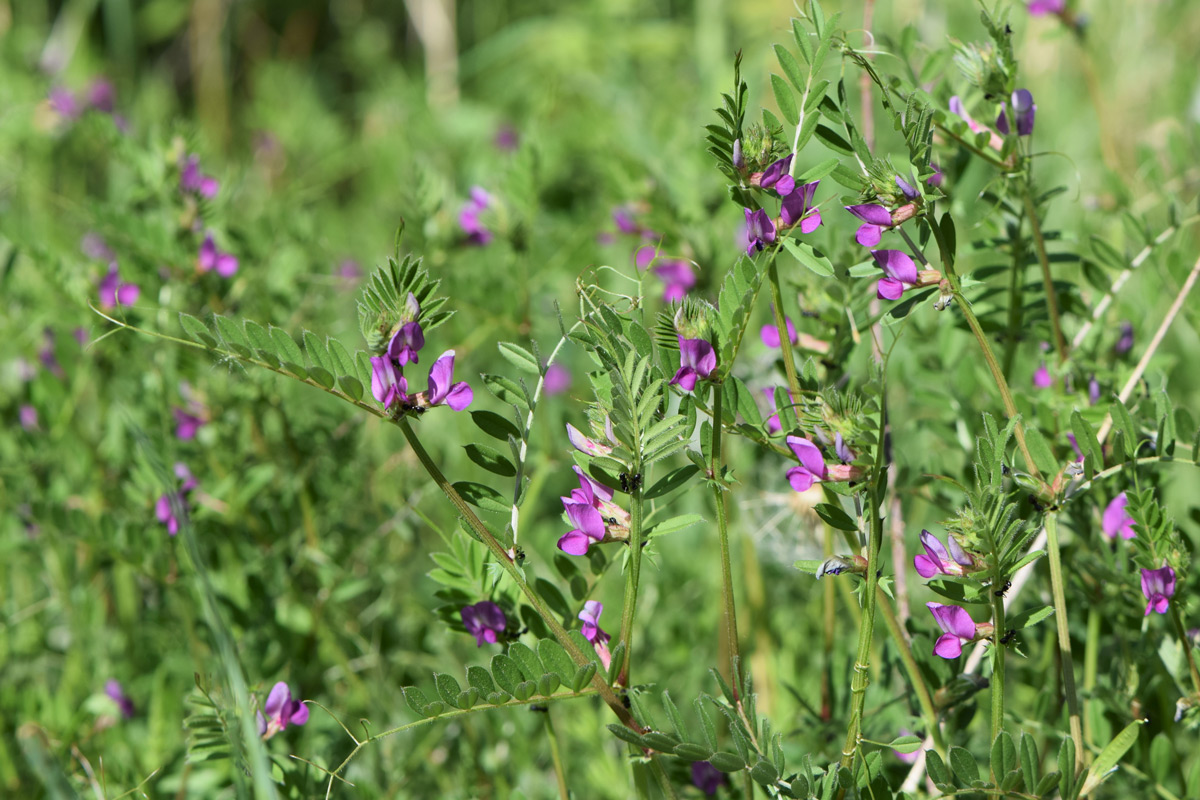
Common vetch belongs to the legume family (Fabaceae) and originally comes from the Mediterranean region. In our gardens, it's mainly known and valued as a green manure plant. Tiny nitrogen-fixing bacteria sit on its roots, capturing nitrogen directly from the air and making it available in the soil.
This annual plant climbs to a height of 30 to 100 cm with its feathery leaves. From June to October, it produces pretty purple to violet butterfly-shaped flowers that bees and bumblebees love. As a green manure, it covers bare beds quickly and reliably, loosens compacted soils with its root system and suppresses weeds. After dying back in the autumn frost, it stays on the ground as a natural mulch layer, or you can dig it in at full bloom so the nutrients benefit the following crops.
In the companion planting garden, common vetch plays a special role: you don't eat it, but it works for your soil fertility. Between soft fruit like blackcurrants or blackberries, it also works well as an underplanting that protects the soil and supplies nitrogen at the same time.
Facts and figures
Planting & harvest times of Common vetch
Direct sowing from Early April to Late August.
Sow Common vetch
Common vetch is always sown directly into the bed. There's no need to start it indoors, and for a green manure plant it wouldn't make sense either. Scatter the seeds broadcast across the area and then rake them in to a depth of about 2 to 5 cm. You'll need roughly 10 to 12 g of seed per square metre.
You can sow from April to August. The rule of thumb is: sow whenever a bed is free and there are still at least 8 to 10 weeks until the first frost. If you're sowing early in spring, watch out for possible late frosts, as common vetch isn't winter hardy. Germination starts from about 2 °C, with the optimum temperature between 8 and 15 °C. With consistent soil moisture, the first seedlings appear after 7 to 14 days.
Sowing in a mix with other green manures works particularly well. If you sow it together with a partner like phacelia or mustard, reduce the sowing rate of each species to about 60 to 70 per cent of the normal amount.
Location and soil
Common vetch is really undemanding when it comes to its spot in the garden. It feels most at home in full sun but can cope with light partial shade too. It's hardly fussy about soil: medium to heavy, chalky loam soils are ideal, but sandy soils work as well, though they'll produce less plant mass.
As a legume, common vetch supplies itself with nitrogen through its root nodule bacteria. Extra fertilising isn't just unnecessary, it's actually counterproductive because it would disrupt the symbiosis with the bacteria. Avoid waterlogging, but otherwise this plant is truly low-maintenance.
Good and bad companions of Common vetch
Phacelia is an excellent partner for common vetch. The two complement each other brilliantly: while the vetch enriches the soil with nitrogen, phacelia loosens deeper soil layers with its roots. Together they also make a fantastic bee pasture. Just take care not to sow too densely, or the phacelia can smother the vetch.
Mustard combined with common vetch provides rapid ground cover and helps with nematode control. However, don't choose this mix if you're planning to grow cabbage or other brassicas on the bed afterwards. Sunflowers give the climbing vetch support and attract plenty of insects.
Common vetch doesn't get on well with other legumes. Peas, bush beans, runner beans and field beans belong to the same family and share the same pathogens and pests. Growing them together brings no extra nitrogen benefit and only increases disease pressure.
Predecessors and successors of Common vetch
Common vetch is practically the ideal preceding crop for all heavy feeders. Brassicas like white cabbage, broccoli, red cabbage and kale benefit the most from the fixed nitrogen and improved soil structure. Potatoes also demonstrably thrive better on a bed that was previously green-manured with common vetch. Tomatoes, peppers, pumpkin and courgette as further heavy feeders can also make good use of the enriched nitrogen.
You can use common vetch after practically any non-legume. It fits especially well after brassicas, whose heavily depleted soil benefits from the nitrogen enrichment and root loosening. After potatoes or nightshades like tomatoes, it's also a good choice for soil regeneration.
Avoid growing common vetch after other legumes such as peas or beans, as specific pathogens may have built up in the soil. Red clover shouldn't follow directly after common vetch either. Leave at least 3 to 4 years between two common vetch crops on the same plot.
Varieties
In the home garden, common vetch is usually sold as straightforward green manure seed without a named variety. The variety 'Ebena' is widely used in agriculture and stands out for its fast growth and broad leaves that cover the ground quickly. It also copes well on lighter soils and reliably dies off in winter. For green manuring in the home garden, choosing a specific variety isn't usually necessary.
Care and fertilising
Common vetch supplies itself with nitrogen and normally needs no attention once it's up. During the early growth phase, a bit of water helps if there's a prolonged dry spell, but after that it manages with natural rainfall.
The right moment for incorporating it is crucial. When the plants are in full bloom and just starting to form pods, the nitrogen content is at its highest. At that point, mow the plants down, leave the material as a mulch layer for a few days, then work it into the soil 5 to 10 cm deep. Wait at least 2 to 3 weeks after that before planting the next crop.
Very important: don't let the plants stand until the seeds are ripe! Otherwise vetch will pop up uncontrollably everywhere the following year, and the stems turn woody and decompose only slowly. If you've sown in autumn and don't incorporate before winter, the plants will be killed by the first hard frost and remain as a natural mulch. In spring, you simply rake the remains in lightly.
Diseases and pests
Since common vetch in the garden almost exclusively serves as green manure and gets incorporated before seed maturity, diseases and pests are rarely a real problem. That said, infestations can still occur.
Aphids (Aphidoidea) are the most common visitors. They suck on the shoot tips, which you'll notice from curled leaves. Usually it's enough to encourage natural predators like ladybirds and lacewing larvae. For heavier infestations, a nettle brew helps. Vetch rust (Uromyces viciae-fabae) shows up as orange-brown pustules on leaves and stems and appears mainly in warm, humid weather. A good crop rotation with at least 3 to 4 years between legumes is the best prevention. Leaf spot (Ascochyta spp.) can also appear in cool, damp conditions, recognisable by dark, sunken spots on stems and pods.
Harvest and processing
As a green manure plant, common vetch is normally not harvested but mown at full bloom and worked into the soil. The seeds of common vetch are technically edible, though they contain mildly toxic alkaloids when raw. For eating, you always need to soak them well and cook them thoroughly, similar to lentils. In the home garden, this use hardly plays a role though.
Open the bed planner Try free for 7 days, web, iOS and Android