
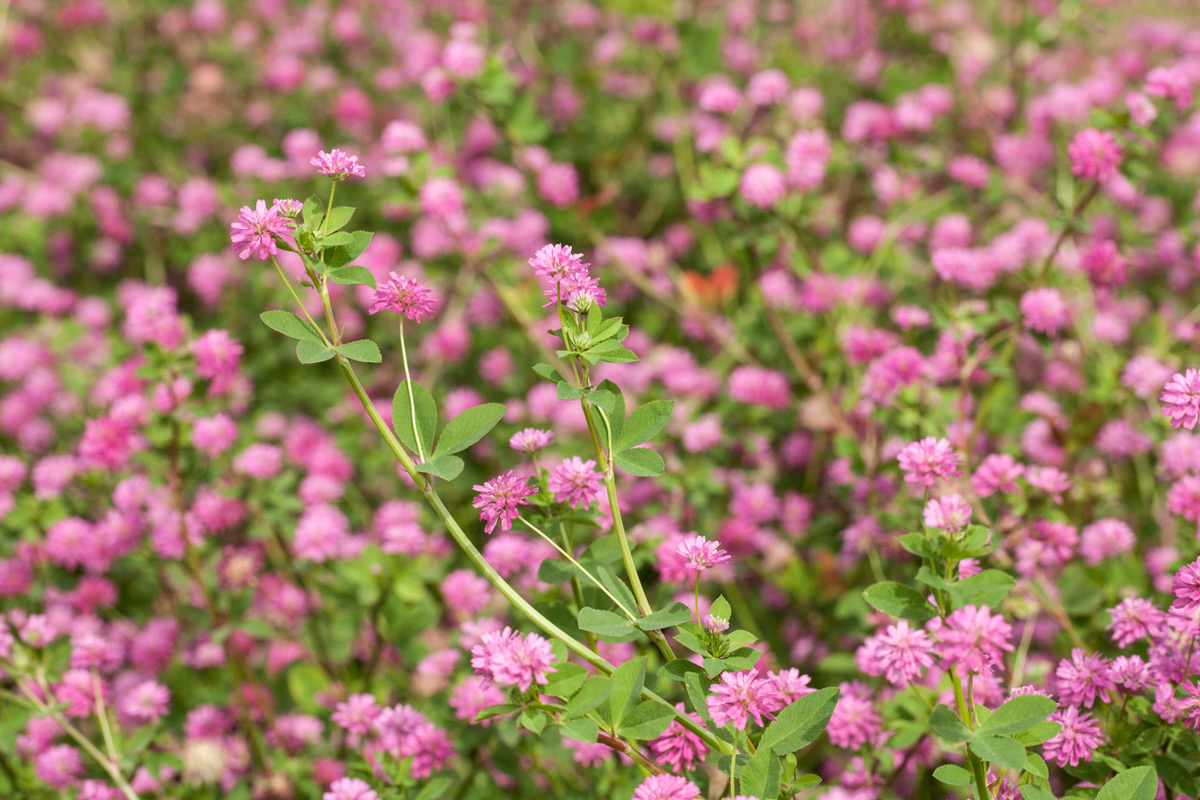
Persian clover is a legume and originally comes from the eastern Mediterranean and the Near East. Farmers have valued it for decades as a catch crop and fodder crop, but in the home garden it still leads a quiet existence. That's a shame, because as a green manure it has pretty much everything going for it: it fixes atmospheric nitrogen via root nodule bacteria, loosens the soil with its strong taproot, suppresses weeds by closing over the ground quickly, and draws in bees and bumblebees with its honey-scented flowers.
The botanical species name resupinatum reveals a charming quirk: before opening, the flowers twist through 180 degrees so that the keel points upwards and the standard points downwards. From May to September it produces pink to violet, ball-shaped flower heads up to 2 cm across. The three-part leaves with finely serrated edges look a lot like those of the better-known white clover. Depending on the site, Persian clover grows 10 to 60 cm tall, though it usually sprawls low across the ground and covers the soil like a living blanket.
In the vegetable garden, Persian clover really shines as a soil worker. It fills gaps between main crops, enriches the soil with nitrogen and, once it's killed off by winter frost, leaves behind a protective mulch layer. The following crop benefits from the nitrogen it leaves in the bed.
Facts and figures
Planting & harvest times of Persian clover
Direct sowing from Early April to Late September. Incorporation takes place around Early June until Late December.
Sow Persian clover
Persian clover is only ever sown directly into the bed; raising it indoors is neither necessary nor sensible. Broadcast the fine seed over a finely crumbled bed. A capped, crusted surface slows germination. Then rake the seed in lightly or press it down so it gets good contact with the soil. Sowing depth is 1 to 2 cm.
You can sow from April to August, as long as the soil stays free of frost. The minimum germination temperature is around 5 °C, and it germinates best at 15 to 25 °C. In mild regions you can sow until mid-September and use the Persian clover as a winter cover that dies off in the frost. The first seed leaves often appear just three days after sowing, which is remarkably fast for a green manure plant. You only need a few grams of seed per square metre. When undersowing beneath main crops, sow a little more sparingly than for a pure stand.
Location and soil
Persian clover does best in full sun but also tolerates partial shade. That makes it particularly interesting as an undersown crop beneath taller plants such as tomatoes or maize. It's pleasingly undemanding when it comes to soil. It likes nutrient-rich loam to clay soils most, but sandy, free-draining soils work well too. The only thing to avoid is persistent waterlogging. If you have heavy clay, loosen it a little before sowing.
The ideal pH is between 6.0 and 7.5. On acidic soil, liming before sowing is worthwhile because the nodule bacteria work less effectively in acidic conditions. Despite its Mediterranean origins, Persian clover needs quite a lot of water while young. Well-established stands, though, cope fine with short dry spells.
Good and bad companions of Persian clover
Persian clover isn't a classic companion plant that you deliberately place next to a particular row of vegetables. Its value lies in acting as a living mulch and soil improver. It works well undersown beneath tomatoes and peppers: it keeps the soil moist, suppresses weeds and tops up nitrogen through its nodule bacteria. Just cut it back if it gets too close to the main crops. It also does well undersown beneath maize, where it prevents erosion and supplies the soil with nitrogen at the same time.
Other legumes such as beans, peas or other clover species make poor neighbours, though. They compete for the same strains of nodule bacteria and cancel out each other's nitrogen-fixing effect. Growing legumes repeatedly on the same ground also raises the risk of legume fatigue and clover rot.
Predecessors and successors of Persian clover
In the crop rotation, Persian clover takes on the role of a green manure. It takes hardly anything from the soil and leaves behind far more than it uses. It works especially well after maize or medium feeders such as carrots, fennel or kohlrabi, because it can then regenerate the soil and get it ready for the next season.
After Persian clover, heavy feeders in particular enjoy the extra nitrogen: brassicas such as broccoli, cauliflower or white cabbage, but also leeks, tomatoes, peppers, courgettes and squash make the best use of that nitrogen reserve. Medium feeders such as carrots, beetroot or fennel are good successors too.
You should definitely avoid Persian clover where other legumes grew previously or where they're planned for the following year. After growing clover, allow at least 3 to 4 years before clover grows on the same ground again. The same rule applies to beans and peas, though the risk is somewhat lower.
Varieties
You'll find a few proven varieties at garden retailers. 'Gorby' proved particularly strong in Swiss trials: fast early growth, strong competitiveness and good resistance to black blotch. 'Laser' is fine-stemmed and leafy, suits chalky soils particularly well and is often used as a base for mulch sowing. 'Maral' is widely available in German-speaking countries and a solid all-round variety for green manure and bee forage. Since Persian clover mainly serves as a green manure, differences between varieties matter little in the home garden.
Care and fertilising
Persian clover is one of the easiest green manure plants to look after. During germination, keep the soil evenly moist, because the fine seed on the surface dries out quickly. Once the stand has closed over densely, it copes with less water.
If the Persian clover grows too vigorously, simply cut it back to about 5 cm with shears or the lawnmower. This encourages branching and stops it setting seed. If you don't want it to self-seed, cut it before it comes into full flower.
To work it in as a green manure, mow the plant mass shortly before or during flowering and incorporate it shallowly into the soil. As with all legumes, leave the roots in the ground to rot down; they add extra organic matter and keep loosening the soil. If sown in autumn, the stand dies off over winter and forms a natural mulch blanket that you can simply rake in come spring.
Diseases and pests
Compared with other clovers, Persian clover is fairly robust against disease. One clear advantage: stem and bulb nematodes don't attack it, which makes it a better choice than red clover on infested ground.
The most common fungal disease is black blotch (Cymadothea trifolii). Small black spots form on the underside of the leaves, while the upper side shows yellow patches. Infected leaves curl up and die. If you spot this, mow the area and remove the plant material. The variety 'Gorby' is considered not very susceptible.
Clover rot (Sclerotinia trifoliorum) can in principle affect all clover species, but it hits Persian clover far less often than red or white clover. Typical signs are whitish-grey fungal growth on the stems and patchy gaps in the stand. The fungus's resting bodies survive in the soil for years. The most important prevention: keep breaks of 3 to 5 years between clover crops and use certified seed.
Harvest and processing
Persian clover isn't harvested for eating. It serves as a green manure, a source of mulch and bee forage. To use it as a green manure you have two options: either mow the stand after about 6 to 8 weeks, shortly before or during flowering, and work the mass shallowly into the soil. Or leave a stand sown in late summer standing until it dies off in winter, then rake the mulch blanket in during spring. The mown biomass also makes excellent mulch for other beds. This way you protect the soil and release organic matter slowly. If you keep animals, you can use the protein-rich greenery as fodder too; horses and other livestock happily eat Persian clover. Don't feed it to animals, though, if it's heavily affected by black blotch. One particularly valuable trait is its role as bee forage: the flowers produce nectar that's especially rich in sugar and, even from a late sowing, provide food for wild bees, bumblebees and honeybees well into autumn.