
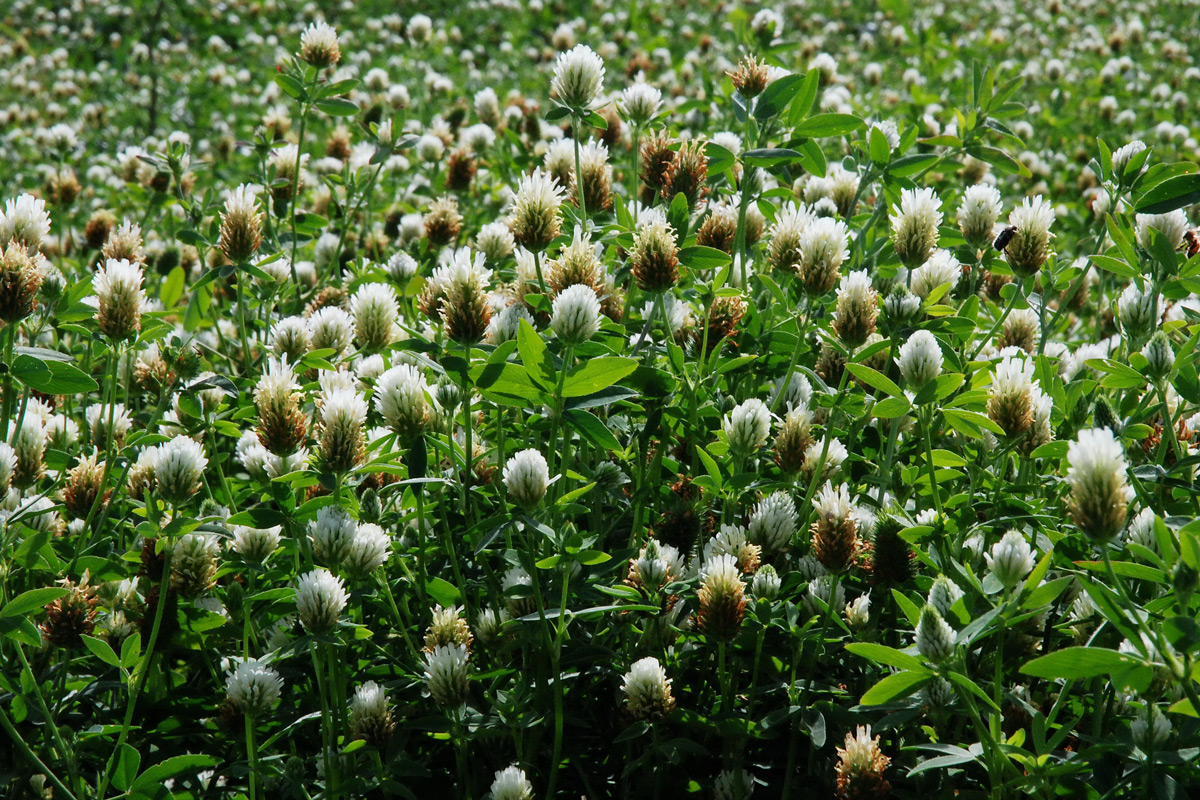
Berseem clover originally comes from the Mediterranean region and has been grown in Egypt for thousands of years. It takes its name from the city of Alexandria. In our climate it has been established as a green manure plant since the 1950s, and it does quiet but effective work for the soil in the vegetable garden.
As an annual legume from the pea family, berseem clover differs clearly from its perennial relatives such as red or white clover. Its upright, hollow stem grows 60 to 100 cm tall and branches well. The leaves are elongated-oval, and in summer whitish to pale yellow flower heads appear that attract honeybees and wild bees.
What makes berseem clover so valuable as a green manure is its combination of speed and performance. In just six to eight weeks it builds up a considerable amount of plant mass. Through its symbiosis with nodule bacteria (rhizobia) it fixes nitrogen from the air and makes it available in the soil. Its taproot pushes into deeper soil layers and loosens compacted areas naturally. After the first hard frost it dies off reliably and leaves behind a mulch layer that you can easily work in come spring.
Facts and figures
Planting & harvest times of Berseem clover
Green manureDirect sowing from Mid April to Late May. Incorporation takes place around Early September until Late November.
Green manureDirect sowing from Mid July to Late August. Incorporation takes place around Early October until Late November.
Sow Berseem clover
Berseem clover is always sown directly outdoors. In spring you can sow from mid-April, as soon as the soil is at least 8 °C and has dried out well. As a catch crop after harvested early vegetables, the best time is from July to early August, mid-August at the latest, so the plants can still build up enough mass before the first frost.
The bed should be finely crumbled and well settled; coarse clods of earth slow down germination. The seeds go 1 to 2 cm deep into the soil. For broadcast sowing in the home garden, reckon on about 20 to 25 g per square metre. Important: after sowing, firm down or roll the area well so the seeds get good contact with the soil. With enough moisture, the first seedlings show after 7 to 14 days.
In cooler areas or with a late spring sowing, it's worth waiting until after the last frosts in mid-May. The young seedlings are sensitive to late frost. If it stays dry after sowing, water carefully, because berseem clover needs even moisture especially in its early stages.
Location and soil
Berseem clover is a Mediterranean plant and loves warmth and sun. In a spot in full sun it performs far better; in partial shade it grows more slowly and produces less biomass. It doesn't like heavy clay soils or waterlogging.
For nitrogen fixation via the nodule bacteria, the soil needs a pH between 6.0 and 7.5. In soils that are too acidic, the rhizobia don't settle in properly and the whole green manure effect fizzles out. A good basic supply of phosphorus and potassium also helps, whereas extra nitrogen fertiliser is counterproductive, because too much nitrogen in the soil inhibits nodule formation.
Good and bad companions of Berseem clover
Berseem clover is usually sown as a green manure on empty bed areas rather than planted directly between rows of vegetables. In some situations, though, you can use it along bed edges or between wider rows. Brassicas such as white cabbage or kohlrabi, being heavy feeders, benefit from the nitrogen enrichment when the clover grows nearby. Carrots with their deep roots hardly compete with the clover and appreciate the ground cover against weeds. Onions also benefit from the dense ground cover, which holds moisture and suppresses weeds.
Berseem clover gets on badly with other legumes such as beans, peas or broad beans. There's a risk of so-called legume fatigue with clear losses in growth, and diseases are shared between them.
Predecessors and successors of Berseem clover
The great strength of berseem clover lies in crop rotation. It leaves behind fixed nitrogen, organic matter and a loosened soil structure that the next crop benefits from straight away. Heavy feeders such as cabbage, squash, courgettes and tomatoes in particular are ideal follow-on crops and can make good use of the nitrogen reserve. On a larger scale, sweetcorn is also a grateful successor.
Under no circumstances should other legumes follow berseem clover, so no beans, peas or lentils. You should also let at least three to four years pass before sowing clover again on the same area, to avoid clover rot and other rotation diseases. Conversely, other clover species and legumes are also poor predecessors for berseem clover.
Varieties
The range of berseem clover varieties is fairly small. For green manure in the garden, almost exclusively multi-cut varieties are used. The variety 'Tabor' stands out for particularly fast early growth and early flowering, which makes it interesting for short growing windows. 'Otto' is a solid all-round variety with good standing ability. When buying seed, it's worth checking the thousand-seed weight: values between 2.7 and 3.2 g point to multi-cut varieties that are suitable for green manure.
Care and fertilising
Berseem clover is extremely low-maintenance and needs hardly any attention once it has emerged. In the early stages, enough soil moisture matters; later on, the stand copes well on its own.
If you want to use the clover as bee forage, leave it standing until full bloom. If it's meant to serve more as a living mulch layer, you can cut it back to about 6 to 7 cm before flowering, which encourages fresh growth.
Working it in as green manure is best done shortly before or at the start of flowering, so around six to eight weeks after sowing. At this point the ratio of carbon to nitrogen in the plant mass is at its most favourable, and the nutrients are released quickly after mixing in. Work the material shallowly into the soil, 5 to 10 cm deep at most. After working it in, wait two to three weeks before planting the next crop so that the so-called nitrogen lock-up has passed.
Diseases and pests
Clover rot (Sclerotinia) is the most important fungal disease and attacks the stem base and leaves, especially in damp weather. Prevention works best through a wide crop rotation with at least three to four years' break between clover species. A stand that isn't too dense and good airflow also help.
Black stem of clover occurs under persistently damp conditions. Northern anthracnose (Kabatiella caulivora) survives on plant debris but is less of a problem in annual berseem clover than in perennial clover species. Mildew shows up occasionally, above all when a dry spell follows a wet period.
Among the pests, aphids can slow growth if they turn up in large numbers. Beneficial insects such as ladybirds and hoverflies normally keep the population in check. Clover seed weevils (small weevils) and pea and bean weevils also occur, but hardly cause any notable damage in healthy stands. Stem and bulb nematodes (Ditylenchus dipsaci) can be avoided through wide crop rotations.
Harvest and processing
Berseem clover doesn't end up on the plate; its harvest is being worked into the soil. You catch the best moment shortly before or at the start of flowering, when the plant mass has reached its maximum and the carbon-to-nitrogen ratio is at its most favourable. This should happen two to four weeks before planting the next crop. You can also add cut plant material to the compost. The high nitrogen content of the still-young plant parts acts as a natural activator there and speeds up decomposition. As bee forage, it's best to leave the stand until full bloom before working it in. The nectar-rich flowers are prized by honeybees and wild bees alike.