
Other names
common spinach, garden spinach
Botanical name
Spinacia oleracea
Family / Genus
Amaranthaceae / Spinacia
Plant category
Leafy Vegetables, Green manure
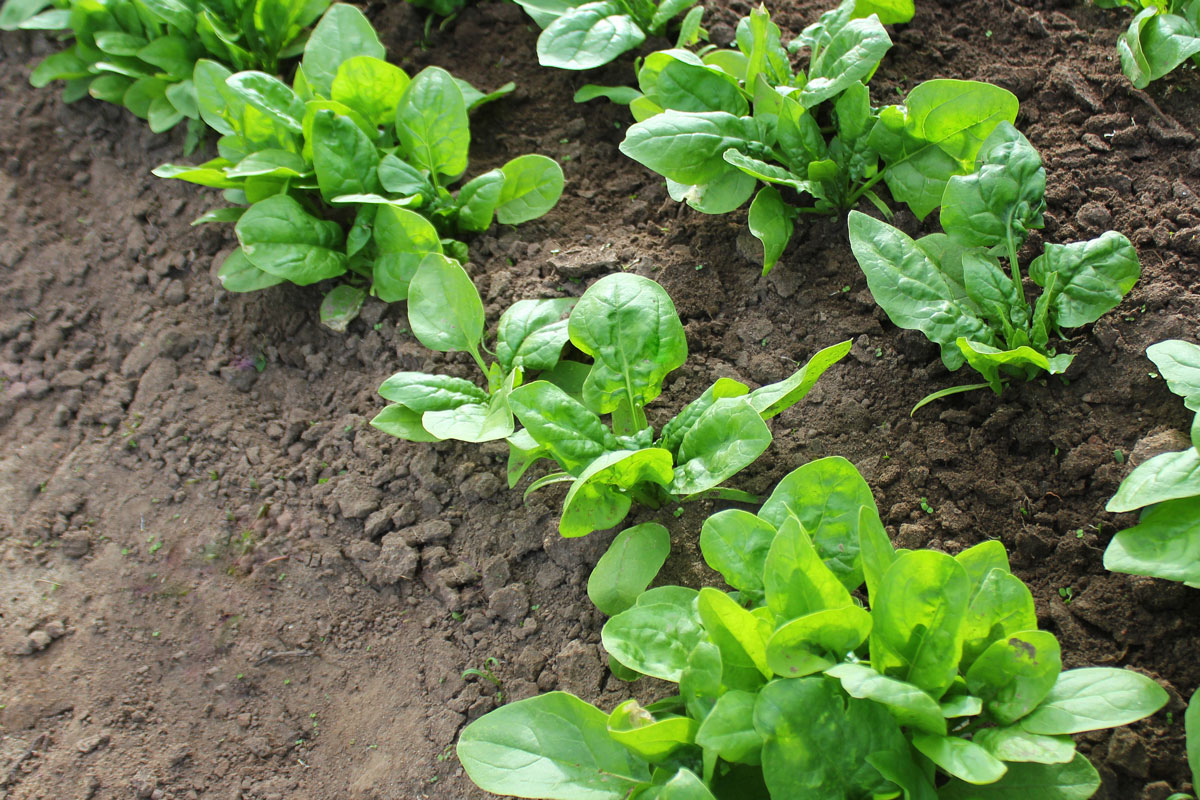
vaivirga/Shutterstock.com
Facts and figures
Light requirements
Sun / partial shade
Nutrient requirements
Medium feeder
Difficulty level
Easy
Culture (according to Gertrud Franck)
C - low growth, short growing period
Culture (according to Sister C. Weinrich)
Companion crop
Green manure
Binds soil nitrogen to prevent leaching
Growing period
50 - 60 days
Row spacing
25 cm
Plant spacing
5 cm
Growth height
15 - 30 cm
Sowing depth
2 cm
Germination temperature (minimum)
2 °C
Germination temperature (optimal)
10 - 20 °C
Germination type
Light and dark
Planting & harvest times of Spinach
1
2
3
4
5
6
7
8
9
10
11
12
Direct sowing
Harvest
Harvest (next year)
GreenhouseDirect sowing from Late February to Mid April. After a growing period of 50 days, harvest can begin around Mid April and continues until Mid June.
SpringDirect sowing from Early April to Late April. After a growing period of 50 days, harvest can begin around Mid May and continues until Mid July.
WinterDirect sowing from Late August to Mid September. After a growing period of 60 days, harvest can begin around Mid October and continues until Late March next year.
Good and bad companions of Spinach
Good neighbours
Broccoli
Spinach between young cabbage is said to keep flea beetles away.
Evidence quality: moderate
Evidence: Long-standing companion planting practice (e.g. Gertrud Franck, Schwester C. Weinrich)
Reasons:
- Pest control through scent or camouflage
Cauliflower
Spinach between the rows covers the soil until the cauliflower is big. Then it is hoed off and left as mulch.
Evidence quality: good
Evidence: Long-standing companion planting practice (e.g. Gertrud Franck, Schwester C. Weinrich)
Reasons:
- Pest control through scent or camouflage
- Practical tip for this pair
Cucumber
Spinach sown early between the cucumber rows is harvested before the cucumbers need the space. It should not stay longer, as both can catch cucumber mosaic virus.
Evidence quality: good
Evidence: Long-standing companion planting practice (e.g. Gertrud Franck, Schwester C. Weinrich)
Reasons:
- Practical tip for this pair
Kale
Evidence quality: moderate
Evidence: Long-standing companion planting practice (e.g. Gertrud Franck, Schwester C. Weinrich)
Melothria
Spinach is considered a good neighbour for cucumbers. For the related Melothria this is only carried over; it sprawls vigorously and often does better on its own.
Evidence quality: moderate
Evidence: Long-standing companion planting practice (e.g. Gertrud Franck, Schwester C. Weinrich), Derived from plant family or pathogen, pair not directly documented
We found conflicting sources. This is our current assessment.
Radish
Radishes fit between rows of spinach. Spinach is said to keep flea beetles away from the radishes, but you cannot rely on it.
Evidence quality: moderate
Evidence: Long-standing companion planting practice (e.g. Gertrud Franck, Schwester C. Weinrich)
Reasons:
- Pest control through scent or camouflage
Bad neighbours
Strawberry spinach
Both belong to the amaranth family and share the same diseases.
Very bad neighbours
Predecessors and successors of Spinach
Good predecessors
Batavia lettuce
Lasting effect: 3 years
Broad bean
Lasting effect: 3 years
Broccoli
Lasting effect: 1 year
Evidence quality: moderate
Evidence: Long-standing companion planting practice (e.g. Gertrud Franck, Schwester C. Weinrich)
Bush bean
Lasting effect: 3 years
Butterhead lettuce
Lasting effect: 3 years
Chickpea
Lasting effect: 3 years
Chicory
Lasting effect: 3 years
Cucumber
Lasting effect: 1 year
Evidence quality: moderate
Evidence: Long-standing companion planting practice (e.g. Gertrud Franck, Schwester C. Weinrich)
Preliminary assessment, we're still researching.
Iceberg lettuce
Lasting effect: 3 years
Lentils
Lasting effect: 3 years
Lollo biando / Lollo rosso
Lasting effect: 3 years
Oak leaf lettuce
Lasting effect: 3 years
Oats
Not a host of the beet cyst nematode, which attacks beets, chard and spinach.
Lasting effect: 3 years
Pea
Lasting effect: 3 years
Phacelia
Not a host of the beet cyst nematode, which attacks beets, chard and spinach.
Lasting effect: 3 years
Pole bean
Lasting effect: 3 years
Romaine lettuce
Lasting effect: 3 years
Runner bean
Lasting effect: 3 years
Soya bean
Lasting effect: 3 years
Sugar loaf chicory
Lasting effect: 3 years
Bad predecessors
Black radish
Rotation break: 3 years
Horseradish
Rotation break: 3 years
Oil radish
Rotation break: 3 years
Radish
Rotation break: 3 years
Very bad predecessors
Amaranth
Rotation break: 3 years
Beetroot
Rotation break: 3 years
Orache
Rotation break: 3 years
Spinach
Rotation break: 3 years
Strawberry spinach
Rotation break: 3 years
Swiss chard
Rotation break: 3 years
Good successors
Batavia lettuce
Lasting effect: 3 years
Broccoli
Spinach is a popular short crop before cabbage. But it multiplies the beet cyst nematode, which harms cabbage, so opinions differ.
Lasting effect: 1 year
Evidence quality: moderate
Evidence: Long-standing companion planting practice (e.g. Gertrud Franck, Schwester C. Weinrich)
We found conflicting sources. This is our current assessment.
Butterhead lettuce
Lasting effect: 3 years
Cauliflower
Spinach is a popular short early crop before cauliflower. But it multiplies the beet cyst nematode, which harms cabbage, so this is disputed.
Lasting effect: 1 year
Evidence quality: moderate
Evidence: Long-standing companion planting practice (e.g. Gertrud Franck, Schwester C. Weinrich)
We found conflicting sources. This is our current assessment.
Chicory
Lasting effect: 3 years
Cucumber
Lasting effect: 1 year
Evidence quality: moderate
Evidence: Long-standing companion planting practice (e.g. Gertrud Franck, Schwester C. Weinrich)
Preliminary assessment, we're still researching.
Fennel
Lasting effect: 3 years
Iceberg lettuce
Lasting effect: 3 years
Kale
Spinach is a popular short crop before brassicas. But it multiplies the beet cyst nematode, which harms brassicas, so this is disputed.
Lasting effect: 1 year
Evidence quality: moderate
Evidence: Long-standing companion planting practice (e.g. Gertrud Franck, Schwester C. Weinrich)
We found conflicting sources. This is our current assessment.
Lollo biando / Lollo rosso
Lasting effect: 3 years
Oak leaf lettuce
Lasting effect: 3 years
Romaine lettuce
Lasting effect: 3 years
Sugar loaf chicory
Lasting effect: 3 years
Tomato
Lasting effect: 3 years
Bad successors
Black kale
Spinach itself is undamaged but multiplies beet cyst nematode strongly. Brassicas and beets suffer from it.
Rotation break: 3 years
Brussels sprouts
Spinach itself is undamaged but multiplies beet cyst nematode strongly. Brassicas and beets suffer from it.
Rotation break: 3 years
Chinese cabbage
Spinach itself is undamaged but multiplies beet cyst nematode strongly. Brassicas and beets suffer from it.
Rotation break: 3 years
Flower Sprouts
Spinach itself is undamaged but multiplies beet cyst nematode strongly. Brassicas and beets suffer from it.
Rotation break: 3 years
Kohlrabi
Spinach itself is undamaged but multiplies beet cyst nematode strongly. Brassicas and beets suffer from it.
Rotation break: 3 years
Mizuna (Asian greens)
Spinach itself is undamaged but multiplies beet cyst nematode strongly. Brassicas and beets suffer from it.
Rotation break: 3 years
Mustard
Spinach itself is undamaged but multiplies beet cyst nematode strongly. Brassicas and beets suffer from it.
Rotation break: 3 years
Pak choi
Spinach itself is undamaged but multiplies beet cyst nematode strongly. Brassicas and beets suffer from it.
Rotation break: 3 years
Pointed cabbage
Spinach itself is undamaged but multiplies beet cyst nematode strongly. Brassicas and beets suffer from it.
Rotation break: 3 years
Red cabbage
Rotation break: 3 years
Romanesco
Rotation break: 3 years
Savoy cabbage
Spinach itself is undamaged but multiplies beet cyst nematode strongly. Brassicas and beets suffer from it.
Rotation break: 3 years
Swede
Spinach itself is undamaged but multiplies beet cyst nematode strongly. Brassicas and beets suffer from it.
Rotation break: 3 years
Turnip
Spinach itself is undamaged but multiplies beet cyst nematode strongly. Brassicas and beets suffer from it.
Rotation break: 3 years
White cabbage
Rotation break: 3 years
Very bad successors
Amaranth
Rotation break: 3 years
Beetroot
Rotation break: 3 years
Orache
Rotation break: 3 years
Spinach
Rotation break: 3 years
Strawberry spinach
Rotation break: 3 years
Swiss chard
Rotation break: 3 years
Diseases and pests
Susceptible to
Cucumber mosaic virus
Multiplies, with little harm to itself
Beet cyst nematode
Open the bed planner Try free for 7 days, web, iOS and Android