
Summer savory originates from the Mediterranean and belongs to the mint family (Lamiaceae). The Romans already valued it as a culinary herb and medicinal plant, and since the Middle Ages it has had a firm place in Central European gardens. The name says it all in German – Bohnenkraut literally means "bean herb". Its essential oils make pulses easier to digest and provide a peppery, savoury aroma that becomes even more intense when cooked. Compared to perennial winter savory, it tastes noticeably milder and more delicate.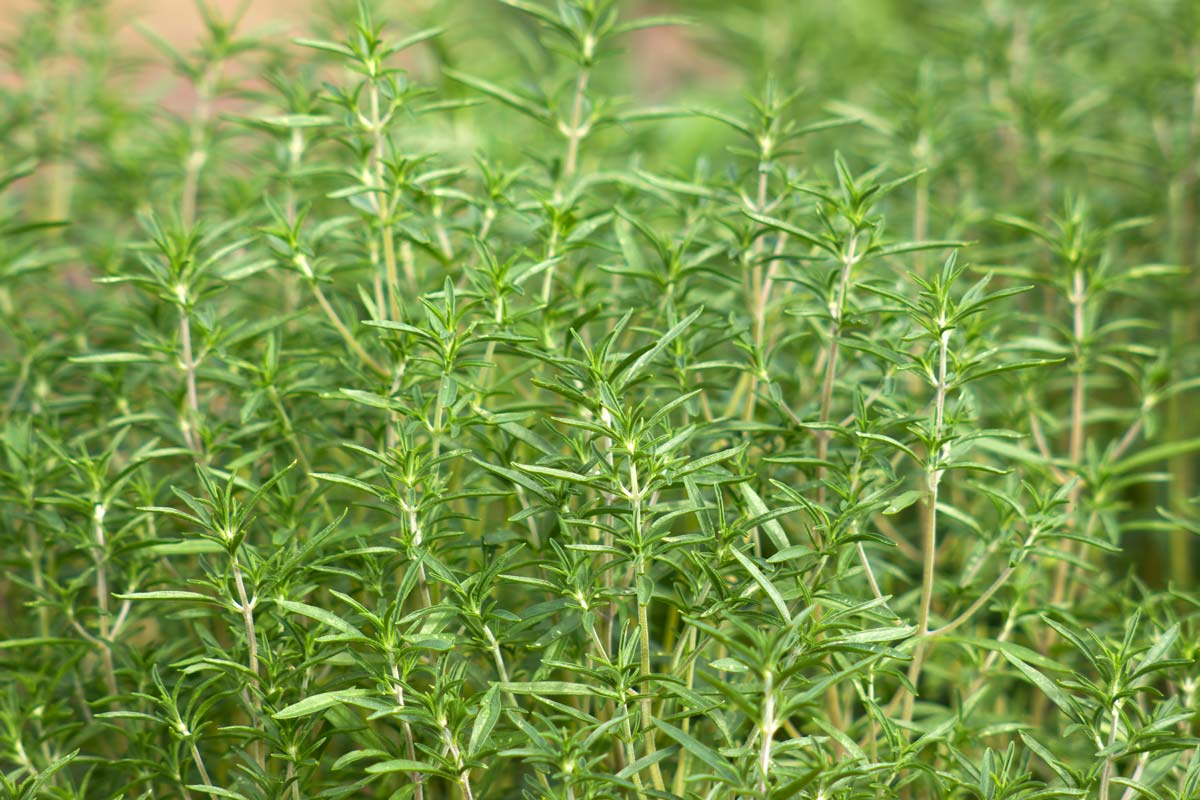
Mira Drozdowski/Shutterstock.com
Facts and figures
Planting & harvest times of Summer savory
Direct sowing from Early May to Late August. Transplant to bed from Early May to Late May. Pre-grow about 42 days before planting out, approximately between Mid March and Mid April. After a growing period of 60 days, harvest can begin around Early July and continues until Late October.
Sow and plant Summer savory
For starting indoors from March, seed trays on the windowsill or in a greenhouse work well. At least 15 °C, ideally 16 to 20 °C, with a germination time of 14 to 21 days. Plant out from mid-May after the last frosts.
Direct sowing outdoors also from mid-May: scatter seeds thinly and just press them down. Thin to 20–25 cm spacing once seedlings reach about 5 cm. A second sowing in June or late July pays off – younger leaves are more aromatic.
Location and soil
Summer savory needs a full-sun spot with at least six hours of direct sunlight a day. Without enough light, the essential oils barely develop and the flavour falls flat. The soil should be loose, well-drained and on the lean side.
Too much fertiliser harms the flavour. On poor soils the leaves become most aromatic. Heavy, waterlogged soils are completely unsuitable – loosen them with sand before planting.
In a herb spiral, summer savory belongs in the upper, dry zone alongside thyme, rosemary and oregano. It also does well in a pot on the balcony or windowsill, as long as the drainage is right.
Good and bad companions of Summer savory
Summer savory and beans form one of the best-known pairings in companion planting. Whether dwarf beans, runner beans, fire beans or broad beans – the essential oils of summer savory drive away black bean aphids while promoting the growth and flavour of the beans.
Brassicas like kohlrabi or cauliflower appreciate summer savory nearby, as the scent keeps cabbage root flies and aphids at bay. Beetroot and endive also respond well.
Basil and summer savory inhibit each other's growth. Lovage is not a good partner either.
Predecessors and successors of Summer savory
Summer savory belongs to the Lamiaceae family and should not be planted before or after basil, sage, oregano, thyme or mint. The whole family gets along poorly with itself. Ideally, leave a four-year gap before planting any Lamiaceae in the same spot.
Varieties
'Aromata' is an Erfurt-bred variety that grows particularly bushy and productive, with a high essential oil content. 'Saturn' scores with large leaves and a favourable leaf-to-stem ratio, making harvests generous. For less-than-ideal locations, 'Pikanta' is a good choice – this Czech variety proves robust and vigorous even in mixed weather. 'Compact' stays low and compact as the name suggests, ideal for pots and small beds.
Care and fertilising
Summer savory is low-maintenance. After germination it hardly needs any water – watering close to the soil prevents fungal problems. A single dose of compost at the start of the season is enough; in pots, give a spring feed with herb fertiliser. Nitrogen-heavy feeding costs you flavour. A cut back to about 10 cm before flowering can trigger a second harvest period. Don't sow too densely, or you'll get more stems than leaves.
Diseases and pests
Summer savory is generally quite robust, especially when the location is right. Slugs reliably avoid the plant, and the essential oils deter many pests. A decoction of summer savory even helps against aphids on other plants.
In too-damp conditions or with too-tight spacing, fungal diseases can appear: downy mildew (Peronospora saturejae-hortensis) is a specific pathogen for savory, while grey mould (Botrytis cinerea) and rust (Puccinia menthae) also occur with care mistakes. On the pest side, there is the green tortoise beetle (Cassida viridis), leafhoppers, and occasionally leaf miner larvae. The best prevention is a sunny, dry location with enough space between plants and no overhead watering.
Harvest and processing
Summer savory has its best flavour just before and at the start of flowering, when the essential oil content peaks. From June you can continuously harvest shoot tips once the plant is big enough. When cutting, snip 5 to 10 cm above the ground and take as little woody stem as possible – the plant will then reshoot. The flowers are edible too, with a mildly peppery taste. Drying is the best method for preserving. The narrow, firm leaves retain their aroma excellently. Dry the stems at room temperature, then strip off the leaves and store them in sealed jars.