
Rhubarb is one of the oldest cultivated plants and originally comes from the mountain regions of Central Asia. Botanically, it belongs to the buckwheat family (Polygonaceae), making it a relative of sorrel and buckwheat. In the kitchen, it's treated like a fruit, but it's actually a vegetable — you eat the leaf stalks, not any kind of fruit. The large heart-shaped leaves are poisonous, by the way, and don't belong on your plate. As a perennial, rhubarb stays in the same spot for 8 to 10 years and reliably delivers a fresh harvest every spring. It's a true beginner's vegetable: tough, low-maintenance and simply unmistakable with its typically tart, fresh flavour. Once planted, you'll enjoy a dependable harvest for many years without having to sow or plant again each year.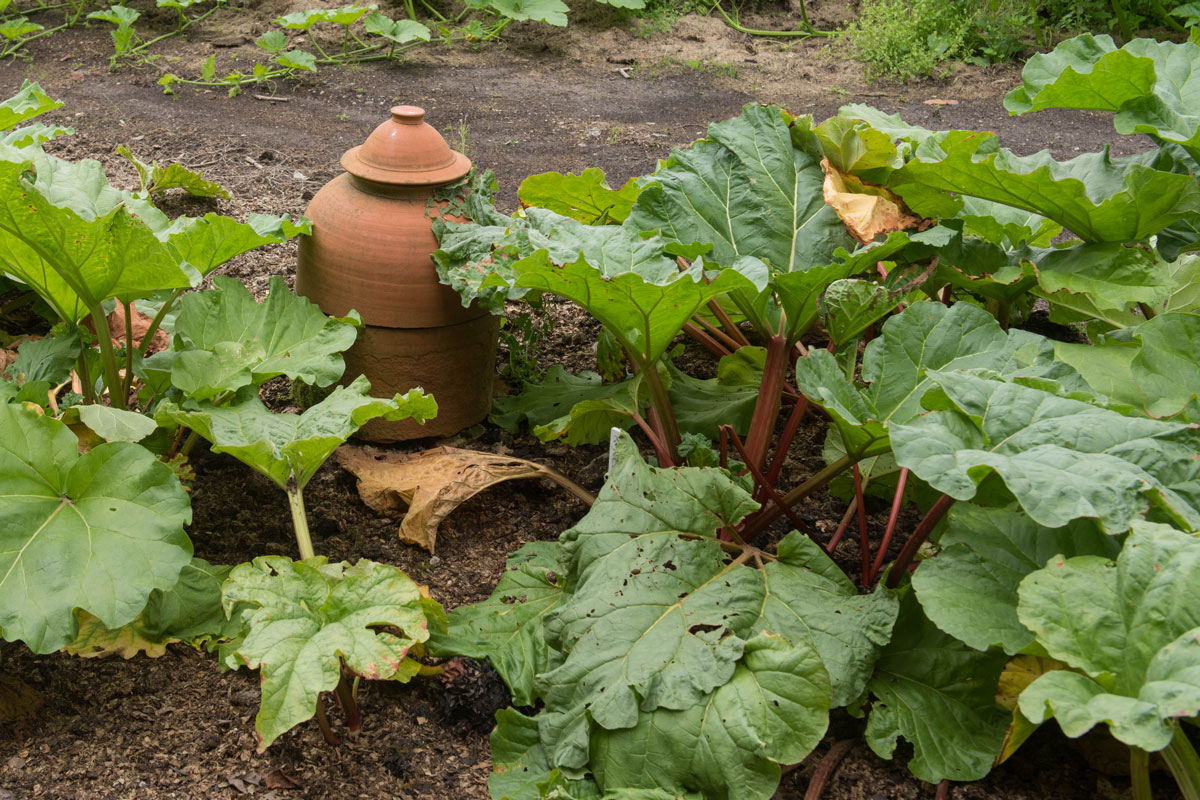
Peter Turner Photography/Shutterstock.com
Facts and figures
Planting & harvest times of Rhubarb
SpringTransplant to bed from Early March to Late April. Harvest begins around Early April and continues until Late June next year.
AutumnTransplant to bed from Early October to Late November. Harvest begins around Early April and continues until Late June next year.
Plant Rhubarb
In practice, rhubarb is almost always planted by dividing rhizomes or as a potted plant. Growing from seed is possible but rarely done, because seedlings take three years or more before they produce a worthwhile crop. With a bought rhizome or young plant, you can harvest the first stalks as early as the second year.
There are two good windows for planting: in autumn, once the foliage has died back, the plant can root in peacefully before spring. Spring, before new growth starts, is also a good time, especially for potted plants. The planting hole should be generous — about 50 cm across — and enriched with well-rotted compost. The buds should sit only about 2 cm below the surface. Firm the soil well afterwards and water thoroughly.
Each plant needs at least one square metre of space, ideally up to two square metres, because rhubarb becomes really sprawling over the years. Growing in a container is possible, but the pot should hold at least 40 to 50 litres. Compact varieties are far better suited for this than the large standard types.
Location and soil
Rhubarb loves a full sun position. It will grow in partial shade too, but you'll get less yield and the stalks won't colour up as nicely. A sheltered spot is an advantage, especially in very sunny locations where evaporation is high.
Rhubarb likes deep, humus-rich soil with good water retention. At the same time, excess water needs to drain away, because waterlogging quickly leads to root rot. Before planting, it's worth clearing the soil thoroughly of perennial weeds — once they get in between the rhizomes, they're very hard to remove. If your soil is heavily compacted, loosen it deeply and improve it with compost.
Good and bad companions of Rhubarb
Lettuce is one of the best partners for rhubarb. Undemanding leaf lettuces hardly compete for nutrients and cover the ground between the large rhubarb leaves, which retains moisture and suppresses weeds. Spinach works well for similar reasons: shallow root system, low nutrient requirements and good ground cover.
Beans and brassicas also make compatible neighbours, as their growth habits and nutrient needs complement each other well. Marigolds, pot marigolds and nasturtiums keep pests like aphids at bay with their essential oils while attracting beneficial insects at the same time.
Other heavy feeders like pumpkin, courgette or sweetcorn shouldn't be planted right next to rhubarb. The intense competition for nutrients can weaken rhubarb over time.
Predecessors and successors of Rhubarb
Rhubarb plays a special role in crop rotation. As a permanent crop, it stays in the same spot for 8 to 10 years and isn't included in the annual rotation.
Rhubarb doesn't tolerate replanting in the same spot. Where rhubarb has grown before, you should leave a sufficiently long gap before planting it again.
When you remove rhubarb after 8 to 10 years, start with soil regeneration using green manure. Light or moderate feeders make good first follow-up crops, as the soil needs a recovery phase after years of heavy feeding.
Varieties
With rhubarb varieties, the colour of the stalk flesh matters most. Red-fleshed varieties like 'Holsteiner Blut' or 'Canada Red' tend to taste milder and contain less oxalic acid. 'Holsteiner Blut' is a tried-and-tested variety with plenty of sugar and a pleasant flavour, while 'Canada Red' keeps its red colour even when cooked. If you're looking for something special, try 'Frambozen Rood' — its flavour is reminiscent of raspberry and strawberry.
Green-fleshed varieties are often higher yielding but more tart. 'Timperley Early' shoots particularly early and doesn't need peeling. 'Goliath' produces stalks up to a metre long but needs plenty of space to match.
For sensitive stomachs, there are low-oxalic-acid varieties like 'Elmsjuwel' or 'Elmsblitz'. And if you want to extend the season, have a look at 'Livingstone' or 'Glaskins Perpetual'. These varieties can be harvested much longer, right up to the first frost, and also do well in containers.
Care and fertilising
As a heavy feeder, rhubarb needs plenty of compost. Add well-rotted compost to the planting hole right from the start. In spring before new growth, give it another feed, and after harvesting in June to July, the plant appreciates a generous helping of 5 to 10 litres of compost per plant. In autumn, a mulch layer of manure or compost does it good.
When watering, less often but deeply is the way to go — this encourages the roots to grow downwards. In a container, you'll need to water more frequently but in smaller amounts to avoid waterlogging.
If your rhubarb sends up a flower stalk, twist it out right at the base. Don't cut it — cut surfaces invite rot. Flowering costs the plant a lot of energy that's then missing for stalk production.
Every 7 to 8 years, it's worth dividing the rhizomes in autumn and replanting them in a new spot. This rejuvenates the plant and gives you new plants for the garden at the same time.
Diseases and pests
Rhubarb is generally a tough plant that rarely causes serious problems when well cared for. The most common pests are aphids, which not only cause direct damage but can also transmit viruses. Checking regularly helps you spot an infestation early. Nettle tea or horsetail brew are proven remedies. Marigolds and pot marigolds as companion plants keep aphids away naturally.
Caterpillars of the dock moth and the rhubarb looper can cause considerable leaf damage. Picking them off by hand or treating with neem products helps here.
Among diseases, viral infections are the most feared — recognisable by white or coloured spots on the leaves. You need to remove affected plants completely and dispose of them in the general waste, not on the compost heap. Root rot caused by Erwinia bacteria and crown rot caused by Phytophthora almost always occur with waterlogging, which shows once again how important good drainage is. Downy mildew and leaf spot disease caused by Ramularia mainly appear when plants are too closely spaced and air circulation is poor.
By the way: you can use rhubarb leaves themselves as a plant protection remedy. A brew made from 500 g of leaves in 3 litres of water helps against black bean aphids and leek moths.
Harvest and processing
Don't harvest until the second year after planting. In the first year, leave the plant completely alone so it can establish itself properly. The main harvest season runs from April to 24th June, Midsummer Day. After that, harvesting traditionally stops because the oxalic acid content rises as the season progresses and the plant needs the remaining growing season to recover. Stalks are ready to harvest when the leaf tissue between the ribs is fully stretched out and the leaf looks broad and flat. Don't cut the stalks — grip them at the base and carefully twist them out. Take no more than a third to half of the available stalks per harvest. The plant needs the remaining leaves for photosynthesis. Remove the leaves straight after harvesting — they're poisonous. Don't eat rhubarb raw. A quick blanch significantly reduces the oxalic acid content and makes the stalks more digestible. Younger stalks from the start of the season are generally less acidic than later ones. People with kidney problems, gout or rheumatism should enjoy rhubarb only in moderation. To freeze rhubarb, cut the stalks into pieces, blanch them briefly for about 3 minutes, let them cool and freeze them. If you pre-freeze the pieces individually on a tray first, they won't clump together.