
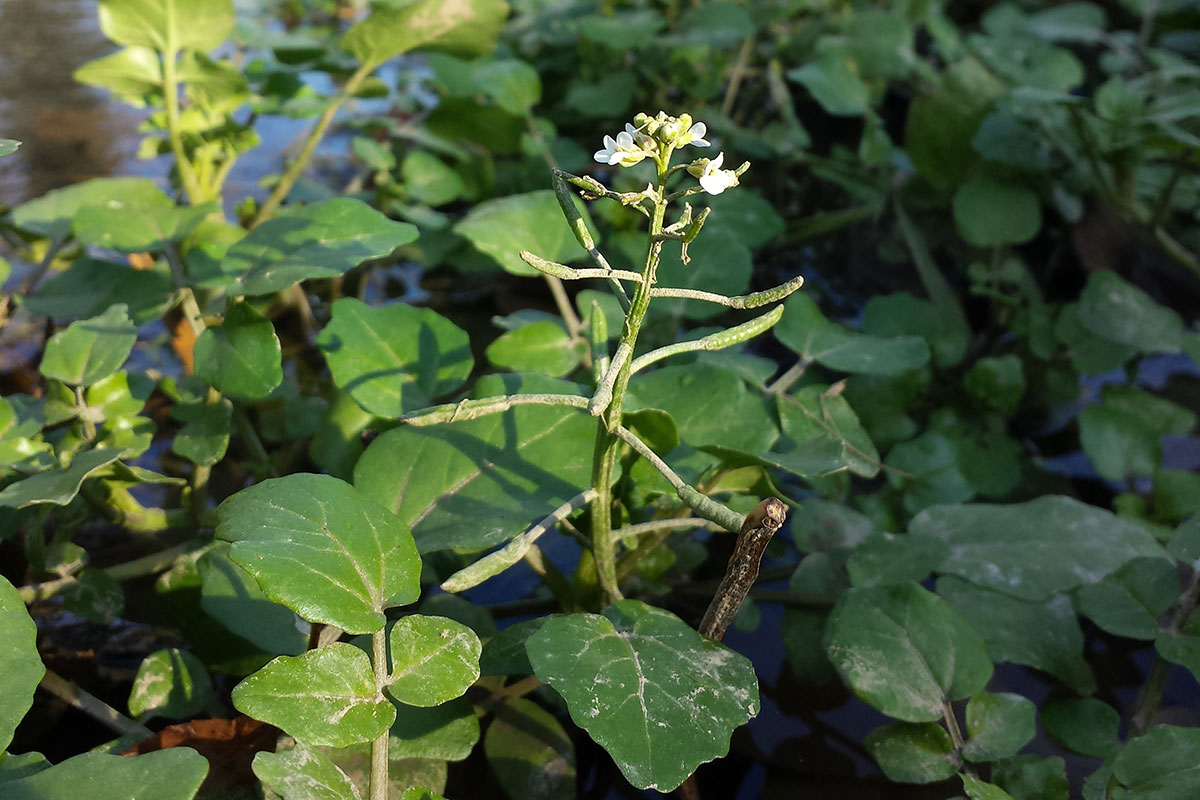
Watercress can now be found almost worldwide along clean, shallow waters with little current, such as springs. It's a perennial and stays green through winter, so it can contribute to a balanced diet even in the cold months. It contains plenty of vitamin C and important minerals like iodine. It also has secondary plant compounds such as mustard oils, which give it its peppery flavour. These many nutrients also make it a valuable medicinal plant. Among other things, it helps reduce fever, acts as a diuretic and loosens mucus. It also aids with digestive complaints and can be applied externally as a tincture against eczema.
Facts and figures
Planting & harvest times of Watercress
TransplantTransplant to bed from Early May to Late August. After a growing period of 60 days, harvest can begin around Early July and continues until Late November.
PerennialTransplant to bed from Early May to Late September. In the first year, harvest can begin after a growing period of 120 days and continues until Late May next year. From the second year on, harvest can begin as early as around Early September.
Plant Watercress
You'll find two planting times for watercress above, because it can be grown in two completely different ways. Which one suits you depends on whether you have water in your garden.
Transplant applies to growing in a bed or a container. Here you treat watercress like an ordinary annual herb: planted in spring, harvested through summer and autumn, finished by winter. That's not down to the plant itself but to the small amount of water. A container freezes solid in winter, a stream doesn't. On top of that, standing water warms up in summer and loses oxygen. The roots resent that and the leaves turn yellow. So in a bed or a container you usually raise a new batch every year.
Perennial applies to growing in a stream or at the pond. There the plant stays put for years. It's evergreen, the water protects the roots from frost, and new roots form at every stem node lying in the water. The stand keeps itself going. In the first year it takes a while to become strong enough; from the second year on you can start harvesting in September.
In both cases you plant from early May, once the frosts are over. By water you can plant until the end of September; in a bed or container you should be done by the end of August so there's still something to harvest before winter.
You have two routes to young plants. The easier one is cuttings: in summer take a few shoots from an existing plant and push them into very moist soil. They root on their own, and quickly. The second route is sowing. The seeds are tiny and need light to germinate, so you just scatter them on the soil and press them down lightly without covering them. They germinate after about two weeks.
The order matters: raise them without much water at first, just evenly moist. Only once the cuttings have roots or the seedlings are big enough do they go into the water. Then raise the water level bit by bit as the plants grow. The shoot tips should always stick out.
Space the plants about 10 cm apart; for several rows allow 30 cm between rows. You usually don't need to thin, because the fine seeds spread out well on their own. If the seedlings do stand too close, you can move them apart three to four weeks after germination.
Location and soil
Watercress, much like wasabi, is a bit of a special case when it comes to growing. It prefers things moist to wet, as you can probably guess from its name. Cool, clear, flowing water is what it likes best. If you have a small stream or a cool pond, that's the ideal spot.
You can also grow it with more effort in soil or a water basin, as long as you keep the soil constantly very moist or regularly replace the water in the basin so it doesn't heat up too much. The yield and lifespan usually suffer quite a bit though.
Good and bad companions of Watercress
Predecessors and successors of Watercress
- Shared soil-borne pathogen
Care and fertilising
You don't feed watercress. It takes its nutrients from the water and from the humus in the soil, and that's plenty. In a pond, fertiliser is actually harmful because it feeds the algae. The only exception is a bed with no water inflow or outflow, where you mix in a little compost when you set it up.
The real care comes down to never letting it dry out. Along a stream that takes care of itself, and all you really have to do is harvest. In a bed, water regularly and thoroughly, so the soil stays muddy and moist the whole time.
The tub causes the most work. If the water sits too long, it loses oxygen and turns cloudy. How often you need to change it depends mainly on the temperature. In a warm summer spot, swap it every two days, while in the shade and during the cool season much less often will do. Just make sure the water stays clear and doesn't start to smell.
A second reason for fresh water is hygiene, because bacteria can settle on the plant in standing water, and watercress is eaten raw.
Diseases and pests
Harvest and processing
Watercress flowers from May to September. Once it starts flowering, the leaves lose much of their flavour, turn tough and give up some of their vitamins. That's why you stop harvesting after May and only start again once flowering is over. Use it like 'ordinary' cress in salads, in herb quark, to season soups or simply on a slice of buttered bread. Exactly when you harvest depends on which of the two growing methods you have chosen. By the water, so in the perennial culture, you harvest from autumn right through to May. That's the big advantage of this plant: it stays green over winter and gives you fresh leaves when nothing else in the bed is doing anything. In the first year the planting needs about 120 days to become strong enough. From the second year on you can start as early as the beginning of September. Always cut back only single shoots and never too much at once, so the plant can recover. In the bed or container, so in the annual culture, the harvest falls in the middle of summer and in autumn. At first that sounds like a contradiction to the flowering time, but it isn't: watercress sown or planted in spring is usually still too young to flower in its first year. It only flowers in the following year, which you won't wait for in a container anyway. So here you can harvest continuously from about 60 days after planting until frost puts an end to it. The plant is ready to harvest as soon as it is around 10 cm tall. You use the shoot tips and the leaves; the flowers and buds are edible too and make a nice garnish. It tastes best freshly harvested and keeps only two to three days in the fridge. It isn't suitable for drying, because that destroys exactly the mustard oils that give it its flavour.
Open the bed planner Try free for 7 days, web, iOS and Android