
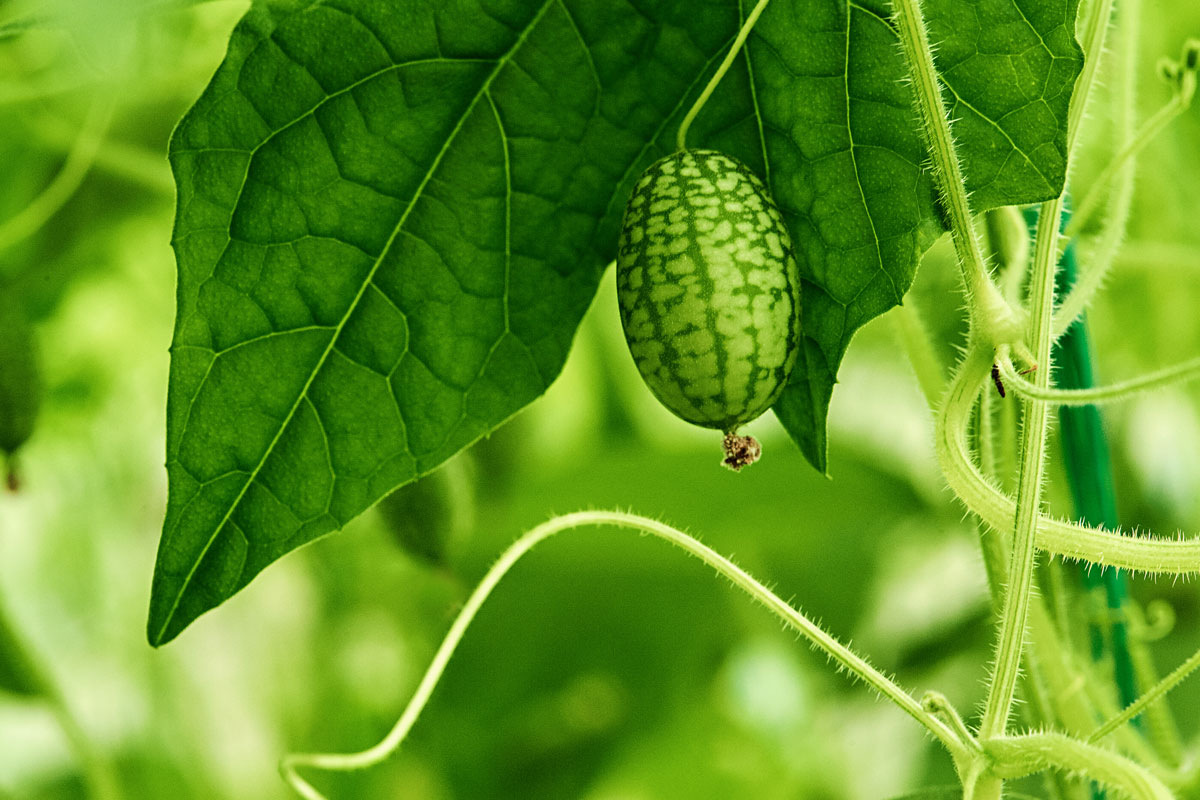
The fruits of the Mexican sour gherkin Melothria look like tiny melons and are great for snacking straight from the plant – kids love them too. The flavour is sour and cucumber-like.
Facts and figures
Planting & harvest times of Melothria
Transplant to bed from Mid May to Late June. Pre-grow about 45 days before transplanting, approximately between Early April and Mid May. After a growing period of 100 days, harvest can begin around Mid July and continues until Late October.
Location and soil
Like other cucurbits, they prefer humus-rich, nutrient-rich soil and plenty of sun.
They definitely need a climbing support, as they can climb up to 3 m high. In a bed, a bean pole works well, or you can plant them in a pot with a trellis, or next to a pergola, a rose arch or something similar. The dangling mini cucumber-melons are also very decorative.
They also thrive in greenhouse conditions.
Good and bad companions of Melothria
The cucamelon prefers to grow on its own. It climbs up to three metres high and spreads vigorously, so give it its own trellis, a wigwam of bean poles or a spot along the fence rather than squeezing it in among other crops. Keep some distance from cucumbers, melons, squash and courgettes, as they share mildew and viruses that aphids carry from plant to plant.
- Supports pollination
- Shade, wind shelter, ground cover
- Shade, wind shelter, ground cover
- Allelopathy, growth inhibition
- Shared pathogen, spreads through proximity
- Shared pathogen, spreads through proximity
- Shared pathogen, spreads through proximity
- Allelopathy, growth inhibition
- Shared pathogen, spreads through proximity
- Shared pathogen, spreads through proximity
Predecessors and successors of Melothria
The cucamelon belongs to the cucurbit family, so it only returns to the same spot after four years at the earliest. The same gap applies to cucumbers, melons, squash and courgettes, because they share diseases that survive on plant debris in the soil. Beans, peas, leeks or celery make good preceding crops, and you can still harvest a batch of lettuce from the bed until mid-May. Cabbage, tomatoes and peppers draw heavily on the soil and, like sweetcorn, count as poor preceding crops. In the year after the cucamelon, beetroot or chard fit in well.
- Nitrogen release
- Nitrogen release
- Nitrogen release
- Loosens soil, improves soil structure
- Nitrogen release
- Nitrogen release
- Nitrogen release
- Nitrogen release
- Nitrogen release
- Shared soil-borne pathogen
- Shared soil-borne pathogen
- Shared soil-borne pathogen
- Shared soil-borne pathogen
- Self-incompatibility
- Shared soil-borne pathogen
- Shared soil-borne pathogen
- Shared soil-borne pathogen
- Shared soil-borne pathogen
- Shared soil-borne pathogen
- Shared soil-borne pathogen
- Self-incompatibility
- Shared soil-borne pathogen
- Shared soil-borne pathogen
Care and fertilising
Similar to cucumbers.
At first the plants grow very slowly, but at some point they really take off.
Diseases and pests
The Mexican sour gherkin is pleasingly tough. It can catch the same diseases as the cucumber, powdery mildew above all, but it falls ill far less often. If white coatings that wipe off appear on the leaves, cut off the affected leaves; the fruits stay untouched. Aphids like to settle on the shoot tips and can transmit viruses. Waterlogging does the Mexican sour gherkin no good, as the roots then rot.
Harvest and processing
You can snack on them straight from the plant, toss them into a salad or pickle them like gherkins.
Open the bed planner Try free for 7 days, web, iOS and Android