
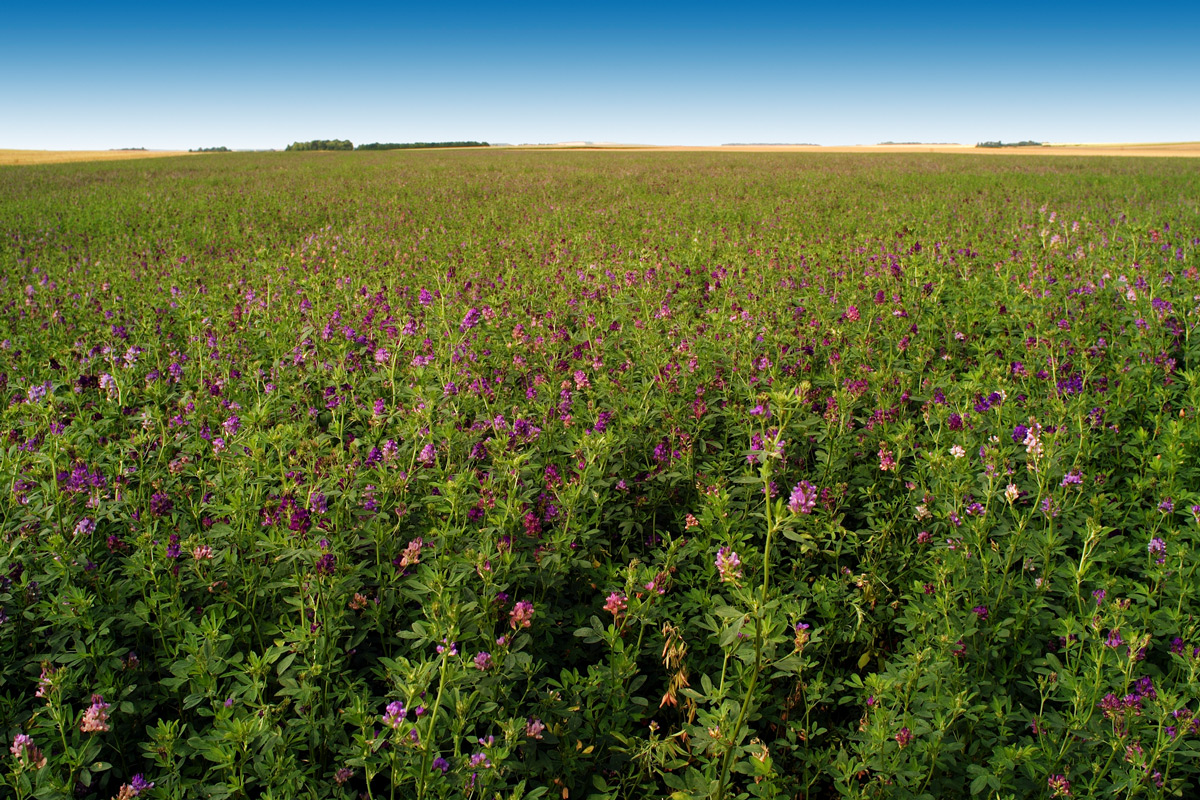
Alfalfa is one of the oldest cultivated plants in the world. The ancient Persians were already growing it over 2,500 years ago, and its Arabic name 'Alfalfa' roughly translates to 'father of all food'. Pretty impressive for a plant that shines mainly as a soil improver in the garden.
In the vegetable garden, alfalfa plays to its strengths as a green manure. It fixes up to 30 g of nitrogen per square metre per year through root nodule bacteria (Sinorhizobium meliloti). Its taproot reaches down to 5 metres and breaks through even stubborn compaction layers. The channels left behind after the roots die off permanently improve aeration and water uptake. At the same time, alfalfa builds up plenty of humus through the large amount of organic matter it leaves behind.
From June to September, alfalfa opens its violet butterfly-shaped flowers and becomes a real feast for insects. Hardy down to minus 20 °C, it reliably protects the soil from erosion and drying out through winter too.
Botanically, alfalfa belongs to the legume family (Fabaceae). In garden centres you'll mostly find hybrid alfalfa (Medicago × varia), a robust cross between common alfalfa and sickle medick.
Facts and figures
Planting & harvest times of Alfalfa
Direct sowing from Early March to Late August.
Sow Alfalfa
Alfalfa is always sown directly into the bed — there's no point in starting it indoors for green manuring. You can sow between March and August, with an early sowing in April being ideal. The soil should be at least 5 °C by then; alfalfa germinates best at 15 to 20 °C. The seedlings take roughly 7 to 14 days to appear.
The seedbed should be fine and crumbly, and as weed-free as possible. Broadcast the seeds at about 2 to 3 g per square metre. A handy trick: mix the seed with a good amount of sand, and it spreads much more evenly. The seeds should only go 1 to 2 cm deep. Then press them down lightly, for example with the back of a rake. Good soil contact noticeably improves germination.
On plots that have never grown alfalfa before, inoculating the seed with the right root nodule bacteria makes sense. Many suppliers already offer pre-inoculated seed. On acidic soils, a lime application before sowing helps, as the nodule bacteria only work properly above a pH of 6.5.
Location and soil
Alfalfa loves sun and can't cope with shade. It's less fussy about soil, as long as it's deep and well-drained. Chalky to slightly loamy soils are perfect.
Alfalfa doesn't tolerate waterlogging. Wet, boggy or heavily compacted soils are unsuitable. On the other hand, it's remarkably drought-tolerant: thanks to its deep taproot, it copes well even in dry summers. As a light feeder, it supplies itself through nitrogen fixation and needs no extra fertilising.
Good and bad companions of Alfalfa
As a green manure, alfalfa usually occupies its own bed section and is rarely planted directly next to vegetables. In green manure mixes, phacelia has proven an excellent partner. It provides quick ground cover while the alfalfa is still growing slowly, and shares no diseases with it. Mustard also complements alfalfa well, as it rapidly produces biomass and suppresses weeds. However, don't sow mustard if you're planning brassicas on that patch the following year.
Alfalfa doesn't get on well with other legumes. Peas, beans, lupins and lentils share soil-borne diseases with it, such as clover rot and Fusarium wilt. Avoid this combination at all costs, whether as direct neighbours or in the same bed section.
Predecessors and successors of Alfalfa
In crop rotation, alfalfa is both demanding and generous. On the one hand, it needs a clean history: after other legumes like peas, beans or clover, you should wait at least 4 to 6 years before sowing alfalfa. The clover rot pathogen persists in the soil and will make short work of your plants otherwise. After itself, alfalfa also needs a break of 4 to 6 years.
Good predecessors are any crops outside the legume family: cabbage, carrots, beetroot or potatoes all leave soil where alfalfa starts without problems.
On the other hand, alfalfa is one of the most valuable preceding crops there is. The deeply loosened, nitrogen-rich soil benefits heavy feeders in particular. Cabbage profits especially from the nitrogen and improved soil structure. Potatoes appreciate the loose soil for their tubers. Squash, courgettes and tomatoes make use of the available nitrogen in the first weeks after incorporation. However, no other legumes should follow directly after alfalfa, as disease pressure would be too high and extra nitrogen isn't needed anyway.
Varieties
In garden centres, you'll find alfalfa seed almost exclusively as hybrid alfalfa (Medicago × varia). This is a natural cross between common alfalfa with violet flowers and the yellow-flowering sickle medick. Hybrid alfalfa grows more vigorously than the pure species and is better adapted to our climate.
Specific variety names hardly matter in the home garden — the focus is on the soil-improving effect. When buying, make sure the seed has already been inoculated with root nodule bacteria, or get the inoculant separately. You can find organically certified seed from various suppliers, sometimes also as ready-made alfalfa-clover-grass mixes for green manuring.
Care and fertilising
In its early stages, alfalfa is a bit sensitive. Water regularly in the first weeks after sowing until the young plants have established. After that, alfalfa hardly needs any water thanks to its deep roots. Fertilising isn't necessary — the plant looks after itself.
The biggest problem in the early phase is weeds. A topping cut about 5 to 6 weeks after sowing, when the plants are around 15 cm tall, helps enormously against weed pressure and strengthens the stand. From the second year onwards, a dense alfalfa stand suppresses weeds all on its own.
When incorporating as green manure: mow before seed set, otherwise alfalfa will self-sow uncontrollably. You can leave the cuttings as mulch or work them shallowly into the soil. Allow at least 4 to 6 weeks between incorporation and the next sowing, so the biomass can decompose and the nitrogen becomes available for the following crop.
Diseases and pests
Clover rot (Sclerotinia trifoliorum) is the most significant disease affecting alfalfa. You'll spot it by black necrosis on leaves and shoots in autumn; later, whitish fungal mycelium forms on the stems. Plants wilt and die off in patches. The fungus survives as hard black sclerotia in the soil for several years. The best prevention is a consistent crop rotation: grow no susceptible legumes in the same spot for at least 4 to 5 years.
Verticillium wilt (Verticillium albo-atrum) enters through the roots and causes yellowing, but it rarely occurs in home gardens. The alfalfa weevil (Otiorhynchus ligustici) can become a problem with multi-year cultivation, as its larvae damage the roots. Aphids occasionally appear on young shoots but cause barely any notable damage in the garden.
As a general rule: the greatest risk comes from growing legumes too frequently in the same spot.
Harvest and processing
As a green manure, alfalfa isn't harvested in the traditional sense. Instead, you work it into the soil when it's time for the next crop. Ideally, mow the plants in autumn or spring and either leave the cuttings as mulch or chop them shallowly into the soil. Larger stem remains are better off on the compost heap. If you want to use alfalfa as cut material for mulching, you can cut it back 3 to 4 times during the season to a stubble height of about 8 to 10 cm. The nutrient-rich material is brilliant for mulching other beds. Alfalfa also offers a rather special use as sprouts: the seeds germinate in a sprouting jar within 2 to 3 days and produce crisp sprouts packed with vitamin C and amino acids. Make sure you let the sprouts fully develop though, as the seeds contain canavanine, which is mostly broken down during the germination process.
Open the bed planner Try free for 7 days, web, iOS and Android