
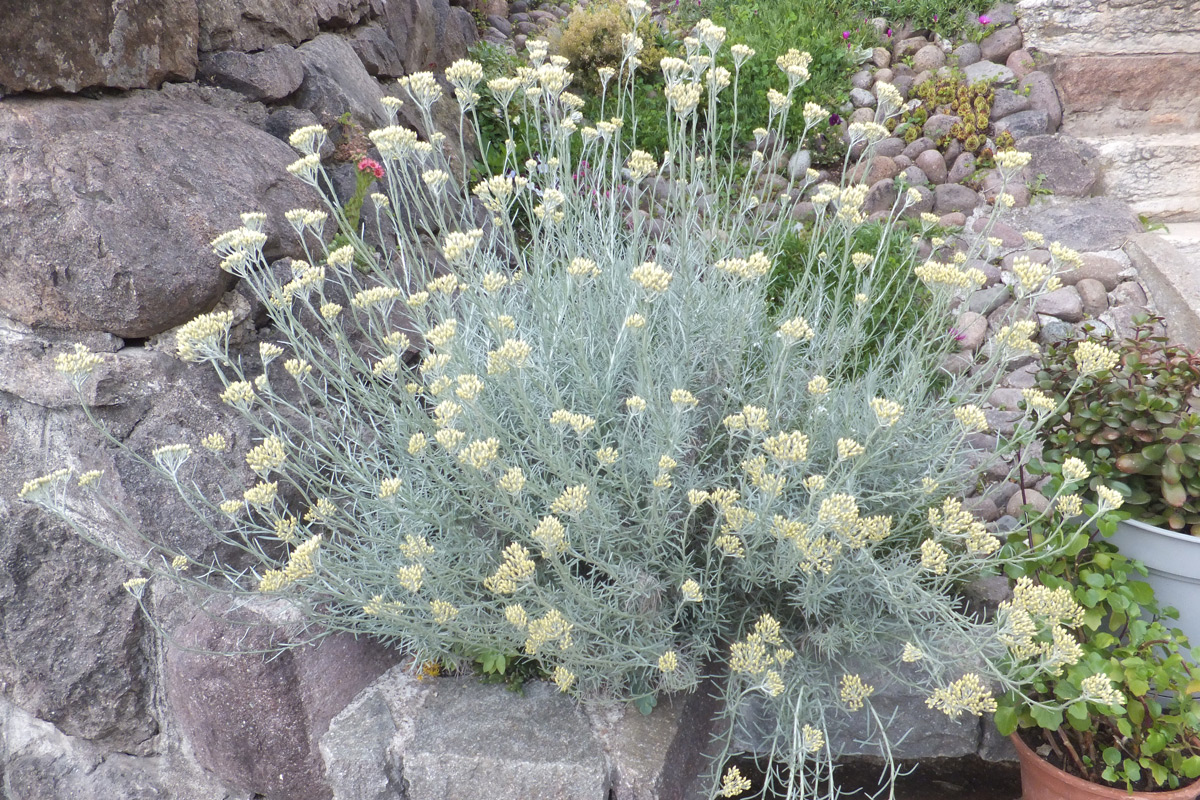
The curry plant is an evergreen subshrub from the Mediterranean and belongs to the daisy family. With its narrow, silvery foliage and sulphur-yellow flower heads from July to September, it really stands out in the herb bed. Brush past the leaves and you will catch a spicy scent of curry, although the plant has nothing to do with curry powder. The flowers keep their colour even when dried, which is where names like Italian strawflower or immortelle come from. In our climate, the curry plant usually lives for only two to three years and grows 30 to 50 centimetres tall.
Facts and figures
Planting & harvest times of Curry plant
Transplant to bed from Mid May to Late June. Pre-grow about 50 days before transplanting, approximately between Late March and Early May. In the first year, harvest can begin after a growing period of 140 days and continues until Late September. From the second year on, harvest can begin as early as around Early June.
Plant Curry plant
Spring is the best time to plant a curry plant, as it then has time to root in well before winter. Set out young plants from the nursery from mid-May, once there is no more risk of night frost, about 40 centimetres apart, since a mature bush easily grows half a metre wide. To raise your own, sow seeds from mid-February to March on a bright windowsill at around 20 degrees. The seeds need light to germinate, so just press them onto the surface and keep the compost evenly moist. They sprout after about two weeks. Propagating from cuttings or by layering is easier, and they root in around four weeks.
Location and soil
The curry plant needs a warm spot in full sun and poor, very free-draining soil. Sandy, stony ground with a neutral to slightly chalky pH suits it well, but it can't cope with heavy, wet soil. Waterlogging in winter is the biggest danger, so a herb spiral, rock garden, gravel bed or a spot against a warm wall works especially well. In a terracotta pot, it thrives on balconies and patios that get hot in summer.
Good and bad companions of Curry plant
The curry plant is no partner for the vegetable patch. As a perennial subshrub it needs poor, dry soil, while most vegetables want rich ground that stays evenly moist. In practice, mixing it with annual vegetables hardly ever works, so give your curry plant its own spot in a herb bed at the edge of the vegetable garden.
In a Mediterranean herb bed, the curry plant finds its neighbours among plants of a similar size with the same needs. Low-growing hyssop and compact lavender varieties suit it particularly well, and they grow alongside each other in the wild too. Rock roses make a lovely addition where they are hardy. Rosemary, thyme, sage, oregano and winter savory often share the same bed because they love sun and dry conditions just as much, but nobody knows of any effect they have on each other.
Don't plant herbs that need moist soil next to it. Mint, parsley, chives, lovage and basil demand more water and feeding than the curry plant can handle. People say the spicy scent keeps moths and other insects away. That idea comes from its old use against clothes moths in the house, and there is no evidence of such an effect on vegetable pests. In summer, bees and other insects love to visit the flowers.
- Practical tip for this pair
Predecessors and successors of Curry plant
The curry plant stays in the same spot for several years, so this subshrub doesn't follow a crop rotation the way vegetables do. In our climate it usually starts to decline after two to three years. At that point, it's best to put a young plant grown from cuttings in a new spot in the herb bed. The curry plant isn't known to leave behind any soil-borne diseases for the next crop.
If you redesign the bed afterwards, don't sow calendula or chamomile right where the curry plant stood. Both belong to the daisy family and grow less well after other members of that family, so leave a three-year gap. There are no restrictions for any other herbs or vegetables. The soil under a curry plant is usually poor and stony though, so dig in well-rotted compost before planting hungry vegetables.
- Family rule
- Family rule
Varieties
Garden centres usually offer three forms of curry plant. The large-leaved curry plant grows up to 50 centimetres tall and is the standard garden form. A low, compact selection with fine, needle-like leaves fits into small pots from three litres upwards and into window boxes. Nurseries sell a Dalmatian relative as immortelle, which people value mainly as a fragrant and medicinal plant. Some nurseries stock selections that tolerate a little more frost.
Care and fertilising
The curry plant needs hardly any care. In the bed, water it only during long dry spells, and in a pot only once the top of the compost has dried out. Avoid waterlogging at all costs. It doesn't like organic fertiliser, and a little magnesium lime and rock dust once a year is plenty. After flowering, by mid-September at the latest, cut the plant back hard to keep it bushy. Without protection it usually survives frosts down to about minus 5 degrees, and once well established and kept dry, down to about minus 10 degrees. In exposed spots, cover it with brushwood or fleece. Overwinter potted plants somewhere bright and cool at about 10 degrees and keep them almost dry.
Diseases and pests
The curry plant is very tough, and pests almost always steer clear of its strongly scented, felty leaves. Wet soil is the biggest threat. If the plant sits in waterlogged ground, especially in winter, the roots rot and it dies. Free-draining, stony soil or a pot with a drainage hole and a layer of gravel is the best prevention.
In warm, humid summers, a white, powdery coating of powdery mildew sometimes appears on the curry plant. It rarely weakens the plant, and an airy position plus cutting back affected shoots is enough. Now and then aphids or whitefly feed on the shoot tips, mainly on weakened or overcrowded plants. A strong jet of water usually sorts them out. If you see yellow or spotty leaves when buying, the plant is probably sick, so leave it on the shelf.
Harvest and processing
You can harvest the young shoot tips of the curry plant from when it starts growing in spring through to late summer. They taste strongest just before flowering in June and July. Cut whole sprigs with sharp scissors above the woody parts. Cut the flowers at full bloom and dry them for scented posies and arrangements. They are not suitable for eating. In the kitchen, add sprigs of curry plant to vegetables, rice or meat only at the end of cooking and take them out again before serving. If they cook for too long, they turn harsh and bitter. Producers extract an essential oil from immortelle flowers, which aromatherapy uses as a skin oil.
Open the bed planner Try free for 7 days, web, iOS and Android