
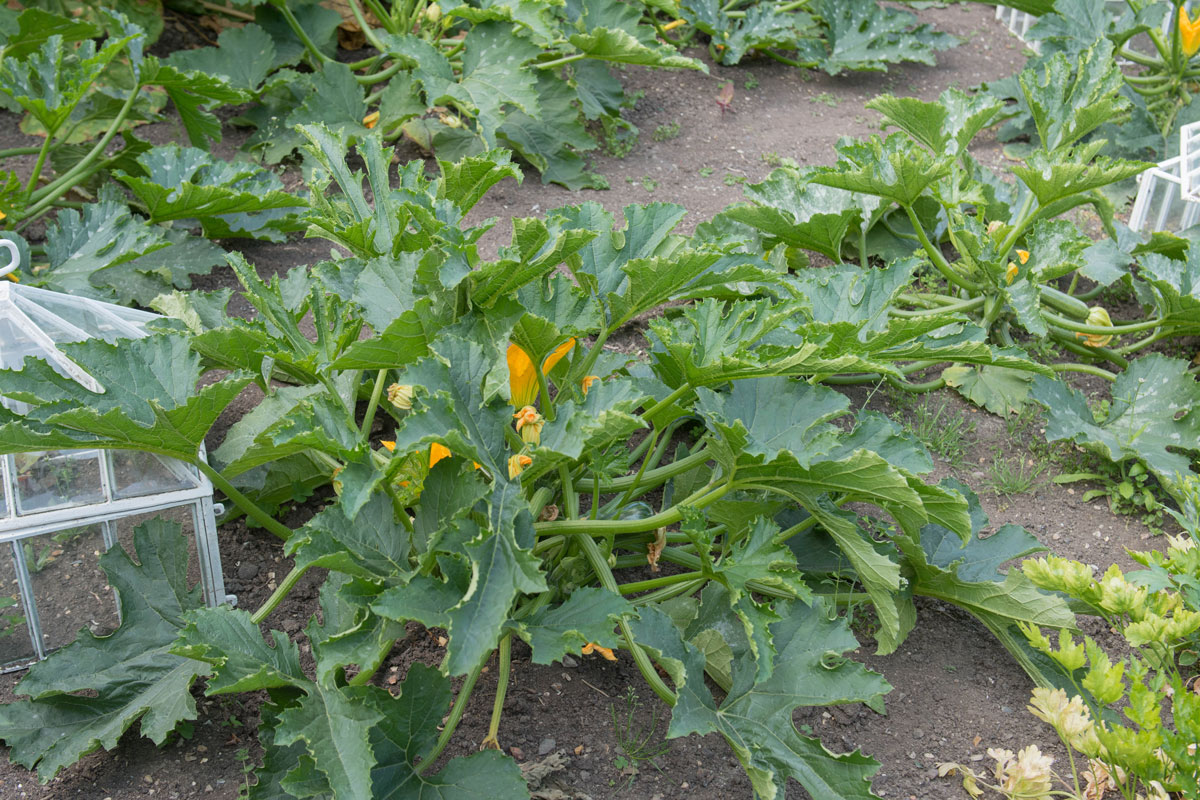
Courgettes, the 'little squash', can be harvested just 5 weeks after planting, since you basically pick the fruits continuously while they're still unripe. You can often keep this up right until the first frosts, as the plants are quite robust.
The main difference between a courgette and a squash is that courgettes don't form runners and are always harvested unripe. Though the lines are blurry. There are climbing courgette varieties and squashes without runners. The pattypan squash is also sometimes listed as either squash or courgette.
Facts and figures
Planting & harvest times of Courgette
Direct sowing from Mid May to Mid June. Transplant to bed from Mid May to Mid June. Pre-grow about 30 days before transplanting, approximately between Mid April and Mid May. After a growing period of 60 days, harvest can begin around Mid June and continues until Late October.
Sow and plant Courgette
The plants often grow very large. If you don't have much space, make sure to look for compact varieties or grow your courgettes in a large pot (at least 30 litres).
You should have at least 2 plants, otherwise yields can be very low if there's no pollinator plant nearby.
Courgette plants, like squash or cucumber plants, don't like having their roots disturbed. So don't prick them out — sow the seeds directly into larger pots (8 cm or more).
Good and bad companions of Courgette
Courgettes need plenty of room, around one square metre per plant, and full sun. Carrots, parsnips and onions have proved their worth in the rows alongside, as have beans, beetroot, dill and fennel. Basil, chamomile and marjoram are happy in among the courgettes. Sow radishes around the young plants in spring, and you will have harvested them before the big leaves need the space.
Put winter radish somewhere else, and cabbage is considered a poor neighbour for courgettes. Keep your distance from cucumbers, squash and melons, as they share mildew and viruses that aphids carry from plant to plant. For the same reason, do not put young courgettes right next to older ones.
- Supports pollination
- Practical tip for this pair
- Practical tip for this pair
- Shared pathogen, spreads through proximity
- Shared pathogen, spreads through proximity
- Shared pathogen, spreads through proximity
- Shared pathogen, spreads through proximity
- Shared pathogen, spreads through proximity
Predecessors and successors of Courgette
As a preceding crop you can sow a green manure or plant broad beans, which are already harvested by the time the courgettes go in and leave behind a well-fed soil. Lettuce and radishes work as an earlier crop too, so the space doesn't sit empty for long. In that case, though, only feed the soil shortly before the courgettes go in.
Courgettes return to the same bed after four years at the earliest, and the same goes for pumpkins, cucumbers and melons. They share diseases that survive on plant debris in the soil. Peas, beans or an early sowing of field beans make good predecessors, because courgettes are hungry feeders and need plenty of nitrogen. If sunflowers grew in the bed, wait three years, as both pick up white mould. After courgettes the soil is in good shape. The following year onions, garlic, leeks and shallots do well there, and so do carrots and parsnips if you kept the courgettes properly weeded.
- Nitrogen release
- Nitrogen release
- Nitrogen release
- Nitrogen release
- Nitrogen release
- Nitrogen release
- Nitrogen release
- Nitrogen release
- Shared soil-borne pathogen
- Self-incompatibility
- Shared soil-borne pathogen
- Shared soil-borne pathogen
- Shared soil-borne pathogen
- Shared soil-borne pathogen
- Shared soil-borne pathogen
- Shared soil-borne pathogen
- Weed suppression for the next crop
- Weed suppression for the next crop
- Shared soil-borne pathogen
- Self-incompatibility
- Shared soil-borne pathogen
- Shared soil-borne pathogen
- Shared soil-borne pathogen
- Shared soil-borne pathogen
- Shared soil-borne pathogen
Care and fertilising
Courgettes are prone to mildew, both downy and powdery, so they benefit from a regular boost with horsetail tea or fermented horsetail, sprayed directly onto the leaves as well. Prepare the bed well with compost or manure before planting.
For a steady harvest and good-looking fruits, you need to water regularly.
Diseases and pests
From mid-July onwards, courgettes often show powdery mildew as a white coating that wipes off easily, first on the older leaves. The plants usually keep cropping anyway. Water in the morning and at the base of the plants so the foliage dries off quickly, and don't put new plants right next to older ones. Viruses such as zucchini yellow mosaic make the leaves mottled and the fruits lumpy. Aphids carry them from plant to plant, so a fine mesh net until flowering helps. Some varieties stand up better to mildew and viruses.
In wet weather, pumpkins and courgettes sometimes come down with gummy stem blight: the tissue at the base of the stem turns soft, a sticky sap oozes out, and small black dots appear. Cut out affected shoots straight away and always water at the base of the plant.
In cool, damp weather you may see cucumber scab and septoria leaf spot, so clear away affected plants completely in autumn. In spring and autumn, slugs and snails like to feed on young plants.
Harvest and processing
Harvest courgettes while they are still young, 10 to 25 cm is plenty. The bigger they get, the mushier and less tasty they become. Watch out for bitter courgettes. Never eat them! The bitter compounds are toxic, cause vomiting and diarrhoea even in small amounts and can seriously damage the mucous membranes of your digestive tract. Fruits can turn bitter if you use seeds from courgettes that grew next to ornamental gourds. Ornamental gourds often still carry plenty of these bitter compounds, which is why you must not eat them. If both grow too close together, the bitter compounds cross back in. In longer dry spells the plants can also suddenly start producing these compounds again, out of stress.
Open the bed planner Try free for 7 days, web, iOS and Android