
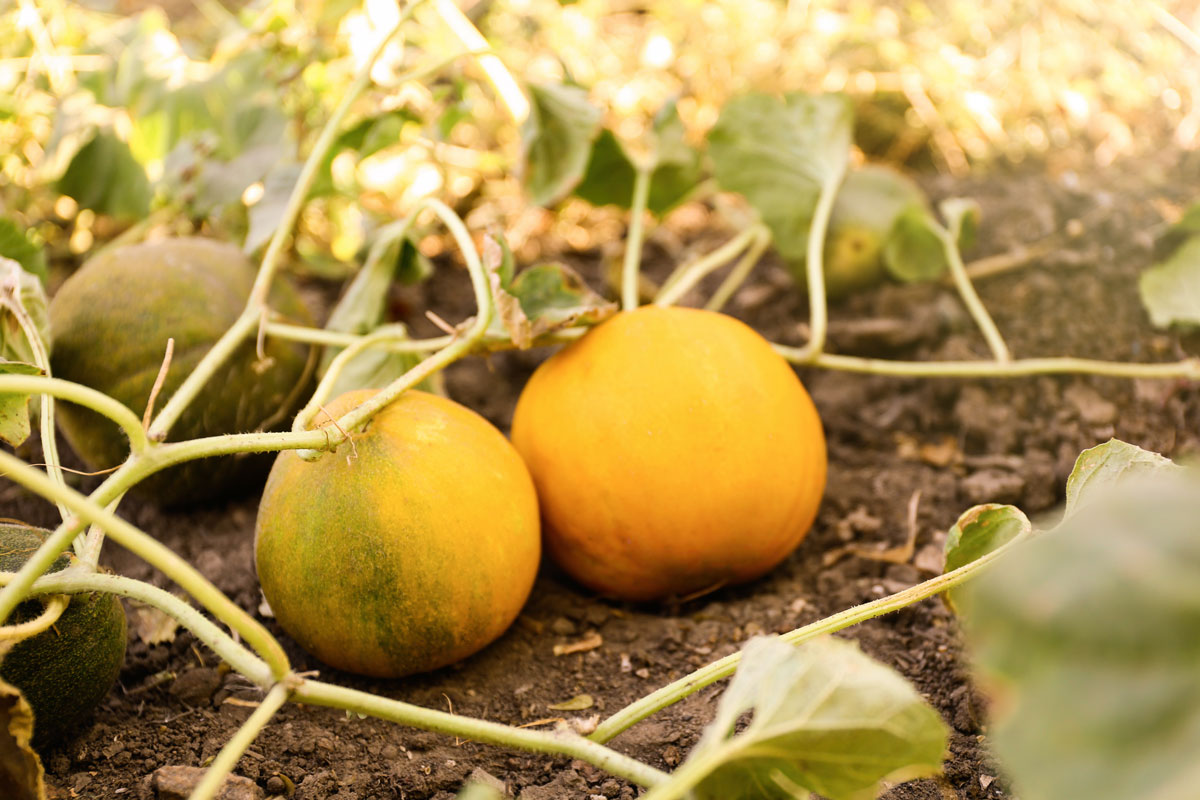
Melons are a bit trickier to grow because they need so much warmth. The honeydew, or sweet melon, is slightly easier to cultivate than the watermelon. Funnily enough, it is more closely related to the cucumber than to the watermelon; both belong to the genus Cucumis. There are even cucumber-like sweet melons that don't taste sweet and are used much like cucumbers. Cut a melon open and you'll spot the family resemblance straight away: the seeds sit in a central cavity, just as in a cucumber.
Melon seeds almost 6000 years old have turned up in excavations of ancient settlements. In Persia and Egypt, sweet melons were grown around 4000 years ago, but the crop only reached Central Europe in the 18th century, and then only in heated greenhouses and hotbeds.
Strictly speaking, the name honeydew refers only to the smooth-skinned yellow winter melons. In seed catalogues, though, the term usually covers all sweet melons, including cantaloupe, netted and Charentais types. For your garden that's an important distinction, because the small-fruited types ripen much earlier.
Honeydew melon is an annual that produces vines several metres long, depending on the variety. It carries male flowers and fruiting flowers on the same plant, with the male ones clearly in the majority. Each flower opens in the morning and closes for good the same afternoon. In Gertrud Franck's row-based companion planting it belongs to group A, and Sister Christa Weinrich treats it as a lead crop. Both mean the same thing: it occupies its spot for the whole season and you plan everything else around it.
Facts and figures
Planting & harvest times of Honeydew melon
OutdoorsTransplant to bed from Late May to Late June. Pre-grow about 30 days before transplanting, approximately between Late April and Late May. After a growing period of 130 days, harvest can begin around Late August and continues until Late October.
GreenhouseTransplant to bed from Late April to Late June. Pre-grow about 30 days before transplanting, approximately between Late March and Late May. After a growing period of 130 days, harvest can begin around Mid August and continues until Mid November.
Plant Honeydew melon
Always start honeydew melons indoors; direct sowing outdoors usually doesn't give enough time to ripen here. Sow from early to mid April, about 30 days before you plan to plant out. For outdoor growing that means sowing from late April to late May, for the greenhouse from late March.
The seeds are best sown straight into a larger pot with potting compost. Don't prick them out, as melons cope badly with root damage. Biodegradable pots that you plant out together with the seedling are ideal. Put two seeds per pot and pull out the weaker plant later. Sow 1 to 2 cm deep; melon germinates in the dark. Soaking for a few hours in lukewarm water gets germination going, and with seeds from a shop-bought fruit you wash off the germination-inhibiting jelly layer under running water. Keep the compost evenly moist but never wet, or the seeds will rot. At 24 to 28 °C the seedlings appear after four to ten days; below 18 °C hardly anything happens.
In the last week before planting out, put the pots outside for a few hours every day, first in partial shade, then in full sun. Without this hardening off you'll get leaf scorch. The plants can only go outdoors after the last frosts in mid May, so from late May to late June; in the greenhouse from late April. More important than the date is the night temperature, which should stay above 10 °C. Below 12 °C the melon simply stops growing. Each plant needs about one to one and a half square metres.
Honeydew melon is self-fertile but not self-pollinating. So it doesn't need a second plant as a pollen donor, but without bees or bumblebees it won't set a single fruit. The pollen is large and sticky, and wind won't carry it to the stigma. In a greenhouse or polytunnel you absolutely must ventilate during flowering, or the yield stays at zero. If no fruit sets, hand pollination with a soft brush in the morning helps, ideally repeated over several days. Planting several plants is still worthwhile, because more flowers open at the same time attract pollinators better. If you find grafted young plants at a specialist nursery, grab them; they're more cold-tolerant and less prone to root diseases.
Location and soil
Full sun, warmth and shelter from wind: that's what makes or breaks melon growing. In our climate this heat-loving plant does best in a greenhouse or a hotbed. A hotbed is a special kind of cold frame with a bottom layer of fresh manure. As the manure breaks down it gives off heat, a kind of natural underfloor heating. Unlike watermelon, however, honeydew melon copes with being planted outdoors in more regions; it doesn't always need a wine-growing climate.
Outdoors, pick a sheltered spot, ideally in front of a south-facing wall that stores heat, perhaps with black plastic sheeting as a ground cover and a polytunnel over the top. The black sheeting warms the soil and keeps the fruit dry at the same time. A mound bed adds extra warmth from the decomposition inside and keeps the sensitive root collar dry. A raised bed in a sunny position also warms up faster than a garden bed.
Honeydew melon needs a humus-rich soil with good water retention that is loose, deep and free-draining. Waterlogging leads reliably to root rot, and heavy, chalky soils are unsuitable. The pH can sit in the slightly acidic to neutral range between 6.0 and 7.0. Ideally prepare the bed in autumn: loosen it deeply and work in mature compost or well-rotted manure. Spring still works too. As a heavy feeder, the melon will thank you for it. Remember this: dry air above the plant, evenly moist root zone below.
In a large pot of at least 30 litres with good drainage you can also grow it in a sheltered spot on a balcony or patio, but do choose compact varieties.
Good and bad companions of Honeydew melon
Dwarf bean and broad bean are the most reliable neighbours for honeydew melon. As legumes they fix nitrogen from the air and don't compete for the same nutrient pool as the heavy-feeding melon, while also shading the soil and keeping it moist.
Since the melon vines only take up a lot of space late in the season, you can use the ground beforehand. Kohlrabi fits well because it's harvested early. The same goes for radish, lettuce and spinach, which make good use of the free bed space in the first weeks after planting out.
The most important companion planting idea for honeydew melon is all about pollination. Because its flowers produce little nectar and full fruit set needs eight to ten bee visits per flower, a pot marigold nearby as a bee forage plant is worthwhile. Nasturtium draws aphids away from the melon leaves, which helps twice over because aphids transmit viruses. Basil and chives in between do no harm and are said to keep mildew away. Don't overdo it with mass-flowering neighbours right alongside, though, or they'll pull the bees' attention away completely.
Things go badly with its own relatives. Cucumber, courgette, pumpkin, cucamelon and above all watermelon share powdery and downy mildew, fusarium and the same pests with honeydew melon. If everything is planted close together, you'll lose the whole crop in a wet year with lots of mildew. Tomato and potato are also heavy feeders and compete for water and nutrients; with potato there's also the earthing up and digging out, which damages the shallow melon roots.
- Shade, wind shelter, ground cover
- Shade, wind shelter, ground cover
- Shared pathogen, spreads through proximity
- Shared pathogen, spreads through proximity
- Shared pathogen, spreads through proximity
- Shared pathogen, spreads through proximity
- Shared pathogen, spreads through proximity
Predecessors and successors of Honeydew melon
Honeydew melon is a true heavy feeder and needs a four-year break before it returns to the same part of the bed. This applies to all cucurbits together, so cucumber, pumpkin, courgette, cucamelon and watermelon too. Soil-borne pathogens such as fusarium survive in the soil and reliably catch the next crop of the same family. So put the melon in a different spot every year.
The best preceding crops are legumes. Pea, dwarf and climbing bean, broad bean or lentils leave nitrogen in the soil via their root nodule bacteria, which the melon uses directly. A green manure of subterranean clover or phacelia works just as well, and it loosens the soil and suppresses weeds too. Spinach is a classic beforehand; it's harvested in spring before the melon goes into the bed at the end of May, and as a light feeder it takes nothing out.
Avoid sweetcorn as a preceding crop, as it's a heavy feeder that draws a lot of nitrogen from the soil. The large brassicas also leave the soil exhausted; two heavy feeders straight after each other rarely go well.
After honeydew melon, the soil gets a rest: lamb's lettuce, winter purslane, radish, carrot or onions as light and medium feeders fit well, as do legumes, which build the nitrogen back up. If the harvest ends early, you can still sow a green manure that dies off in the frost.
- Nitrogen release
- Nitrogen release
- Nitrogen release
- Nitrogen release
- Nitrogen release
- Nitrogen release
- Nitrogen release
- Nitrogen release
- Shared soil-borne pathogen
- Shared soil-borne pathogen
- Shared soil-borne pathogen
- Shared soil-borne pathogen
- Shared soil-borne pathogen
- Shared soil-borne pathogen
- Shared soil-borne pathogen
- Self-incompatibility
- Shared soil-borne pathogen
- Shared soil-borne pathogen
- Shared soil-borne pathogen
- Shared soil-borne pathogen
- Shared soil-borne pathogen
- Shared soil-borne pathogen
- Self-incompatibility
Varieties
For our summers, one rule for honeydew melon stands above all others: early ripening and small-fruited. Late varieties with large fruit simply don't reach ripeness here. Of all things, the classic yellow melon we know from the supermarket, the Yellow Canary or Amarillo, is a winter melon and one of the most difficult options for the garden. It's only worthwhile in very good sites or in a greenhouse.
'Petit Gris de Rennes' has proven itself; it's an old French variety that ripens reliably even in cooler temperatures and produces small round fruit of 500 to 700 g with orange, slightly caramel-flavoured flesh. 'Sweet Granite' ripens very early and is specifically recommended for regions with short summers, but you have to harvest on time or the fruit spoils from the inside. 'Minnesota Midget' is the most interesting choice for small gardens, raised beds and containers because it ripens early and needs little space. 'Blenheim Orange' delivers the largest fruit among the cold-tolerant varieties, up to a kilo. 'Kolchosnitza' was bred for outdoor growing and ripens very evenly with fruit weighing 0.5 to 0.8 kg. If you want the full cantaloupe flavour, try 'Charentais', but it needs plenty of warmth.
You can save your own seed from open-pollinated varieties, and seeds from a shop-bought melon will germinate too, as long as it wasn't a hybrid. Wash the seeds thoroughly, dry them well and store them cool and dark, and they'll stay viable for around six years. Bear in mind that different melon varieties cross freely via insects, so for true-to-type seed you'll need to isolate or hand-pollinate and bag the flowers.
Care and fertilising
Not necessary in warm sites, but in less favourable spots it's a good idea to prune sweet melon plants. Leave 3 to 5 fruits per plant and then shorten the shoots about 3 leaves after the last fruit. Without this limit, honeydew melon sets too many fruits, which then all stay unripe. If you want to be stricter, also pinch out the main shoot after the fifth leaf so the plant forms side shoots early.
In the greenhouse you can train sweet melons up a string. That saves space and improves air circulation, which noticeably reduces mildew pressure. But do support the fruit with a net bag so it doesn't tear off; old tights work just as well. When training upwards you prune more consistently: when the plant has 4 leaves, cut back to 2 leaves, and on the side shoots always leave just 2 leaves as well. If the melons trail on the ground, place each fruit on straw, a board or a small piece of polystyrene, or it will rot from underneath.
While the fruit is growing, water regularly with water that isn't too cold. Use rainwater from the butt or tap water that has stood for a while, and water only around the roots, never over the foliage. Wet leaves are an open invitation to fungal diseases. Better to water less often but thoroughly, so the water soaks a good 20 cm down, and let the surface dry out slightly in between. Once the fruit has reached its final size and is just ripening, don't overdo the watering or it may split. Uneven watering also costs you sugar.
In a well-prepared bed, honeydew melon lives off the compost for a long time. At flowering and during fruit formation it appreciates a top-up of mature compost, nettle tea or organic liquid feed, roughly every two weeks. Potassium demand is high during fruit formation; go easy on nitrogen, because it makes the tissue soft and prone to mildew.
Diseases and pests
Downy mildew (Pseudoperonospora cubensis) is the most dangerous disease of honeydew melon. It shows as yellow, later brown patches on the upper leaf surface and a grey-violet fuzz on the underside that can't be wiped off. After a wet early summer it often strikes suddenly and can wipe out the crop within two weeks, just before ripening. Prevention is everything: resistant varieties, wide spacing, keeping the leaves dry, good ventilation in the greenhouse.
Powdery mildew (Podosphaera xanthii), with its white coating that wipes off, tends to come late in the year after heat and drought. Remove affected leaves early and put them in the household waste, not on the compost. Horsetail tea strengthens the plants as a preventive.
Aphids transmit cucumber mosaic virus, which makes the fruit bitter and stops sugar formation. There's no treatment for viruses, so check the shoot tips regularly, rinse off aphids and encourage beneficial insects such as ladybirds, lacewings and hoverfly larvae. This is exactly where companion planting helps: nasturtium as a trap plant and flowering herbs for beneficials take the pressure off the melon. Ant trails on the plant give away hidden infestations. Remove plants already infected with virus immediately.
Spider mites, with their fine webbing and bronze-coloured leaves, appear in hot, dry air, especially in the greenhouse. Higher humidity and predatory mites help against them. Thrips leave silvery patches with black droppings; blue sticky traps and beneficials work here.
Fusarium wilt makes the plant wilt from the bottom up. You can't fight it; you can only prevent it through crop rotation and grafted plants. Root rot is almost always down to waterlogging; a mound bed keeps the base dry. And quite mundane but deadly: slugs eat freshly planted melons completely overnight, so pick them off in the first weeks and use slug collars.
Harvest and processing
Unfortunately every variety has slightly different signs of ripeness. Common to all is that a strong scent is a good sign, as is a crack starting to appear at the stalk. Ripe fruit then also comes away from the plant easily. Add to that the colour change, from green to a strong yellow in yellow honeydews, to beige or gold in netted and cantaloupe types. The skin gives slightly under gentle pressure at the stalk end, and the leaves often die back even though you're watering regularly. A heavy, almost perfumed smell and brown spots, on the other hand, indicate overripeness. Important to know: sweet melons don't ripen after picking. Harvest too early and you get a bland fruit that won't improve in the fruit bowl either. That's exactly why supermarket melons so often disappoint. Outdoors you can harvest from late August into October, in the greenhouse from mid August. With a growing time of around 130 days from sowing, it pays to make the most of every warm day. Cut the fruit off with a sharp knife and leave the little stub of stalk on, or it spoils faster. Whole fruit keeps for about ten days to two weeks in cool storage, the smooth-skinned winter melons considerably longer, which is where their name comes from. Once cut, the melon belongs covered in the fridge and should be eaten within two to three days, which is rarely a problem. It tastes best well chilled and on its own, classically with air-dried ham or with cheese. It goes in fruit salads, smoothies, sorbet, cold summer soups and chutneys, as well as savoury salads with poultry or prawns. With around 85 per cent water and about 55 kcal per 100 g, it provides vitamin C, folate, vitamin B6 as well as potassium and magnesium. And if a fruit doesn't turn properly sweet after all, don't throw it away: unripe sweet melons taste like cucumber and can be used in exactly the same way.
Open the bed planner Try free for 7 days, web, iOS and Android