
If you want fresh salad greens from your own garden in the middle of winter, miner's lettuce is hard to beat. While most vegetable beds have long been cleared by November, this little plant is just getting started. It grows exactly when almost nothing else does, delivering tender, mild greens right through to spring. Miner's lettuce originally comes from the west coast of North America. Indigenous peoples there knew it as a food plant long before it found its way to Europe by roundabout routes. By now it has settled in so well that it grows wild in some places. At 15 to 30 cm tall, it stays compact. Fleshy, juicy green leaves grow on long stems from a flat rosette. Something special happens at the top of the plant: two leaves fuse into a round disc, and the flower stalk appears to pierce straight through it. This feature makes it unmistakable and explains why it is also called claytonia or perfoliate. Despite the name sometimes causing confusion with summer purslane, the two have nothing in common. Miner's lettuce belongs to the Montiaceae family, while summer purslane is in a completely different plant family. They look entirely different too.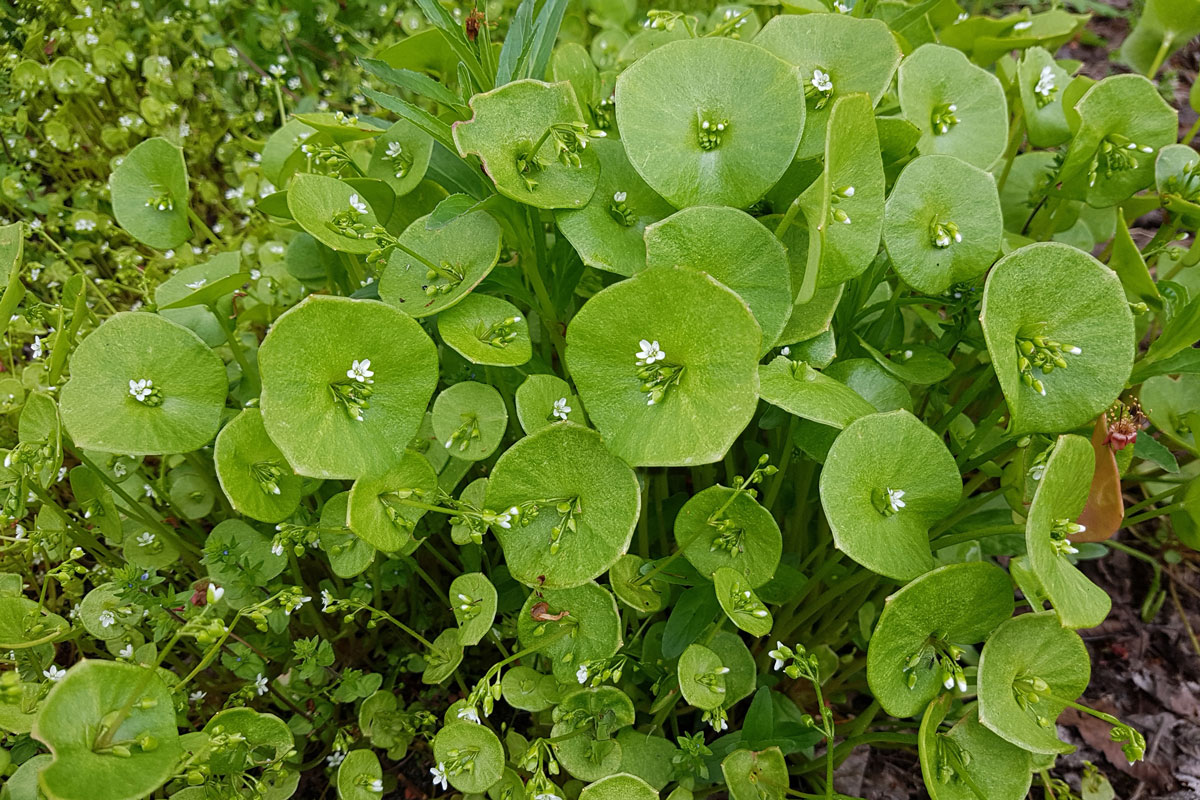
Manfred Ruckszio/Shutterstock.com
Facts and figures
Planting & harvest times of Winter purslane
WinterDirect sowing from Early September to Late December. After a growing period of 45 days, harvest can begin around Mid October and continues until Late April next year.
Winter 2Direct sowing from Early January to Late February. After a growing period of 45 days, harvest can begin around Mid February and continues until Late April.
Sow Winter purslane
Miner's lettuce is a cold germinator. That means it needs cool temperatures below 12 °C, otherwise nothing happens at all. It germinates best at 8 to 12 °C. So a warm room indoors won't work, but outdoors or in an unheated greenhouse it does brilliantly.
Sow from September right through to February. The seeds are tiny. If you mix them with sand before sowing, they spread much more evenly. The seed drills should be no more than one centimetre deep, with 5 to 10 cm spacing within the row, and about 15 cm between rows. Roughly two to three weeks later the first seedlings push through the soil. If things get too crowded, just pull a few out.
You can also start them in advance, but not on a windowsill with a radiator underneath.
For technical reasons, I had to split this into two planting periods (Winter and Winter 2) in our database.
Location and soil
Miner's lettuce prefers it on the shady side. A spot in partial shade or full shade suits it best. Full sun works at a pinch, but the soil dries out faster there, and that is exactly what it doesn't cope with well. Its shallow root system simply can't reach deep down to tap into water reserves.
When it comes to soil, it is undemanding. Loose and humus-rich is ideal, with a bit of sand mixed in. The main thing is that water drains freely without the surface clogging up. If you mix in a shovelful of compost before sowing, you've covered the whole growing period. This brilliant light feeder really doesn't need more than that. And because it roots so shallowly, it also grows perfectly well in pots and window boxes.
Good and bad companions of Winter purslane
Miner's lettuce is easy-going when it comes to neighbours. It is the only food crop in the Montiaceae family. That means there are practically no family conflicts with other vegetables. You can sow it anywhere there's a gap.
Predecessors and successors of Winter purslane
When beans, peas, potatoes or tomatoes have been cleared in late summer, the bed often sits empty. This is exactly where miner's lettuce comes into its own. It makes an ideal follow-on crop for fresh greens heading into winter.
It does especially well after legumes like beans and peas, because they have enriched the soil with nitrogen.
The biggest advantage in crop rotation: since no other vegetable belongs to the same family, you can theoretically sow miner's lettuce after any other crop. As far as I know, there are no negative predecessors or successors on record.
Varieties
There isn't much variety choice with miner's lettuce. In shops you'll usually just find seed of the species Claytonia perfoliata. If you fancy a bit of variety, look out for Siberian miner's lettuce (Claytonia sibirica). It grows in the same way and tastes similar. You'll barely notice any real differences between the two in the bed.
Care and fertilising
Miner's lettuce demands almost no care. Once sown, it just keeps growing as long as the soil stays moist. That really is the only thing you need to watch: don't let it dry out.
Feeding is unnecessary — miner's lettuce is a light feeder.
During hard frost without snow cover, you can lay fleece over the plants. Miner's lettuce is tough and survives temperatures down to minus 15 °C, but a bit of protection helps during extreme bare frost.
If you don't want miner's lettuce spreading all over your garden, cut the flowers off in good time. Otherwise it self-seeds vigorously and pops up next autumn in spots where you might not have wanted it.
Diseases and pests
Miner's lettuce is largely robust and low-maintenance. The biggest threat is slugs, which go for young seedlings in particular. Keep an eye out in the first few weeks after sowing, and pick them off by hand or put up a slug barrier if needed. The fungal disease Alternaria, which causes brownish leaf spots, is rarely an issue in home gardens. Good air circulation and keeping the leaves dry when watering are enough to prevent it.
Harvest and processing
Six to eight weeks after sowing, you can cut the leaves with a sharp knife just above soil level. Leave about 2 cm of stem and the plant will sprout again. Depending on your sowing date, the harvest runs from October to April. During frost it's better to wait, otherwise the leaves go soft and mushy. Young leaves taste like mild spinach with a slightly nutty note and are best eaten raw in salads. Older leaves can be quickly tossed in a pan. Miner's lettuce provides vitamin C, iron, potassium, magnesium and omega-3 fatty acids, with a low nitrate content. In the fridge, loosely covered in a bowl with a damp cloth, the leaves keep well for about a week.