
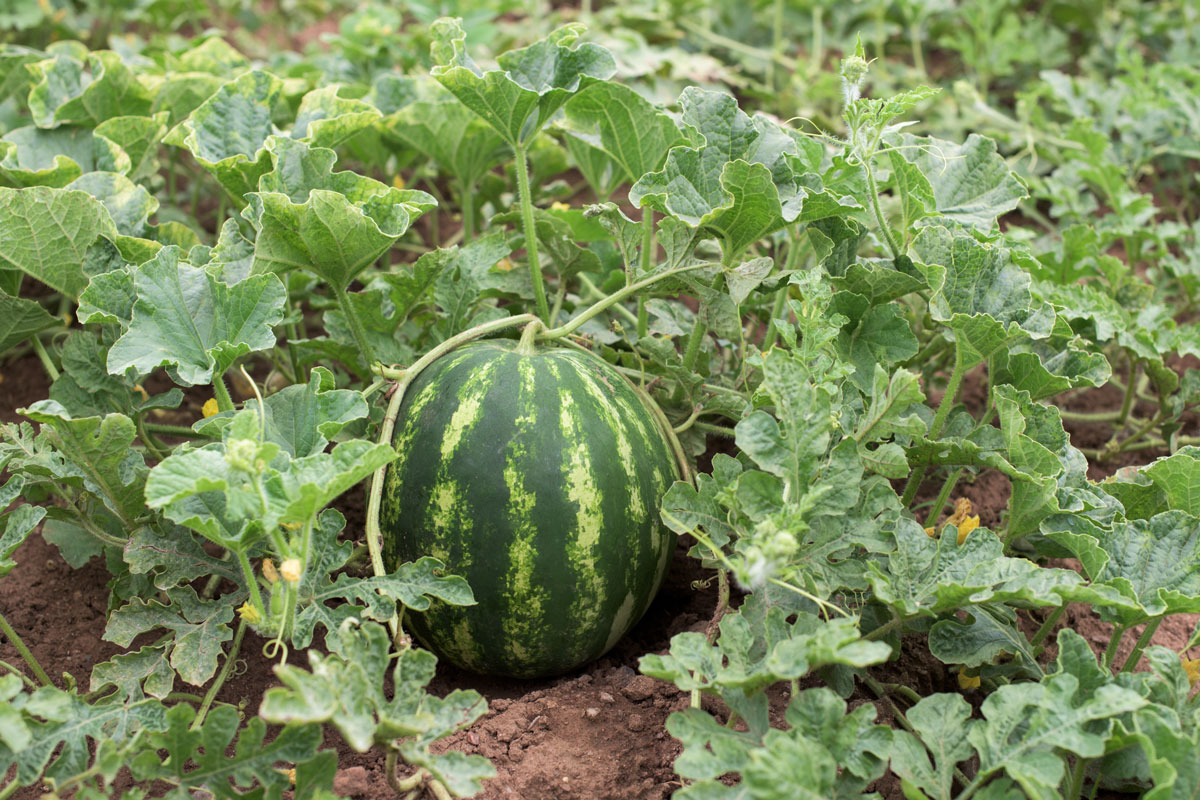
Growing watermelons isn't entirely straightforward, but it works. This annual fruiting vegetable comes from Africa, likes warmth and shelter from wind, and has been cultivated for at least 6,000 years. In its dry homelands the fruit was not just food but a storable source of water. The plant is built exactly for that, with a thick rind, an enormous storage volume and a root that reaches deep down.
Botanically the watermelon belongs to the cucurbit family, but sits in a genus of its own. Sweet melons such as honeydew, netted and Galia melons descend from Cucumis melo and are more closely related to the cucumber. That difference matters in practice, because watermelons need noticeably more heat and are looked after differently. The fruit is a pepo with roughly 95 per cent water content, the flesh usually red, and depending on the variety also yellow, orange or white.
The plant grows prostrate to climbing, with roughly hairy, deeply lobed leaves and long tendrils. Some varieties stay bushy, most spread out widely. Thanks to warmer summers and early-ripening varieties, a home-grown harvest is now realistic here too, but it takes far more attention than courgettes or pumpkins.
Facts and figures
Planting & harvest times of Watermelon
OutdoorsTransplant to bed from Late May to Late June. Pre-grow about 30 days before transplanting, approximately between Late April and Late May. After a growing period of 120 days, harvest can begin around Late August and continues until Mid October.
GreenhouseTransplant to bed from Late April to Late June. Pre-grow about 30 days before transplanting, approximately between Late March and Late May. After a growing period of 120 days, harvest can begin around Mid August and continues until Late October.
Plant Watermelon
Start watermelons indoors, direct sowing outdoors isn't worth it here because the plants would get going far too late. The seeds go straight into a larger pot with potting compost, about 2 to 3 cm deep. Don't prick them out, because they cope badly with root damage and every repotting slows growth for weeks. So they go from the pot straight into the bed.
A tried and tested trick: put three seeds in one pot, keep the compost evenly moist and pinch out the two weaker seedlings after a few weeks. Watermelon germinates in the dark, below 18 °C practically nothing happens, at 22 to 26 °C the seed leaves show after about 7 to 14 days. After that the young plants need plenty of light, but not yet harsh midday sun, and at least 20 °C all the time.
The right moment is about 30 days before you plan to plant out, so late April to late May for outdoors, and around a month earlier for the greenhouse. Sowing too early backfires with leggy plants. The melons only go into the bed after the last frosts, better still two weeks later, once the soil is warmer than 15 °C. Set the young plants in deep, up to the seed leaves, and they should have at least four true leaves by then. Reckon on about one square metre per plant, so roughly 100 x 100 cm. Compact bush varieties manage with 70 to 80 cm, sprawling varieties want 150 cm.
Location and soil
Full sun and shelter from wind are essential for watermelon, six to eight hours of direct sun a day are the minimum. A south-facing wall that stores heat is a dream spot. Cool wind slows the plants down more than anything else.
This heat-loving plant does best here in a greenhouse or a hotbed. A hotbed is a special kind of cold frame with a bottom layer of fresh manure. As it decomposes it produces heat, a natural underfloor heating of sorts. In wine-growing climates some varieties also grow outdoors, perhaps with a black plastic mulch, and you can even raise them in a large pot in a sheltered spot on the balcony or patio. In a polytunnel you have to ventilate well, otherwise mildew moves in.
The soil should be loose, deep, rich in humus and free-draining, with a high water-holding capacity. Watermelon really dislikes heavy, waterlogged ground. Work in mature compost and then let it rest for about four weeks so the soil life can unlock the nutrients. A cleared compost heap, by the way, is the best melon spot a garden has to offer.
Good and bad companions of Watermelon
Sweetcorn is the watermelon's best neighbour. It provides shelter from wind, the tendrils can climb up it, and both love the same warm, nutrient-rich soil. Together with dwarf beans this comes close to the Three Sisters. The beans supply nitrogen through their root nodule bacteria and cover the soil, but keep a little distance, because they don't like their roots right next to each other. Broad bean and pea fit for the same reason.
Sunflower, French marigold and pot marigold around the bed are no mere decoration with watermelon, they mean real extra yield. Female flowers stay open for only about six hours, and enough bees and bumblebees have to come by in that short window. Mass-flowering nectar plants belong in the wider surroundings, though, not in the middle of the melon bed, otherwise they pull the pollinators away from the nectar-poor melon flowers.
Kohlrabi, radish and carrot are good bed partners because they stay compact or are harvested early, before the tendrils spread out. Watermelons don't get on with potato, tomato and pepper, all hungry feeders with a similar water demand or similar disease susceptibility. Don't put other cucurbits such as cucumber, courgette and pumpkin in the same bed, because mildew pressure builds up. Fennel is a matter of debate, we'd rather advise against it.
- Shade, wind shelter, ground cover
- Supports pollination
- Shared pathogen, spreads through proximity
- Shared pathogen, spreads through proximity
- Shared pathogen, spreads through proximity
- Shared pathogen, spreads through proximity
- Shared pathogen, spreads through proximity
Predecessors and successors of Watermelon
With watermelon, crop rotation isn't fine-tuning, it's the only effective protection against fusarium wilt. Leave at least three years between all cucurbits, four years is safer. Cucumber, pumpkin, courgette, honeydew melon, Melothria and watermelon itself are therefore off limits both as preceding and as following crops, because the spores survive for years on plant residues in the soil.
Legumes are ideal as a preceding crop. Pea, dwarf, runner and broad bean, chickpea, soya bean and lentils leave nitrogen behind, which the hungry watermelon benefits from directly. A green manure of subterranean clover or phacelia works just as well and loosens the soil and attracts bees on top of that. French and pot marigolds as a preceding crop pay off on ground that has carried fruiting vegetables for a long time, because French marigold works against root-parasitic nematodes. Spinach, leek and the celery types are unproblematic predecessors too.
Avoid all brassicas and sweetcorn as a preceding crop, they drain the soil and leave it hungry. After the melon, which stays in the bed into October, there's no time for a follow-on crop in the same year anyway. The following year, moderate and light feeders outside the cucurbit family are the right choice.
- Nitrogen release
- Nitrogen release
- Nitrogen release
- Nitrogen release
- Nitrogen release
- Nitrogen release
- Nitrogen release
- Nitrogen release
- Shared soil-borne pathogen
- Shared soil-borne pathogen
- Shared soil-borne pathogen
- Shared soil-borne pathogen
- Shared soil-borne pathogen
- Shared soil-borne pathogen
- Shared soil-borne pathogen
- Self-incompatibility
- Shared soil-borne pathogen
- Shared soil-borne pathogen
- Shared soil-borne pathogen
- Shared soil-borne pathogen
- Shared soil-borne pathogen
- Shared soil-borne pathogen
- Self-incompatibility
Varieties
With watermelon, the variety decides between success and failure. What you want are early-ripening, small-fruited and cold-tolerant breeds, large Mediterranean varieties usually don't ripen here.
The classic is 'Sugar Baby' with smooth, dark green fruits of about 1.5 to 2.5 kg and intensely red, juicy flesh. For small beds there's the compact version 'Bush Sugar Baby', which manages on around one square metre and carries one to two fruits per plant. For cooler sites 'Blacktail Mountain' is recommended most often, it shrugs off cold nights in May and June and produces fruits of around 3 to 5 kg. 'Crimson Sweet' with its striped rind is considered robust and productive, 'Golden Midget' and 'Mini Love' stay small and early, 'Asahi Miyako' grows compactly. If you like variety, try a yellow-fleshed one.
There are two pitfalls with seed. Many varieties are F1 hybrids whose offspring don't come true, and bought young plants are often grafted onto gourd rootstocks. For your own seed you need open-pollinated varieties. You can save yourself the trouble with seeds from supermarket melons, they're usually bred for few seeds and germinate poorly.
Care and fertilising
Unlike sweet melons, watermelon plants must not be pruned, because the flowers and fruits develop at the ends of the tendrils. Cut here and you remove exactly the flower buds. This rule is the most common beginner's mistake, because pruning instructions for sweet melons are often copied without checking.
While the fruits are growing, water regularly and evenly with water that isn't too cold and is as low in lime as possible, ideally in the morning, straight at the root collar and never over the foliage. Unlike the cucumber, watermelon forms no extra roots along its tendrils, so all the water runs through a single point. In hot weather that can easily be 5 to 10 litres per plant every two to three days, but do avoid waterlogging. Once the fruit has reached its final size and is only ripening, don't overdo the watering, or it may split. The name watermelon doesn't come from how much watering it needs, but from the huge amount of water the fruit stores.
As a hungry feeder, watermelon needs plenty of food, especially potassium, which drives sugar content and fruit quality. In practice, well-incorporated compost plus two doses of horn meal or nettle feed are enough, once before flowering and once when the small fruitlets appear. During ripening you stop feeding.
As long as the tendrils don't cover the ground yet you can hoe, after that only weed by hand, otherwise you damage the shallow roots. As soon as fruits form, slip straw, a board or a tile underneath so they don't lie on damp soil. You can also train watermelons up a cord or a net, then the foliage dries faster and slugs have a harder time reaching the fruits. In that case be sure to support the melons in a net bag so they don't tear off.
A word on pollination, because stubborn misconceptions persist here. Watermelon carries male and female flowers on the same plant and is self-fertile, so you don't need a second plant as a pollen donor. But the pollen is large and sticky and isn't carried by the wind, without bees and bumblebees there's no fruit. A well-shaped melon needs at least eight bee visits per female flower, and the flower is receptive for a single morning only. Small or misshapen fruits are therefore almost always a pollination problem, not a feeding problem. In the greenhouse you either have to let insects in or lend a hand yourself in the morning with a brush or a picked male flower, and then on several days. Only seedless triploid varieties really need a second, seed-forming variety as a pollinator.
Diseases and pests
The most dangerous disease of watermelon is fusarium wilt (Fusarium oxysporum). The soil-borne fungus enters through the roots, the plant wilts suddenly, often on one side first, and cutting the stem open reveals brown vascular tissue. There is no cure, infected plants go in the general waste and not on the compost. You can only prevent it through crop rotation with at least a three-year break for all cucurbits, through tolerant varieties and, on known infected ground, through plants grafted onto bottle gourd or fig-leaf gourd.
Powdery mildew (Podosphaera xanthii) shows up in hot, dry summers as a floury white coating on the upper leaf surfaces. Downy mildew (Pseudoperonospora cubensis), by contrast, appears in damp weather, with yellow patches on top and greyish-purple fuzz on the leaf undersides. Against both, airy planting, good ventilation under glass and watering at the base rather than over the foliage help. Remove affected leaves early; if need be, sulphur products are an option in organic growing, but dose sparingly and observe the waiting period. That's exactly why cucumber, courgette and pumpkin shouldn't stand right next to the watermelon.
Among the pests, aphids top the list. They weaken the shoot tips and also transmit viruses such as melon mosaic virus; a sharp jet of water or wiping them off is usually enough. In the greenhouse spider mites cause trouble, recognisable by fine webbing on the leaf undersides, and higher humidity and predatory mites help against them. Thrips leave silvery speckles on the leaves. Slugs go for both the flowers and the fruits lying on the ground, and training the plants up a support is the most effective answer. Against fruit rot it simply helps to lay the melons dry on straw or a board.
Harvest and processing
You can tell ripe watermelons by their dull, hollow sound, unripe fruits have no echo. Even more reliable is the spot where the fruit rests on the ground, which turns from whitish to yellowish. On top of that, the tendril opposite the fruit withers, the stalk dries out and the rind barely shines any more. Take all four signs together and you'll rarely be wrong. In our latitudes don't expect ripe fruits before mid-August. After roughly 120 days of growing you harvest outdoors from about late August to mid-October, in the greenhouse from mid-August to late October. Cut the melon off with a sharp knife, even if it would come away by hand, and leave the short stalk stub on the fruit, otherwise it spoils faster. Very important: watermelons don't ripen after picking. They aren't climacteric, a fruit harvested too early stays bland forever. Undamaged melons keep for two to three weeks at around 13 °C in a cool cellar, best stored so they don't touch each other and don't get bruised. Once cut, they belong covered in the fridge and are past it after about three days. Watermelon tastes best fresh. For cubes, halve the fruit, cut the flesh crosswise and lever the pieces out with the knife. It works in smoothies with berries and mint, in summer salads with pasta or lentils, and marinated on the barbecue it's surprisingly good. Besides plenty of water it provides fibre, minerals, the red pigment lycopene and the amino acid citrulline.
Open the bed planner Try free for 7 days, web, iOS and Android