
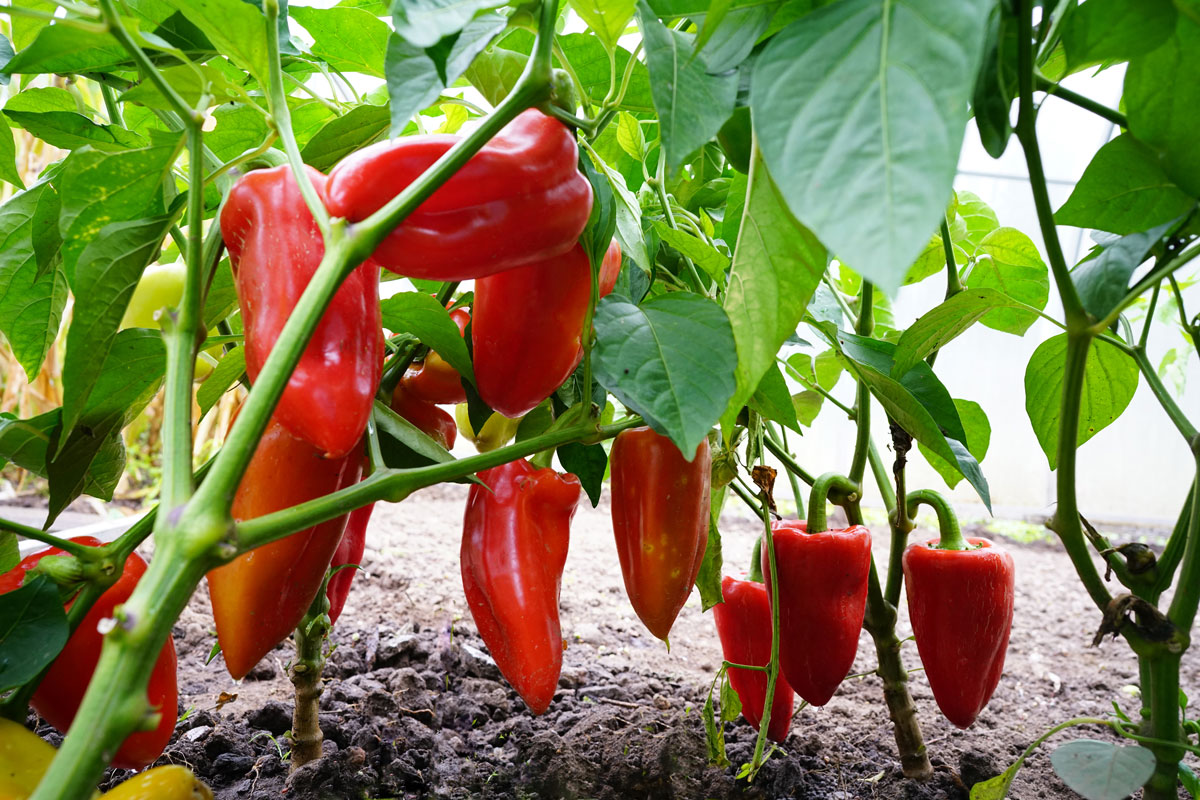
Sweet peppers and chillies are botanically the same plant. When we say peppers, we usually mean the mild, non-hot vegetable peppers, such as bell peppers or sweet pointed peppers.
Together with chillies and aubergines, they need more warmth than any other crop and have a very long growing season. That is why they hardly suit growing outdoors, except in areas with a wine-growing climate. Hardy, early-ripening varieties from Hungary and the Balkans still do well in beds in cooler areas, and you can grow others in pots in a sheltered spot on a balcony or patio.
Facts and figures
Planting & harvest times of Sweet pepper
OutdoorsTransplant to bed from Mid May to Mid June. Pre-grow about 60 days before transplanting, approximately between Mid March and Mid April. After a growing period of 140 days, harvest can begin around Early August and continues until Late October.
GreenhouseTransplant to bed from Late April to Early June. Pre-grow about 60 days before transplanting, approximately between Late February and Early April. After a growing period of 140 days, harvest can begin around Mid July and continues until Early November.
Plant Sweet pepper
Start your peppers indoors, as direct sowing in the bed doesn't work in our climate. Sow from early to mid-March, about eight to ten weeks before the last frosts, or from mid-February for the greenhouse. The seeds germinate best at 25 °C. Below 20 °C they germinate slowly or go mouldy.
After about three weeks, prick out the seedlings a little deeper into their own pots and keep them in a bright spot at 20 to 22 °C. Once well hardened off, plant them outdoors after mid-May, 40 to 50 centimetres apart, or in the greenhouse from late April.
With sweet peppers and chillies, it depends on the variety whether the seeds need light or darkness to germinate. Most germinate in the dark.
Location and soil
Sweet peppers need lots of warmth and light. They grow best in a greenhouse, in a polytunnel or against a sunny, sheltered house wall. The soil should be deep, rich in humus and loose. Peppers cope badly with waterlogging and compacted soil. Below 15 °C the plants drop their flowers, and below 10 °C they stop growing. In a container with 10 to 20 litres of soil they do well on a balcony or patio, because the roots warm up faster there.
Good and bad companions of Sweet pepper
Outdoors, lettuces make good companions for sweet peppers. With at least 60 centimetres between rows, you can plant them in between, ideally varieties that cope with partial shade. Basil needs as much warmth as peppers and counts as one of their best companions in many countries. Thyme works well as a low edging. In the greenhouse this only works in a wide bed, because the peppers cast a lot of shade on the soil. French marigolds between the plants are said to keep whitefly away, as long as they are there from the start. Sister Christa Weinrich recommends parsley, pot marigolds, mustard and brassicas as companions, and carrots, onions and garlic are also seen as good partners.
Where the European corn borer is a problem, sow sweetcorn next to your peppers, even as late as June and August. The moths then stick to the corn and leave the peppers alone.
Fennel is said to stunt the growth of peppers. People say so in many countries, but there is no proof. Peas, beetroot and celery also count as poor neighbours, and in England and France kohlrabi too. An old rule keeps tomatoes, aubergines and potatoes away from peppers, because they supposedly attract the same pests. In the greenhouse they usually grow together anyway. What really matters is the gap in the crop rotation.
- Practical tip for this pair
- Practical tip for this pair
- Practical tip for this pair
- Practical tip for this pair
- Practical tip for this pair
- Practical tip for this pair
- Trap or decoy plant
- Practical tip for this pair
- Practical tip for this pair
- Pest control through scent or camouflage
- Practical tip for this pair
- Shared pest is attracted or multiplies
Predecessors and successors of Sweet pepper
Sweet peppers are heavy feeders and come at the start of the crop rotation. Wait four years before planting them again in a bed that held peppers, chillies, tomatoes, aubergines or potatoes. After cape gooseberries and tomatillos, three years are enough. Otherwise verticillium wilt builds up in the soil. This fungus blocks the plant's vessels and makes it wilt.
As peppers only go into the bed in mid-May, you can still harvest a crop of lettuce or radishes beforehand. Sister Christa Weinrich names both as early crops. Peppers don't need legumes as a preceding crop, because too much nitrogen gives you lots of leaves and few fruits. Well-rotted compost feeds them better.
After the harvest, sow mustard as a green manure in autumn to take up the leftover nitrogen. The following year, cauliflower and romanesco grow well after peppers, while cucamelons struggle after heavy feeders.
- Shared soil-borne pathogen
- Family rule
- Shared soil-borne pathogen
- Shared soil-borne pathogen
- Shared soil-borne pathogen
- Shared soil-borne pathogen
- Family rule
- Shared soil-borne pathogen
- Uptake of residual nitrogen
- Shared soil-borne pathogen
- Family rule
- Shared soil-borne pathogen
- Shared soil-borne pathogen
- Shared soil-borne pathogen
- Family rule
- Shared soil-borne pathogen
Varieties
With peppers, you can tell apart the mild vegetable peppers, such as thick-walled bell peppers, cone-shaped wax peppers, pointed peppers and tomato peppers, from the long pepperoncini and the hot chillies, which have their own plant page. For growing outdoors in cooler areas, choose early-ripening, thinner-walled varieties from Hungary, the Balkans and Burgenland, such as ‘Roter Augsburger’. For the greenhouse and containers, you can find pepper varieties resistant to viruses and verticillium wilt.
Care and fertilising
Don't give peppers all their fertiliser at once, feed them bit by bit: put well-rotted compost in the planting hole and, once the fruits set, give a small dose of plant liquid feed every one to two weeks. Too much nitrogen means leaves instead of fruit and encourages blossom end rot. Water generously and evenly, a thorough soak twice a week rather than a little every day, and never let the soil dry out completely. In cool areas, pinch out the first flower in the fork of the stem so the plant can grow strong first. Tall varieties need a cane or strings, and outdoors a fleece protects them on cold nights.
Diseases and pests
Outdoors, sweet peppers have few problems, but under glass you need to keep a closer eye on them. Aphids are the most common pest, especially the peach-potato aphid. They like to turn up when plants get too little light or too much nitrogen. Keep enough space between plants and spray early with a soft soap solution if you spot them. In the greenhouse, heat and dry air bring red spider mite, thrips and whitefly as well. Humid air and beneficial insects keep them in check.
Aphids also spread viruses such as cucumber mosaic virus. Young pepper leaves then become mottled, crinkled or blistered, and the plants stay small. Viruses can also hide in seed and in tobacco, so wash your hands after smoking.
In mid and late summer, caterpillars of the European corn borer, cabbage moth and tomato moth eat holes in the fruits. Pick them off. Sweetcorn next to the peppers helps against the corn borer.
If your peppers wilt from the bottom up and the vessels in the stem are brown, verticillium wilt is usually to blame. Remove diseased plants and leave four years before growing any nightshade family crop there again. Brown, sunken patches at the tip of the fruit aren't a disease but blossom end rot, caused by uneven watering and heat.
Harvest and processing
You can pick peppers green as soon as the fruits are smooth, glossy and big enough, but they only turn sweet and full of flavour once they change colour. That takes three to six weeks. If you pick regularly, the plant keeps setting new flowers. If too many ripening fruits hang on it, it stalls. Before the first frost, pull up the whole plants and hang them upside down in a frost-free room, where the last fruits will finish colouring. Fresh peppers keep for only about a week, ideally at 10 to 16 °C and not in the fridge, because below 7 °C they spoil quickly. They taste just as good raw in salads, stuffed, roasted or pickled, and ripe red fruits are especially rich in vitamin C.
Open the bed planner Try free for 7 days, web, iOS and Android