
Pot marigold belongs to the daisy family (Asteraceae) and most likely originates from the Mediterranean region. It probably arrived in Central Europe during the Crusades at the end of the 11th century. Since then, it has become a staple in cottage gardens and is hard to imagine them without it. In English, it's also sometimes called calendula, after its Latin name Calendula officinalis. In the garden, pot marigold is a real all-rounder. Its taproot reaches up to 70 cm deep into the soil, loosening it effectively. Through its roots, it releases saponins that drive away harmful nematodes. This makes it an excellent green manure and soil healer. Over 50 species of wild bees and numerous butterflies benefit from its rich supply of pollen and nectar. Hoverflies and lacewings feed on it, and their larvae in turn eat aphids, creating a completely natural form of pest control. The distinctive scent of the plant also keeps wireworms and cabbage whitefly at bay. Pot marigold was named Medicinal Plant of the Year in Germany in 2009. Hildegard von Bingen documented its healing properties as far back as the 12th century. The petals are edible and can be used in many ways in the kitchen. For cats, however, the plant is toxic due to its essential oils.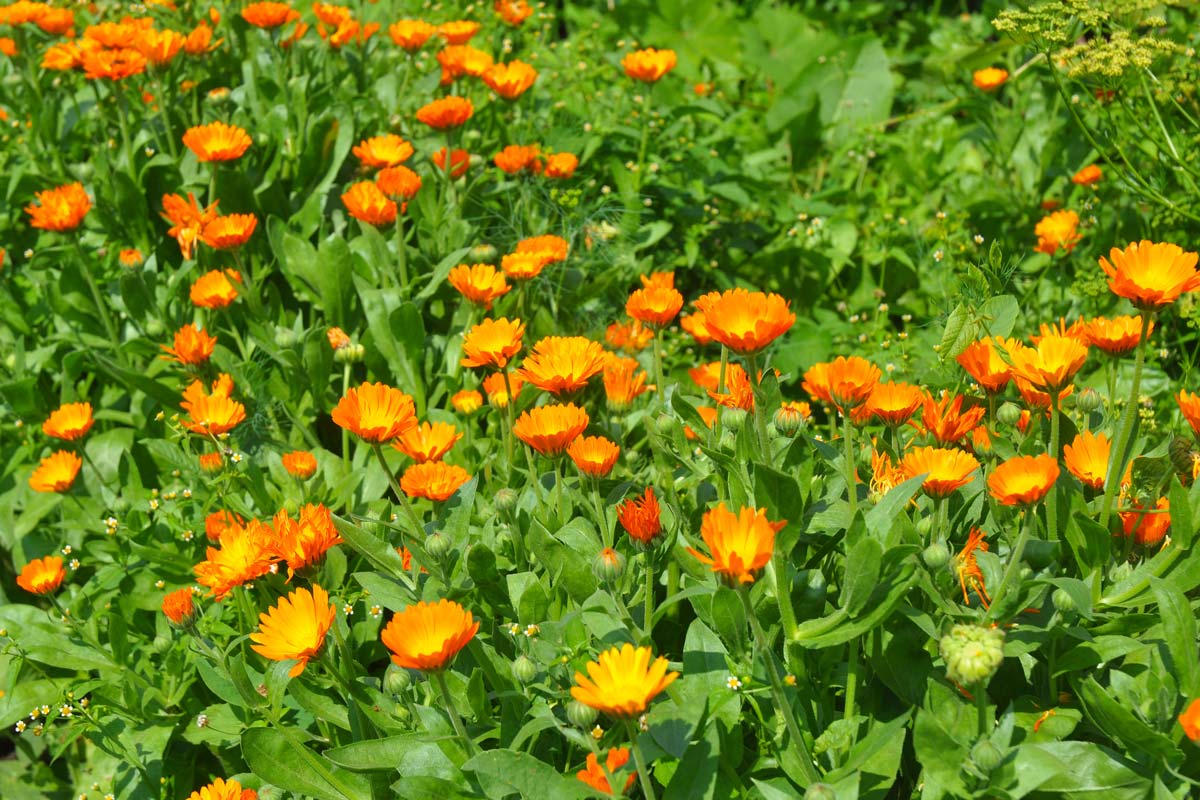
Radovan1/Shutterstock.com
Facts and figures
Planting & harvest times of Pot marigold
SummerDirect sowing from Early April to Mid August. Transplant to bed from Mid May to Late June. Pre-grow about 60 days before planting out, approximately between Mid March and Late April. After a growing period of 75 days, harvest can begin around Early June and continues until Late October.
AutumnDirect sowing from Early September to Late September. After a growing period of 75 days, harvest can begin around Early May and continues until Late July next year.
Sow and plant Pot marigold
Pot marigold is a light germinator that germinates reliably at temperatures from 10 °C. The optimum range is 15 to 20 °C. Place the seeds only about 5 to 10 mm deep in the soil and press them down lightly. The first seedlings appear after about two weeks.
Direct sowing outdoors is the simplest and most common method. You can sow from April right through to August. Staggering the sowing over several weeks extends the flowering period until the first frost. Starting seeds indoors from February or March on a windowsill is also possible; plant the young plants out into the bed after the last frosts in mid-May.
An autumn sowing in mild regions is also an option and gives you a particularly early bloom the following year. Pot marigolds self-seed prolifically. If you leave a few plants standing in autumn, they'll pop up again all on their own the next year.
Location and soil
Pot marigold loves a sunny spot. In full sun, it flowers most abundantly and the bloom colours are particularly vibrant. Partial shade leads to fewer flowers and increases the risk of powdery mildew.
It thrives best in loose, loamy and slightly nutrient-rich soils. The soil should stay slightly moist.
Too much nitrogen in the soil makes the plants leggy and less sturdy, while a lack of phosphorus and potassium reduces flower production.
Good and bad companions of Pot marigold
Pot marigold is usually not grown as a crop in its own right but planted deliberately as a companion flower in beds. A few individual plants or small groups among vegetables and herbs are enough to make use of its benefits.
Next to tomatoes, it's particularly useful. Its root secretions can reduce nematodes that often weaken tomatoes. Potatoes benefit too: the scent of pot marigold can keep wireworms and Colorado beetles away. Strawberries also appreciate the extra protection against nematodes. At the same time, it looks lovely as a relaxed bed edging.
With brassicas like kale, broccoli or savoy cabbage, it can help deter cabbage whitefly. Cucumbers, squash and courgettes benefit mainly from the fact that pot marigold attracts plenty of pollinators. Together with borage, it ensures lots of insect activity in the bed.
Parsley, peas and beans also tend to grow well near it. There are hardly any genuinely bad neighbours.
Predecessors and successors of Pot marigold
In crop rotation, pot marigold plays a special role as a soil improver. Its saponins drive away nematodes, the taproots loosen compacted layers, and after digging in, the plant residues break down quickly.
There's no need for a growing break with pot marigold. You can plant it in the same spot year after year or scatter it across the bed without any problems. Since it readily self-seeds anyway, this often happens all by itself.
Crops that suffer from nematode damage benefit especially as follow-on plantings. Tomatoes, carrots, potatoes and strawberries grow noticeably better after pot marigold. It also works brilliantly as a green manure. Simply sow it any time from March to September, leave it for at least ten weeks, then dig the plants into the soil.
Varieties
For making teas and ointments, there are specially bred varieties with a high concentration of active compounds. Orange varieties generally contain more carotenoids than yellow ones. If you want to do something good for insects, choose single-flowered varieties. Double flowers may look stunning, but they offer less pollen and make it harder for insects to reach the nectar.
Care and fertilising
Pot marigold is one of the most low-maintenance plants around. Cut off spent flowers regularly. This encourages the plant to keep producing new blooms. The more diligently you harvest, the more abundantly it flowers.
Diseases and pests
Powdery mildew (Erysiphaceae) is the most common disease affecting pot marigold. You'll spot it by the white, powdery coating on the leaves. It occurs mainly when plants are spaced too closely and in partially shaded spots. Spraying with diluted milk can also help. Downy mildew (Peronosporaceae) occasionally appears as well, showing as a coating mainly on the undersides of the leaves. Remove any affected plant parts.
Among pests, aphids are the most frequent visitors. Pot marigold usually handles the infestation without much trouble and even serves deliberately as a decoy plant, drawing aphids away from vegetable crops. Lacewings and hoverflies, attracted by the pot marigold, provide natural control.
Harvest and processing
Harvest the flowers of pot marigold as soon as they have fully opened. The main harvest period runs from June to October, and with later sowings sometimes even into November. Pick them in the morning, once the dew has dried. Regular harvesting is the secret to a long flowering season, as every picked flower encourages the plant to produce new ones. For drying, pluck the ray florets (the outer petals) individually and spread them out on paper or a drying frame. The gentlest method is air-drying over two to three days. For medicinal use, the temperature should not exceed 35 to 45 °C. The flowers are fully dried when the flower bases no longer feel springy and the petals come away easily. In the kitchen, you can add the petals fresh to salads, where they contribute a slightly salty-bitter flavour. In the past, they served as an inexpensive substitute for saffron to colour rice or butter. Buds can be pickled in vinegar and used as a caper substitute. Only use the ray florets for this; the rest tastes too bitter. The best-known use is probably calendula ointment, which helps with grazes, dry skin and minor burns. The active compounds it contains, such as flavonoids, saponins and essential oils, reduce inflammation and support cell regeneration. Brewed as a tea, pot marigold is said to soothe digestive complaints. If you're allergic to plants in the daisy family, though, steer clear. For seed saving, wait until around mid-August when the seeds are dry and can be easily rubbed off by hand. Stored in a glass jar in a dry, dark place, they remain viable for three to four years.