
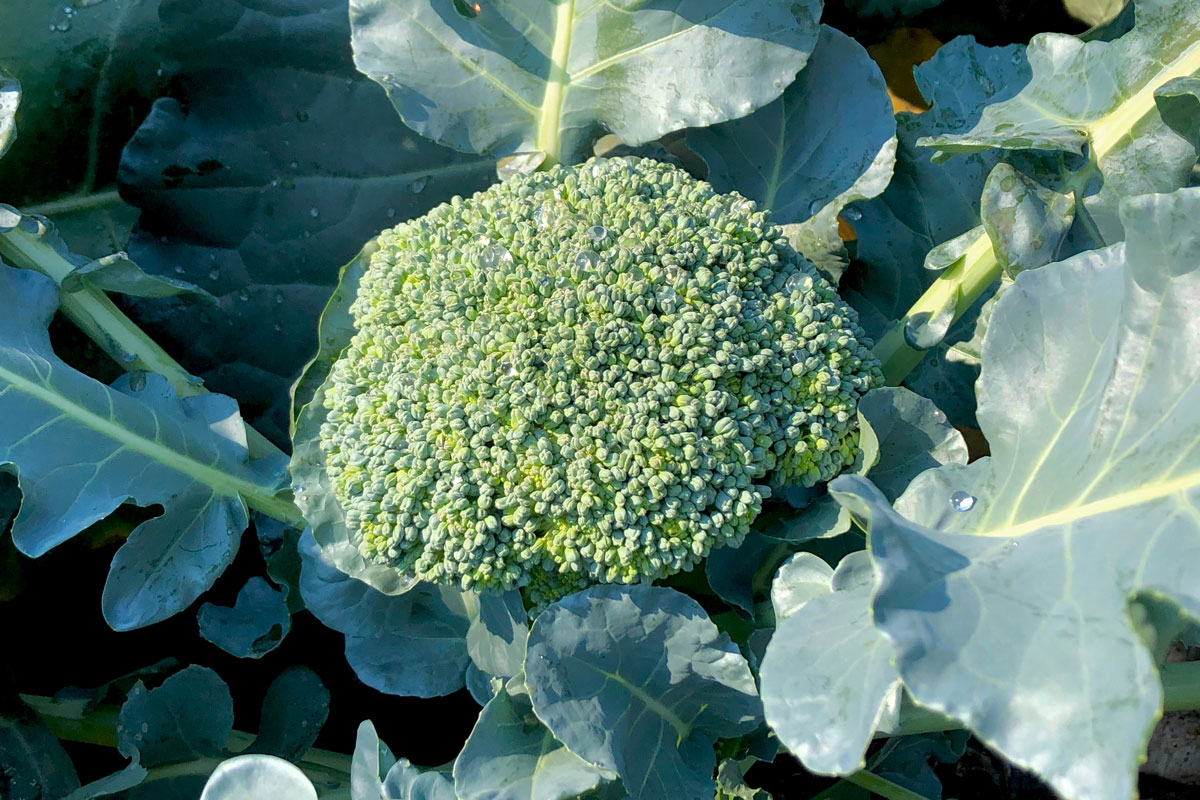
Broccoli is one of the most productive brassicas in the home garden, because you don't just harvest it once. You eat the flower heads while the buds are still tightly closed, along with the fleshy stalk, and once you've cut the main head the plant keeps pushing new little side shoots out of the leaf axils. A single plant gives you fresh florets for the kitchen over several weeks.
The name comes from the Italian brocco, meaning sprout or shoot. Broccoli travelled from Asia Minor via Italy into Europe and has been grown here since the 16th century. Its worldwide reputation as a particularly healthy vegetable came in the 20th century by way of the USA, and not without reason: it's packed with vitamin C, vitamin K, folic acid, beta-carotene plus calcium, potassium and magnesium. Then there are the glucosinolates and sulforaphane, which studies examine for their cancer-inhibiting effect.
Compared with its close relative the cauliflower, broccoli is the easier-going brother. It takes light frost, copes with harsher sites and forgives small mistakes in care more readily. Here it grows 60 to 100 cm tall and puts down deep roots, which helps it through summer dry spells. Leave it standing after harvest and let it flower, and you get excellent bee forage on top of that, plus you encourage parasitic wasps and hoverflies throughout the bed.
Facts and figures
Planting & harvest times of Broccoli
SummerDirect sowing from Early April to Late June. Transplant to bed from Early May to Late July. Pre-grow about 30 days before transplanting, approximately between Early April and Late June. After a growing period of 85 days, harvest can begin around Early June and continues until Late November.
WinterDirect sowing from Early August to Late August. Transplant to bed from Early September to Late September. Pre-grow about 30 days before transplanting, approximately between Early August and Late August. After a growing period of 240 days, harvest can begin around Early April and continues until Late May next year.
Sow and plant Broccoli
Best to raise broccoli under cover, because the young plants need around 30 days before they go out and can use a head start against slugs and weeds in the bed. Direct sowing works too, but gives less reliable stands. Use deep pots for raising, as the roots head downwards early. Press two or three seeds per pot 0.5 to 1 cm deep into lean seed compost, moisten with a spray bottle so nothing gets washed out, and keep them bright at 15 to 20 °C. The seedlings show after 7 to 10 days; prick them out as soon as the first true leaves appear.
For summer broccoli, sow indoors from late February to the end of June and plant out from mid-May to the end of July. You can sow straight into the bed from mid-April to the end of June. Winter broccoli gets sown in August and planted in September, then harvested in April and May the following year. Young plants with blue-purple leaves were raised too cold; better not to plant those out at all.
In the bed each plant gets 50 x 50 cm of space; you can go down to 40 cm in the row if you grow fairly compact varieties. Put the insect netting on as you plant, not two weeks later, otherwise the pests are already underneath. Two to three weeks after planting out, earth the plants up lightly, which steadies the heavy stalks.
Location and soil
Broccoli wants sun to light partial shade and a spot where the wind won't flatten the tall plants. The soil should be rich in humus and nutrients, deep and good at holding water; heavy loam or sandy loam suits it very well. The lime content is decisive: a pH around 7.0 or a little above keeps the plants healthy, while acid soil favours the dreaded clubroot. Work ripe compost in before planting and add seaweed lime if the pH is low.
Even moisture matters more than a lot of water at once. Waterlogging damages the roots and opens the door to fungal diseases, so the bed has to be able to dry out properly. Broccoli only works to a limited extent in a pot; the container should be at least 30 cm deep and needs regular water and feeding.
Good and bad companions of Broccoli
Celery is the most important bed partner for broccoli. Gertrud Franck planted celeriac or celery alternately with cabbage in the same row and noticed that cabbage whites hardly laid any eggs there. Tomatoes also count as good protective neighbours, as long as you aren't putting a net over the broccoli anyway. Dill, borage, pot marigold and French marigold along the edge attract beneficial insects, and thyme and sage are said to confuse cabbage pests with their scent.
Dwarf beans, climbing beans and peas sit well alongside, and so do beetroot, chard, spinach and carrots. While the broccoli is still small, there is plenty of room between the plants. That is where loose-leaf lettuce, butterhead lettuce, lamb's lettuce or a ring of radishes grow, all long harvested by the time the broccoli needs the space, and the lettuce is also meant to keep flea beetles away from the young cabbage. Radicchio and sugarloaf chicory cope with the shade of the big leaves and can stay in place into autumn.
Better not to put potatoes right next to broccoli, and sow garden cress on its own. Nasturtium is itself a food plant for cabbage white caterpillars, and nobody knows for sure whether it takes pressure off the broccoli or draws the butterflies in to begin with. Other brassicas next to broccoli are no problem, as long as you keep them apart in the crop rotation.
- Pest control through scent or camouflage
- Pest control through scent or camouflage
- Pest control through scent or camouflage
- Pest control through scent or camouflage
- Practical tip for this pair
- Pest control through scent or camouflage
- Pest control through scent or camouflage
- Practical tip for this pair
- Practical tip for this pair
- Attracts beneficial insects
- Pest control through scent or camouflage
- Practical tip for this pair
- Practical tip for this pair
- Pest control through scent or camouflage
- Practical tip for this pair
- Pest control through scent or camouflage
- Practical tip for this pair
- Practical tip for this pair
- Practical tip for this pair
- Pest control through scent or camouflage
- Practical tip for this pair
- Pest control through scent or camouflage
- Pest control through scent or camouflage
- Practical tip for this pair
- Pest control through scent or camouflage
- Pest control through scent or camouflage
- Allelopathy, growth inhibition
- Shared pest is attracted or multiplies
Predecessors and successors of Broccoli
Broccoli and all other brassicas need a four-year gap on the same bed. Clubroot, cabbage root fly and swede midge survive in the soil, and after an outbreak of clubroot you should keep brassicas off that spot for seven to ten years. This applies to every type of cabbage, and to rocket, cress and radish too. Mustard as a green manure could be a problem, since it is a brassica as well. Gertrud Franck writes that it is such a distant relative that no negative effects arise.
The best preceding crops for broccoli are peas, beans and other legumes, whose nitrogen the hungry broccoli puts to good use. Cabbages also grow particularly well after onions, garlic and shallots, and lettuce or celery clear the bed in good time. After beetroot, chard, spinach and leek the beet cyst nematode can persist in the soil, and it damages cabbages too. Broccoli harvested early leaves behind a well-rooted bed in summer, which endive or lamb's lettuce can follow; the next year parsnip, leek or beans fit well. Carrots, salsify and lettuce grow less well after cabbages, and onions turn soft after all the crop residues and keep badly in store.
- Nitrogen release
- Nitrogen release
- Nitrogen release
- Nitrogen release
- Nitrogen release
- Nitrogen release
- Nitrogen release
- Nitrogen release
- Both host the same nematode species
- Shared soil-borne pathogen
- Shared soil-borne pathogen
- Shared soil-borne pathogen
- Shared soil-borne pathogen
- Shared soil-borne pathogen
- Both host the same nematode species
- Shared soil-borne pathogen
- Shared soil-borne pathogen
- Self-incompatibility
- Shared soil-borne pathogen
- Self-incompatibility
- Shared soil-borne pathogen
- Self-incompatibility
- Shared soil-borne pathogen
- Self-incompatibility
- Shared soil-borne pathogen
- Shared soil-borne pathogen
- Self-incompatibility
- Shared soil-borne pathogen
- Self-incompatibility
- Shared soil-borne pathogen
- Self-incompatibility
- Shared soil-borne pathogen
- Shared soil-borne pathogen
- Shared soil-borne pathogen
- Self-incompatibility
- Shared soil-borne pathogen
- Self-incompatibility
- Shared soil-borne pathogen
- Self-incompatibility
- Shared soil-borne pathogen
- Self-incompatibility
- Shared soil-borne pathogen
- Shared soil-borne pathogen
- Shared soil-borne pathogen
- Self-incompatibility
- Loosens soil, improves soil structure
- Loosens soil, improves soil structure
- Loosens soil, improves soil structure
- Loosens soil, improves soil structure
- Loosens soil, improves soil structure
- Weed suppression for the next crop
- Loosens soil, improves soil structure
- Loosens soil, improves soil structure
- Loosens soil, improves soil structure
- Loosens soil, improves soil structure
- Shared soil-borne pathogen
- Shared soil-borne pathogen
- Shared soil-borne pathogen
- Too much nitrogen for a sensitive successor
- Shared soil-borne pathogen
- Shared soil-borne pathogen
- Shared soil-borne pathogen
- Too much nitrogen for a sensitive successor
- Both host the same nematode species
- Shared soil-borne pathogen
- Shared soil-borne pathogen
- Self-incompatibility
- Shared soil-borne pathogen
- Self-incompatibility
- Shared soil-borne pathogen
- Self-incompatibility
- Shared soil-borne pathogen
- Self-incompatibility
- Shared soil-borne pathogen
- Shared soil-borne pathogen
- Self-incompatibility
- Shared soil-borne pathogen
- Self-incompatibility
- Shared soil-borne pathogen
- Self-incompatibility
- Shared soil-borne pathogen
- Shared soil-borne pathogen
- Shared soil-borne pathogen
- Self-incompatibility
- Shared soil-borne pathogen
- Self-incompatibility
- Shared soil-borne pathogen
- Self-incompatibility
- Shared soil-borne pathogen
- Self-incompatibility
- Shared soil-borne pathogen
- Shared soil-borne pathogen
- Shared soil-borne pathogen
- Self-incompatibility
Varieties
With broccoli it pays to look at the growing season. Summer varieties crop from July, autumn varieties into November, and winter varieties stand in the bed through the cold season. Then there's the difference between heading broccoli, with one large main head followed by side shoots, and sprouting broccoli, which forms many small florets on long stalks.
Calabrese Natalino is one of the few open-pollinated varieties and the first choice if you grow your own food. This mid-early variety from Calabria tastes mild and slightly nutty, keeps producing after the head is cut right into autumn, and you can save its seed. Purple Sprouting is a purple sprouting broccoli, hardy, can be grown as a perennial and has an almost asparagus-like flavour. If you want lots of side shoots and a long harvest period, Limba is a good fit. Among the hybrids you'll find heat-tolerant types for summer growing and very frost-hardy varieties for the autumn and winter harvest that hold out down to about -10 °C.
Care and fertilising
Even watering decides the head quality with broccoli. The soil should stay permanently moist without sitting wet. Water directly at the root collar where you can, then the leaves stay dry and fungal diseases have a harder time. A mulch layer of grass clippings, comfrey leaves or other mulch holds the moisture, cools the roots in high summer and saves you a lot of weeding. Where you don't mulch, hoe between the rows regularly; that airs the soil and takes away hiding places from pests.
As a heavy feeder, broccoli needs food. Two to three weeks before planting, work in 3 to 4 litres of well-rotted compost per square metre, plus a good 100 g of horn meal for a slow nitrogen supply. Four to six weeks after planting out comes the first top-up feed with diluted nettle feed at 1:10; after another three to four weeks you can feed again and give a little more potassium, which firms up the heads. With winter broccoli the opposite applies: don't feed in autumn, or the tissue goes soft and freezes more easily. Move the feeding to spring.
Hollow stems and brown buds point to boron deficiency, which shows up more often in broccoli than in other brassicas. A balanced compost supply and the occasional soil test help you spot it in time.
Diseases and pests
Clubroot (Plasmodiophora brassicae) is the biggest risk in a broccoli bed. This soil-borne slime mould causes swollen, knobbly roots. The plants struggle, wilt in warm weather and stay small. You cannot treat the pathogen, so put affected plants straight into the household waste and never on the compost heap. To prevent it, leave a four-year gap before growing brassicas again, make sure drainage is good, keep the pH at 7.0 or above and drop a handful of calcified seaweed into the planting hole.
The swede midge hits broccoli harder than any other brassica. Its tiny larvae sit in the heart of the young plant, the leaves twist, and the head either fails to form or breaks up into lots of small shoots. A fine insect-proof net with a mesh of no more than 0.8 mm keeps them out, and you should leave at least two years between two brassica crops on the same bed.
The cabbage white (Pieris brassicae and Pieris rapae) is the most common pest. It is not the butterflies but their green-and-yellow striped caterpillars that strip the leaves down to the ribs. A net fitted from planting day onwards keeps them off, and celery plus strongly scented herbs like thyme around the bed put them off laying. For heavy infestations, a product based on Bacillus thuringiensis works well; otherwise pick off the egg clusters and caterpillars by hand.
The cabbage root fly (Delia radicum) lays its eggs at the base of the stem, and the maggots destroy the roots and stem base. Netting, cardboard collars around the stem base and a sound rotation are the only things that really work. Flea beetles (Phyllotreta spp.) leave round holes in young leaves and show up mainly in dry spells, so moist soil and a layer of mulch slow them down. The cabbage aphid (Brevicoryne brassicae) forms mealy, grey-dusted colonies on the shoot tips. Here beneficial insects help, drawn in by pot marigolds and French marigolds, along with a strong jet of water or a soft soap solution. Downy mildew (Peronospora parasitica) and alternaria leaf spot appear when the leaves stay wet, so generous spacing and watering at the base are your best protection.
Harvest and processing
Harvest broccoli when the main head is compact and a strong blue-green and the buds are still tightly closed. Once they open and turn yellowish the best moment has passed, the flavour turns strongly cabbagey and the nutrients drop off. In heat that happens within a few days, so during the harvest period it's better to look in daily. Cut the head with a sharp knife along with 10 to 15 cm of stalk and a few leaves, and leave the plant standing. Smaller side shoots grow from the leaf axils, and you can keep picking those for weeks. Summer broccoli is ready about 7 to 9 weeks after planting; winter broccoli needs several months and crops in spring. Broccoli doesn't store for long. It keeps 2 to 4 days in the fridge, a little longer wrapped in a damp cloth. If you harvest more, break it into florets, blanch briefly and freeze it. In the kitchen: steam briefly or cook it in the wok rather than boiling it for ages, as that keeps far more of the good stuff.
Open the bed planner Try free for 7 days, web, iOS and Android