
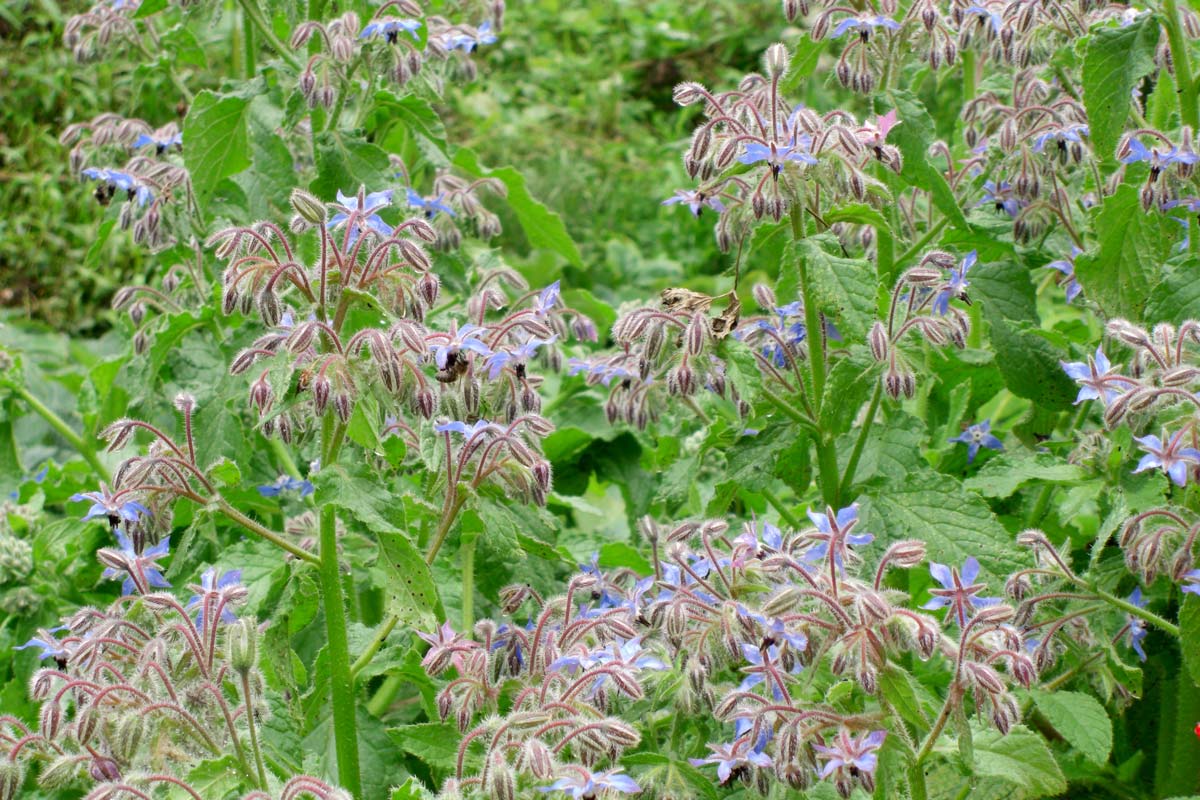
Borage, also known as cucumber herb, is an annual herb from the Mediterranean and belongs to the borage family. The whole plant is covered in coarse, bristly hairs, grows 50 to 70 cm tall and carries sky-blue, star-shaped flowers from early summer into autumn. The young leaves taste of cucumber, and the flowers are edible. For bees and bumblebees, borage is one of the best nectar plants in the vegetable garden. Its strong taproot loosens even heavy soil. Once you have it in your garden, you won't get rid of it in a hurry, because it happily self-seeds.
Facts and figures
Planting & harvest times of Borage
Direct sowing from Early April to Late July. Transplant to bed from Mid April to Late May. Pre-grow about 28 days before transplanting, approximately between Mid March and Late April. After a growing period of 60 days, harvest can begin around Early June and continues until Late October.
Sow and plant Borage
Borage is best sown straight into the bed, because it grows a taproot and doesn't like being transplanted. Sow from April to July, as soon as the soil is warmer than 10 °C. Place the seeds 1 to 2 cm deep, as borage germinates in the dark, and the seedlings appear after one to two weeks. Thin the plants to about 40 cm apart, or simply leave single plants where they come up on their own. For fresh young leaves all summer long, sow again every four weeks. If you want to harvest earlier, sow into small pots from the end of February and plant out with the whole root ball about a month later.
Location and soil
Borage likes sun best but copes with partial shade too. It prefers loose, humus-rich soil that stays evenly moist and can't stand waterlogging. To produce plenty of strong leaves, borage needs fertile soil. On poor or dry ground it stays smaller. It does well in a container as long as the pot is deep enough for the taproot. Because it grows large and spreads, it belongs at the edge of the bed.
Good and bad companions of Borage
Borage is one of the most valuable companions in the vegetable garden, because its flowers attract bees, bumblebees and hoverflies for months. Plants that rely on insects for pollination benefit most. Strawberries with borage next to them give a good third more fruit, and the berries are better shaped. Cucumbers, courgettes, squash and melons are also said to set fruit better thanks to all those flower visitors.
Gertrud Franck sowed borage between kohlrabi and other brassicas, where it was meant to keep pests away. Sister Christa Weinrich prefers to put it at the edges of beds and rows, next to cabbage, potatoes, peas, dwarf beans, lettuce and endive. Anyone who has ever let borage grow knows why: it gets big, spreads out and crowds smaller neighbours. So keep picking the leaves and don't let it flower in the middle of your vegetables. At the edge of the bed it can bloom freely.
In North America, borage is considered a good neighbour for tomatoes and is said to keep caterpillars away. There is no proof of this, but as a bee plant it suits tomatoes and peppers well. There are no known bad neighbours for borage.
- Supports pollination
- Practical tip for this pair
- Pest control through scent or camouflage
- Pest control through scent or camouflage
- Practical tip for this pair
- Pest control through scent or camouflage
- Pest control through scent or camouflage
- Pest control through scent or camouflage
- Practical tip for this pair
- Supports pollination
- Supports pollination
- Practical tip for this pair
- Pest control through scent or camouflage
- Practical tip for this pair
- Pest control through scent or camouflage
- Pest control through scent or camouflage
- Practical tip for this pair
- Practical tip for this pair
- Pest control through scent or camouflage
- Pest control through scent or camouflage
- Pest control through scent or camouflage
- Pest control through scent or camouflage
- Pest control through scent or camouflage
- Supports pollination
- Pest control through scent or camouflage
- Supports pollination
- Pest control through scent or camouflage
Predecessors and successors of Borage
Borage belongs to the borage family and isn't related to any vegetable. It still needs a place in your crop rotation, though, because it is highly susceptible to Sclerotinia, also called white mould. This soil fungus makes the stems rot soft and leaves behind black resting bodies that survive in the soil for many years. Borage produces a particularly large number of them, much like sunflowers. Keep a three-year gap between borage, sunflowers and borage itself.
Many vegetables suffer from Sclerotinia as well: lettuces and chicories, brassicas, beans and peas, carrots, celery and parsley, tomatoes, peppers, cucumbers, squash and courgettes. Only put them where borage grew after three years. Onions, leeks and sweetcorn are fine to grow there without worry.
Because borage self-seeds, it often stays in the same spot for years. So don't leave all the seedlings every year, and pull most of them out early. Its deep taproot brings up nutrients from the subsoil, which also benefits the plants that follow it.
- Shared soil-borne pathogen
- Shared soil-borne pathogen
- Shared soil-borne pathogen
- Shared soil-borne pathogen
- Shared soil-borne pathogen
- Shared soil-borne pathogen
- Shared soil-borne pathogen
- Shared soil-borne pathogen
- Shared soil-borne pathogen
- Shared soil-borne pathogen
- Shared soil-borne pathogen
- Shared soil-borne pathogen
- Shared soil-borne pathogen
- Shared soil-borne pathogen
- Shared soil-borne pathogen
- Shared soil-borne pathogen
- Shared soil-borne pathogen
- Shared soil-borne pathogen
- Shared soil-borne pathogen
- Shared soil-borne pathogen
- Shared soil-borne pathogen
- Shared soil-borne pathogen
- Shared soil-borne pathogen
- Shared soil-borne pathogen
- Shared soil-borne pathogen
- Shared soil-borne pathogen
- Shared soil-borne pathogen
- Shared soil-borne pathogen
- Shared soil-borne pathogen
- Shared soil-borne pathogen
- Shared soil-borne pathogen
- Shared soil-borne pathogen
- Shared soil-borne pathogen
- Shared soil-borne pathogen
- Shared soil-borne pathogen
- Shared soil-borne pathogen
- Shared soil-borne pathogen
- Shared soil-borne pathogen
- Shared soil-borne pathogen
- Shared soil-borne pathogen
- Shared soil-borne pathogen
- Shared soil-borne pathogen
- Shared soil-borne pathogen
- Shared soil-borne pathogen
- Shared soil-borne pathogen
- Shared soil-borne pathogen
- Shared soil-borne pathogen
- Shared soil-borne pathogen
- Shared soil-borne pathogen
- Shared soil-borne pathogen
- Shared soil-borne pathogen
- Shared soil-borne pathogen
- Shared soil-borne pathogen
- Shared soil-borne pathogen
- Shared soil-borne pathogen
- Shared soil-borne pathogen
- Shared soil-borne pathogen
- Shared soil-borne pathogen
- Shared soil-borne pathogen
- Shared soil-borne pathogen
- Shared soil-borne pathogen
- Shared soil-borne pathogen
Varieties
There are only a few varieties of borage. Besides the blue-flowered form, there is the white-flowered 'Alba' and varieties with pale-marked leaves. Creeping borage (Borago pygmaea) is a separate species. It is perennial, grows only 15 to 30 cm tall and spreads with creeping shoots, so it's best planted at the edge of the vegetable garden.
Care and fertilising
Borage needs little care. Water it in dry spells, because it only grows vigorously in moist soil. In a pot it often needs water every day. On a well-fed vegetable bed it doesn't need any extra fertiliser. Its juicy stems snap easily in the wind, so a cane or sturdy neighbouring plants give it support. Cut off spent shoots if you don't want it to self-seed everywhere. You can leave pulled-up plants on the bed as mulch or steep them to make a feeding liquid fertiliser.
Diseases and pests
Borage is tough and has only a few serious problems in the garden. Aphids on the shoot tips are the most common. Ladybirds and hoverflies, which borage attracts itself, often deal with the aphids soon enough. Simply cut off heavily infested shoots.
In late summer, once the main flowering is over, a white, floury coating often appears on the leaves. That's powdery mildew. The borage fungus only attacks plants in the borage family, such as comfrey and forget-me-nots, and doesn't harm the vegetables next to it. Give the plants enough space and pull out badly affected ones. They die off in autumn anyway.
Sclerotinia is more serious. In damp weather the borage stems rot soft, a white fungal growth with black specks forms, and the plant collapses. The black resting bodies stay in the soil for many years and then go on to attack lettuce, beans, cabbage and many other vegetables. Remove diseased plants with all their remains and don't put them on the compost heap.
Painted lady caterpillars sometimes feed on the leaves. Just pick them off. Slugs and snails are said to avoid the rough, hairy leaves.
Harvest and processing
Pick the young borage leaves about six to eight weeks after sowing, ideally before the plant flowers. Later on they turn coarse and lose their delicate flavour. Finely chopped, they go well with cucumber salad, quark, egg dishes and herb sauces such as Frankfurt green sauce. Keep picking the flowers into autumn. They decorate salads and drinks and can be frozen in ice cubes. Borage produces pyrrolizidine alkaloids, substances that can damage the liver and raise the risk of cancer if eaten regularly. So only eat the leaves and flowers occasionally and in small amounts. In folk medicine borage was thought to lift the mood and strengthen the heart, but because of these substances you shouldn't use it as a tea or remedy.
Open the bed planner Try free for 7 days, web, iOS and Android