
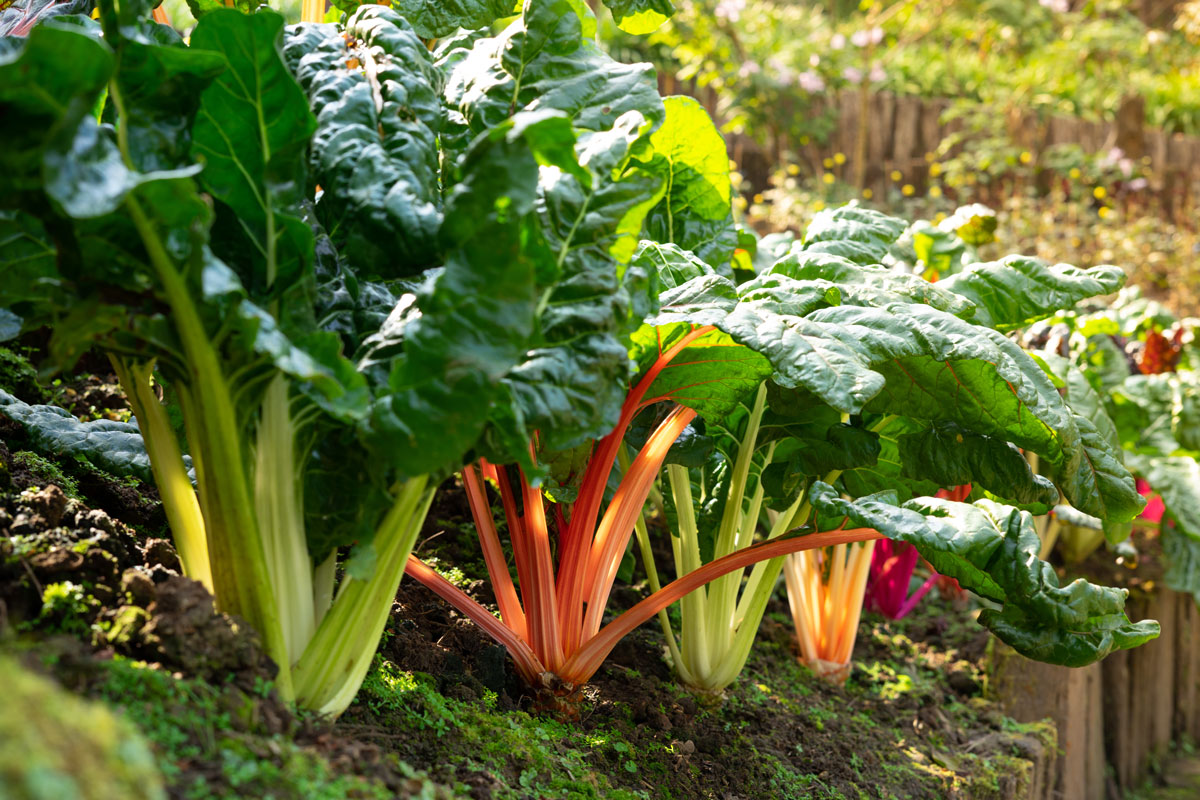
Swiss chard is closely related to beetroot, sugar beet and fodder beet, sharing the same botanical name. They're all the same species, Beta vulgaris, just bred in different directions: with beetroot the selection focused on the root, with chard on the leaf and stem.
In Switzerland, Italy and the Balkans, chard is a standard vegetable in gardens. Over here it's become much more common again in recent years. This vegetable, which brings real flair to the veg patch with colourful varieties in bold shades and striking leaf patterns, is easy to grow and can be harvested right through until winter sets in, and sometimes even into the following spring.
This long harvesting season is its real strength. Swiss chard is biennial and only forms its leaf rosette in the first year. If you always pick just the outer leaves, the plant keeps pushing new growth from the centre for months. It only sends up a flower stalk in the second year.
Then there's the ornamental value. Colourful-stemmed varieties look just as good in herbaceous borders and containers as in the vegetable bed, and anyone who plants veg among ornamentals makes it harder for specialist pests to find their host plant.
Facts and figures
Planting & harvest times of Swiss chard
SpringDirect sowing from Mid April to Mid July. Transplant to bed from Mid May to Mid July. Pre-grow about 30 days before transplanting, approximately between Mid April and Mid June. After a growing period of 80 days, harvest can begin around Mid June and continues until Late April next year.
WinterDirect sowing from Mid August to Mid September. After a growing period of 80 days, harvest can begin around Late October and continues until Mid June next year.
GreenhouseDirect sowing from Early March to Mid July. After a growing period of 80 days, harvest can begin around Early May and continues until Late April next year.
Sow and plant Swiss chard
Swiss chard is usually direct sown, from mid-April to mid-July, about 2 cm deep. The soil should be at least 6 °C; germination is brisk at 16 to 22 °C. Depending on temperature, it takes 4 to 10 days to emerge, and the soil needs to stay evenly moist until then. Summer sowings fail more often from drought than anything else.
Young plants can't handle frost, otherwise there's a high risk of bolting. Behind this is vernalisation: cold at the seedling stage acts like a winter survived, and the actually biennial chard flowers in its first year. If you start early, cover with fleece for that reason. Red-stemmed varieties are particularly susceptible.
A chard seed is a cluster containing up to six ovules. So several seedlings come up from one spot — you need very little seed but absolutely must thin out. When planting, make sure the spacing is generous enough. The plants get surprisingly large and struggle when too crowded. The type of use matters too: stem chard wants 30 to 40 cm within the row, leaf and cutting chard manage with 15 to 25 cm, with rows 30 to 40 cm apart. Planted too tightly, the stems stay thin and the stand dries poorly after rain, encouraging leaf spot and mildew.
When raising indoors, allow about 30 days and plant out from mid-May to mid-July. Keep the seedlings warm, 18 to 20 °C in the first weeks, otherwise you'll get the same bolters as with too-early direct sowing.
For autumn and winter, sow from mid-August to mid-September; in a greenhouse you can start as early as the beginning of March. Overwintering outdoors only succeeds in mild areas or under glass. Green varieties cope better with frost than colourful ones. In winter the plants usually lose their leaves and then sprout again in spring, provided they haven't frozen through. A winter covering of brushwood can help.
Location and soil
Swiss chard likes it sunny but still copes reliably in partial shade. That makes it interesting for those corners of the garden where tomatoes or beetroot wouldn't thrive any more. The spot should be sheltered from wind, because the large leaves catch a lot of it and the fleshy stems snap easily.
It likes humus-rich soil and appreciates a helping of compost in spring. The soil can be deep and nutrient-rich, ideally with some clay content, because clay holds moisture better. Waterlogging, on the other hand, is something chard can't stand.
On acidic soils, a dose of lime helps, and it pays off doubly: Beta species need comparatively large amounts of boron, and at low pH they struggle to access the boron in the soil.
More important than anything else is even moisture. Drought stress leads to thin, tough stems, bitter flavour and bolting. In a pot, chard works well from about 25 cm diameter upwards, with enough depth for the root.
Good and bad companions of Swiss chard
Swiss chard doesn't get on well with tomatoes, cucumbers or spinach. With tomatoes and cucumbers it's about competition: both are heavy feeders, want lots of water and claim space that the spreading chard needs itself. Courgettes and pumpkins simply smother it.
The best neighbours for chard are onions, shallots, spring onions and chives. They need little feeding, root shallowly and narrowly, and leave it room. Almost as good are French beans, peas and broad beans, because their root nodule bacteria fix nitrogen in the bed rather than taking it.
Carrots and parsnips work because they root deeply and narrowly, while chard spreads out shallowly. Lettuce and radishes are classic gap-fillers, harvested long before the chard reaches its full leaf mass. In turn, chard later shades lettuce plantings, which delays bolting in midsummer.
Beetroot and spinach absolutely don't belong next to it. All three share Cercospora leaf spot and the beet leaf miner. Cercospora spreads via splash water directly from leaf to leaf. Planted side by side, you multiply the infection pressure in a tiny space.
Leeks aren't a good neighbour either, even though they stay healthy themselves — more on that under crop rotation.
When planning, bear in mind how long chard occupies the bed. It blocks the space for months. Its neighbours either need to be finished before the canopy closes, or they need to keep pace the whole time.
- Practical tip for this pair
Predecessors and successors of Swiss chard
Between chard and itself or its relatives in the goosefoot family — beetroot, sugar beet, but also spinach — you need a gap of three years. The same applies to orache, strawberry spinach and amaranth. Four years is the safer option, especially if you've already had leaf spot or beet leaf miners in the bed.
The reason lies in the soil. Cercospora survives as resting spores on plant debris, and the beet leaf miner overwinters as a pupa exactly where its host plant stood the year before. Both find a host straight away in the next goosefoot crop.
Potatoes make a particularly good preceding crop because they leave the soil deeply loosened and weed-free. Peas and beans top up the nitrogen reserves, and celery, cucumbers and quick-growing lettuce work well too.
Two preceding crops you should avoid, even though they look harmless. Leeks themselves take no damage but multiply beet cyst nematodes vigorously. The leeks look healthy yet carry the problem. Mustard, as a brassica, is also a host for this nematode, though there is a way round it: nematode-resistant green manure varieties with a resistance rating of 1 to 2 actually reduce the population, but they need to be in the ground by mid-August. Maize isn't a good preceding crop either, because it hosts Rhizoctonia root rot.
After chard, beans of all kinds, celery, lamb's lettuce and winter purslane fit well. Asparagus doesn't, because it can harbour the pathogen causing red root rot.
- Both host the same nematode species
- Both host the same nematode species
- Both host the same nematode species
- Both host the same nematode species
- Both host the same nematode species
- Both host the same nematode species
- Both host the same nematode species
Crop rotation
What stood on that bed three years ago is hard to recall come spring. grove remembers. Once you have planned with it for a few seasons it knows your beds and warns you as you plant when a growing break is still running. The other way round, grove points you to the spots where Swiss chard fits particularly well right now.
As green manure before Swiss chard, grove suggests Oil radish good for example, provided the crop before it fits as well. As the crop before it, grove suggests Cucumber good, Potato good or Pea good. After it come Bush bean good, Pole bean good or Lamb's lettuce good.
As a preceding crop: Spinach very poor, Beetroot very poor, Orache very poor and 8 more plants may only return to the same spot after 3 years. grove still remembers that three years from now. As a following crop: Spinach very poor, Beetroot very poor, Asparagus very poor and 6 more plants may only return to the same spot after 3 years.
And as soon as next year is planned, the Garden Fairy looks for the right green manure for the cold season in between all by itself. How the Garden Fairy works
Plan crop rotation in the bed planner Try free for 7 days, web, iOS and Android
id="textCultivar">Varieties
Broadly, there's a division into leaf chard and stem chard, where the thickened stems are also eaten as a vegetable. With many varieties you get both.
Among the stem chards, 'Walliser' is the variety for early sowings. This old Swiss breeding produces ribs up to 10 cm wide, pure white, and is considered particularly bolt-resistant. 'Rhubarb Chard' delivers intensely red stems with large smooth leaves, 'Bright Lights' is the best-known colourful mix with yellow, red, pink and white stems. 'Fordhook Giant' is the vigorous white-stemmed classic.
For leaf and cut-and-come-again chard, there's no getting past 'Lucullus': light green, slightly crinkled leaves, narrow cream-white ribs, vigorous and with good flavour. The variety is considered winter-hardy, though a covering of leaf litter still helps. From Italy come 'Verde da Taglio' and 'Erbette' as fine cutting chards, and among old German varieties 'Gelber Bündner' and 'Hunsrücker Schnitt' are available.
For overwintering, go for green and white-stemmed varieties — they're significantly more frost-tolerant than the colourful and red ones.
Care and fertilising
Swiss chard is a moderate feeder and therefore only needs moderate fertilising. A dose of compost in spring is usually enough. Because you harvest it over months, though, it actually takes more from the bed than that classification suggests. With a long growing period, give a light organic feed every four to six weeks. Leave out mineral nitrogen, because chard accumulates nitrate and heavy nitrogen feeds increase that markedly.
Water regularly in dry weather. This is the single most important job — daily on hot summer days. A layer of mulch holds moisture, evens out temperature swings and saves you some watering rounds.
Thinning is essential, otherwise you'll only get spindly stems. You can eat the removed seedlings as baby leaf or transplant them. Remove wilted and yellowed leaves regularly — they hamper new growth from the centre and are an entry point for fungal disease. If a flower stalk appears in the first year, snap it out early.
If you have a greenhouse available, you can dig up outdoor chard and, once you've cleared out the tomatoes for example, plant it under cover to secure your winter crop. Outdoors, cover with leaves, brushwood or fleece once frosts begin. Bare frost without snow cover is the real problem, not the cold itself.
Diseases and pests
Cercospora leaf spot (Cercospora beticola) is the most common problem on Swiss chard. You recognise it by many small round spots with a pale grey centre and a distinct reddish-brown margin, appearing first on the older leaves. In severe cases the spots merge and the tissue dies off. Ramularia leaf spot (Ramularia beticola) looks similar but its spots are larger, paler and more angular. Both fungi survive on plant debris in the soil, so clear up thoroughly in autumn and don't compost affected foliage.
Prevention comes mainly through spacing and watering. A stand that dries off quickly after dew and rain gets sick far less often. Water from below rather than over the foliage, and plant chard well away from beetroot and spinach, because these fungi travel short distances via splash water. Downy mildew on Beta species (Peronospora farinosa f. sp. betae) stays within its family and doesn't jump to spinach (which has Peronospora effusa), nor the other way round.
Powdery mildew (Erysiphe betae) leaves a white coating on the leaves and, unlike the leaf spots, appears in dry conditions. Adequate plant spacing is the most effective measure here too.
The most significant pest is the beet leaf miner (Pegomya betae). From April it lays white eggs on the undersides of leaves; the larvae eat pale, silvery-grey tunnels into the leaf tissue. Three to four generations per year are normal, which is why insect mesh from April to September is the most reliable protection. Remove affected leaves and put them in the household waste, not on the compost.
The black bean aphid (Aphis fabae) sits in colonies on the undersides of young leaves and leaves behind sticky honeydew. Pot marigolds and borage in the bed attract hoverflies whose larvae feed on the aphids; nasturtiums work as a trap plant. Young chard plants are also popular with slugs, and flea beetles leave many small round holes in the leaves during dry spells.
Harvest and processing
You can harvest leaves and stems right up until flowering. After that they become tough, stringy and bitter, and oxalic acid increasingly builds up in the stems. Always harvest from the outside. Cut only the large outer leaves at the base and leave the heart standing — the plant then keeps pushing new growth from the centre and you can harvest for months. If you cut the whole rosette, you usually get regrowth, but noticeably less total yield. Cut the stems as low as possible so no stumps remain as a source of rot. The first harvest comes after roughly 80 days, so from a spring sowing that means from mid-June, from an August sowing from late October. For a lower nitrate content, harvest as late in the day as possible and in sunshine, because light breaks down nitrate in the plant. Fresh chard keeps only about two days in the fridge, wrapped in a damp cloth. When you have a glut, blanch it briefly and freeze it — works just like spinach. Prepare the leaves like spinach and the stems more like asparagus; because of the different cooking times, it makes sense to separate them. Swiss chard contains a lot of oxalic acid; a brief blanch roughly halves the content. In larger quantities raw, it's therefore not suitable for small children or people prone to kidney stones. Reheat cooked chard at most once, and do it thoroughly, because slow warming can convert nitrate to nitrite. A squeeze of lemon juice counteracts that.