
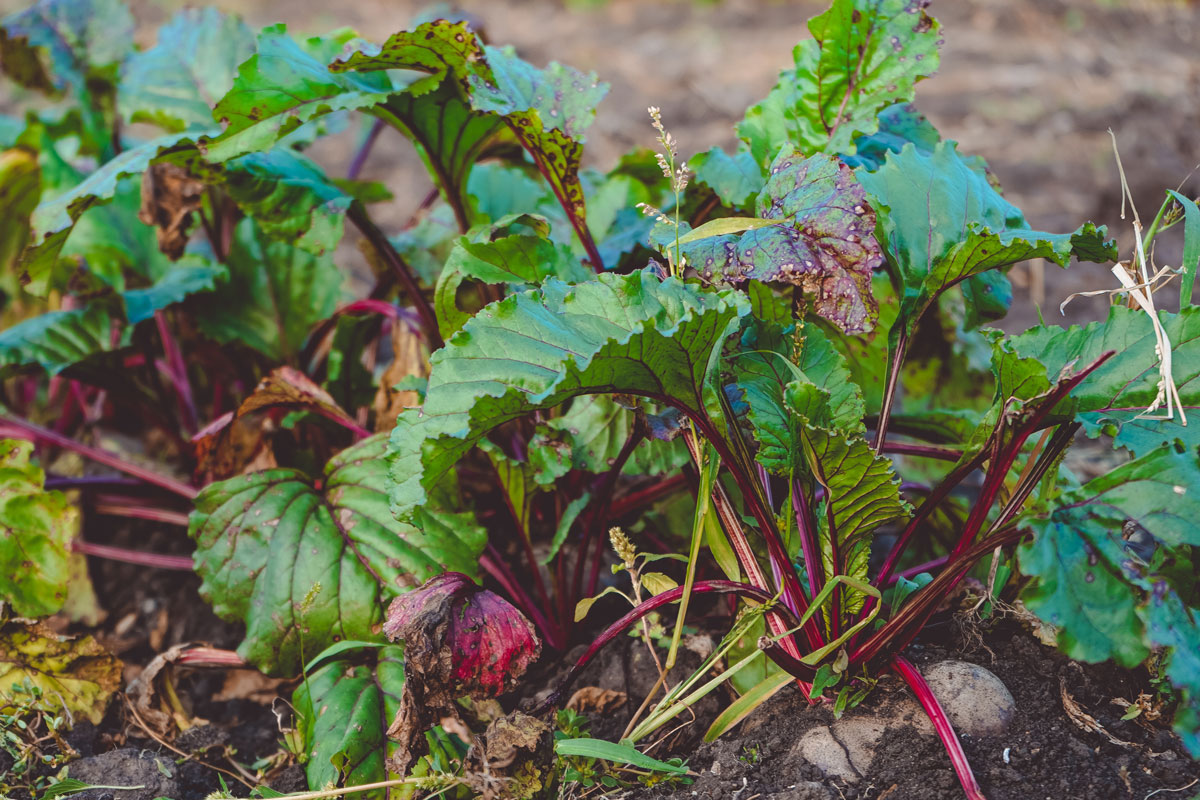
Beetroot is closely related to chard, sugar beet and fodder beet, and shares the botanical name Beta vulgaris with them. They all descend from the wild sea beet of the coastlines, but with beetroot the breeding work focused entirely on the root. The Romans brought it to Central Europe, though the deep red colour only appeared through breeding in the 19th century.
It owes that colour to betanin, which is also used industrially as E 162 to colour food. If you only know the classic dark red globe, you are missing a lot: there are yellow, orange and white varieties, red and white ringed ones, and the shapes range from flat-round through globe-shaped to cylindrical and spindle-shaped.
You can eat the leaves too and cook them like spinach, and young leaves are good raw in a salad. Beetroot is grown as an annual, but it is biennial by nature and would flower and set seed in its second year. It is a rewarding crop for anyone starting out in the vegetable garden: tough, rarely troubled and easy to look after.
Facts and figures
Planting & harvest times of Beetroot
Direct sowing from Mid April to Mid July. Transplant to bed from Mid April to Mid July. Pre-grow about 30 days before transplanting, approximately between Mid March and Mid June. After a growing period of 70 days, harvest can begin around Mid June and continues until Late November.
Sow and plant Beetroot
Sow beetroot directly into the bed from mid-April to mid-July, as soon as the soil reaches 7 to 8 °C. Rush it and you risk bolting, because cold at the seedling stage makes the plant form a flower stem instead of a root. For early sowings, reach for bolt-resistant varieties like 'Boltardy' or 'Rote Kugel'.
Draw the drills 2 to 3 cm deep, with 25 cm between the rows. Sow every 5 to 10 cm in the row and thin to 10 to 15 cm once the seedlings are up. Thinning is nearly always needed, because the seeds come as clusters and one seed produces several seedlings. Varieties like 'Monika' are monogerm and largely save you the job. The thinnings go into the salad bowl as baby leaves.
A few hours soaking in lukewarm water speeds up germination, which runs best at 16 to 22 °C. Raising plants indoors works, but it is unusual because beetroot does not much like being transplanted. If you do, allow around 30 days and harden the plants off beforehand.
For a continuous harvest, sow again every two to three weeks. If you want to store beetroot, plan the last sowing for no earlier than the beginning of June, then the roots are fully mature and ready to store in October and November.
Location and soil
Beetroot wants sun, at least six hours a day. It will still grow in partial shade, but then it stores more nitrate. A spot sheltered from wind is an advantage.
The soil should be deep, loose and rich in humus so the root can swell freely and the taproot beneath it can grow down deep. Beetroot does not tolerate waterlogging, which quickly leads to rot on the roots.
The good pH range lies between 6.5 and 7.5, so neutral to slightly alkaline. Lime soils that are too acidic, and not only for the sake of nutrient availability: beetroot has a high boron requirement and struggles to take up soil boron at a low pH. The result would be heart rot and dry rot, with hollow dark patches in the flesh.
Compost or well-rotted manure before sowing is ideal. Leave out fresh manure, it only pushes the leaves.
Good and bad companions of Beetroot
Onion, shallot, spring onion and chives are the strongest partners for beetroot. They root shallowly and narrowly, offer hardly any competition and keep a fair number of pests away with their sulphurous scent. Garlic also works against voles, which like to gnaw at the roots.
Lettuces fit in well too. They take hardly any nutrients, shade the soil between the rows and are usually harvested before the beetroot really needs the space. Dwarf beans bring nitrogen into the bed through their root nodule bacteria, and brassicas loosen the soil with their strong roots. Dill and savory attract beneficial insects and have always been considered good for flavour and growth.
Chard and spinach, on the other hand, belong well away. All three are closely related and share Cercospora leaf spot and the beet leaf miner, and Cercospora spreads directly from leaf to leaf through splashing water. Carrots are unsuitable for a different reason: two root crops working in the same soil layer compete for space and nutrients. Potatoes and sweetcorn are out as well, the one because of its nutrient hunger and wireworms, the other simply because of the shade it casts. Leeks are no good choice as a direct neighbour either.
Predecessors and successors of Beetroot
Leave a three-year break before beetroot follows itself or its relatives from the goosefoot family, chard and sugar beet, but also spinach. The same goes for orache, strawberry spinach and amaranth. Four years is the safer option.
The reason sits in the soil. Cercospora survives as a resting stage on plant debris, and the beet leaf miner overwinters as a pupa exactly where its host plant stood the previous year.
Peas and beans are ideal as a preceding crop because they leave nitrogen in the soil. Potatoes work well, even though they are unsuitable as a direct neighbour, because as a preceding crop they leave behind a deeply loosened, clean soil. Celeriac, cucumber and quick lettuces are no problem either.
Two preceding crops are worth a second look because they seem harmless. Leek shows no symptoms itself but multiplies the beet cyst nematode strongly. The leek looks healthy and is still carrying the problem. Mustard, as a brassica, is also a host plant of this nematode, but here there is an exception that turns the tables: nematode-resistant green manure varieties with a resistance rating of 1 to 2 actually reduce the population, they just have to be sown by the middle of August. Avoid sweetcorn as a preceding crop, because it hosts Rhizoctonia root rot.
After beetroot, beans, celeriac, lamb's lettuce and winter purslane all fit. Asparagus does not, because it can harbour the pathogen that causes violet root rot.
- Both host the same nematode species
- Both host the same nematode species
- Both host the same nematode species
- Both host the same nematode species
- Both host the same nematode species
- Both host the same nematode species
- Both host the same nematode species
- Both host the same nematode species
Varieties
'Boltardy' is the obvious choice for early sowings. This British variety from the 1960s is notably bolt-resistant, forms even dark red globes and gives tender, sweet flesh. 'Rote Kugel' is the open-pollinated classic with good keeping quality, and it resists bolting too.
Shapes and colours are where it gets interesting. 'Cylindra' forms long cylindrical roots that cut into even slices with no waste, ideal for pickling. 'Tonda di Chioggia' from northern Italy shows red and white rings when you slice it and tastes mild, the most decorative variety for the salad board. 'Boldor' is yellow-orange and does not bleed when cooked, 'Albina Vereduna' is white and equally mild.
For storage, 'Robuschka' is worth it, a biodynamically bred, open-pollinated variety with smooth skin and a fruity, sweet flavour. 'Ägyptische Plattrunde' is the old flat-round traditional variety and matures early. And if thinning annoys you, take the monogerm 'Monika'.
Care and fertilising
Water beetroot evenly, above all during germination and in dry spells. Once the roots start to swell you can ease off, because too much water pushes the leaves at the expense of the root. If a long dry spell suddenly turns into heavy watering, the roots split. A layer of mulch evens out those swings nicely.
Go easy with feeding. As a moderate feeder, beetroot usually manages in a well-prepared bed with no extra feed at all. Skip nitrogen-heavy fertilisers, they raise the nitrate content of the roots and reduce keeping quality. If you do feed, choose something potassium-rich, because beetroot really does need plenty of potassium. Fresh manure is completely unsuitable.
One point that often gets overlooked is boron. On acidic soils with a pH below 6, boron deficiency appears quickly, and you recognise it by heart rot and dry rot, meaning dark hollow patches inside the root. The better route is to raise the pH with a dose of lime rather than adding boron.
Keep the soil between the rows loose and the weeds short as long as the leaves have not yet covered the ground. That noticeably helps the roots swell.
Diseases and pests
Beetroot is tough overall, and if you keep to the rotation break you will have little trouble with most problems. The most common disease is Cercospora leaf spot (Cercospora beticola). It shows up as small round spots with a pale centre and a reddish-brown rim, first on the older leaves. In a heavy attack the foliage dies off, and without leaves the root stops growing. Ramularia leaf spot (Ramularia beticola) looks similar, its spots are larger and paler and it tends to appear in the cooler autumn.
Both fungi survive on plant debris in the soil. Clear the bed thoroughly in autumn and do not compost infected leaves. In mixed planting, distance from chard and spinach helps most, because these fungi travel short distances from plant to plant in splashing water. Water at the base rather than over the foliage.
Powdery mildew (Erysiphe betae) lays a greyish-white coating on the upper leaf surface and, unlike the leaf spots, appears in dry, warm weather. It does not kill cells but it costs yield.
The most important animal pest is the beet leaf miner (Pegomya betae). It lays white eggs on the underside of the leaves, and the larvae mine pale tunnels through the leaf tissue. Insect-proof mesh laid straight after sowing is the most effective protection; otherwise it is usually enough to pick off affected leaves and put them in the household waste.
Aphids sit in colonies on the heart leaves and pass on viruses such as beet mosaic virus. A strong jet of water helps at the start, and pot marigolds or Tagetes nearby attract hoverflies and lacewings, whose larvae finish off the aphids. Young plants also get chewed by flea beetles, which become active above all in dry weather.
Harvest and processing
You can harvest beetroot young after 8 to 10 weeks as baby beet. They are noticeably smaller then, but very tender and full of flavour. The young leaves are just as good in baby leaf salads. Only fully mature roots are suitable for storing, though. Standard varieties need around 120 to 150 days to reach full maturity. Round varieties are ready at 7 to 12 cm across. Do not wait too long, because oversized roots lose flavour, split easily and then rot. Pale rings in the flesh give away a root left in the ground too long. Wilting, ageing foliage, on the other hand, is a good sign, it points to full maturity and the best storage qualities. Lift the roots with a digging fork. Cut the leaves off 2 to 3 cm above the crown rather than tearing them out, otherwise the root bleeds and loses colour and nutrients. Then let them dry off on the bed for a day or two. In store, beetroot keeps until spring. A box of damp sand in the cellar or a frost-free garage works best, cool at 3 to 4 °C, dark and airy but not too dry. In the kitchen you can grate it raw, boil, steam, pickle or juice it. Cook it with the skin on and peel afterwards, that keeps the colour in. Gloves are no luxury, betanin stains thoroughly. Because of the oxalic acid, anyone prone to kidney stones should not overdo it, and it is better to cool cooked beetroot quickly than to leave it standing warm for a long time.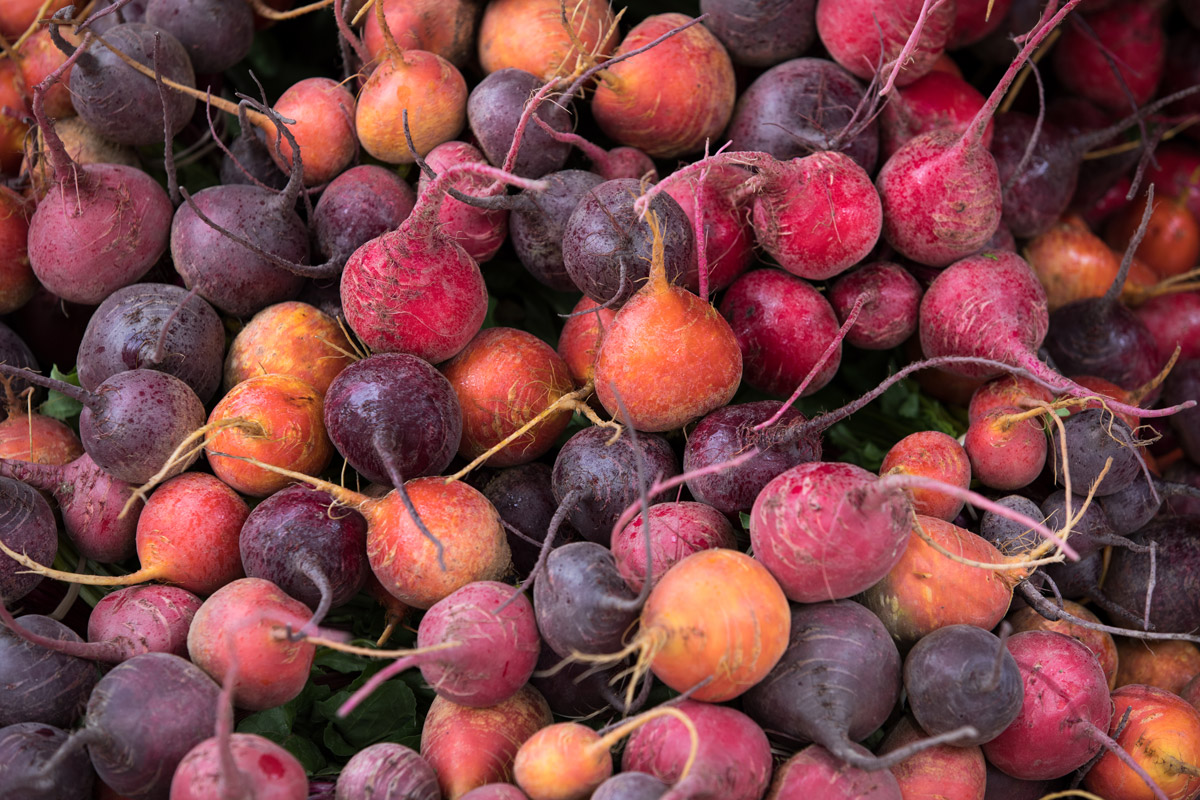
Open the bed planner Try free for 7 days, web, iOS and Android