
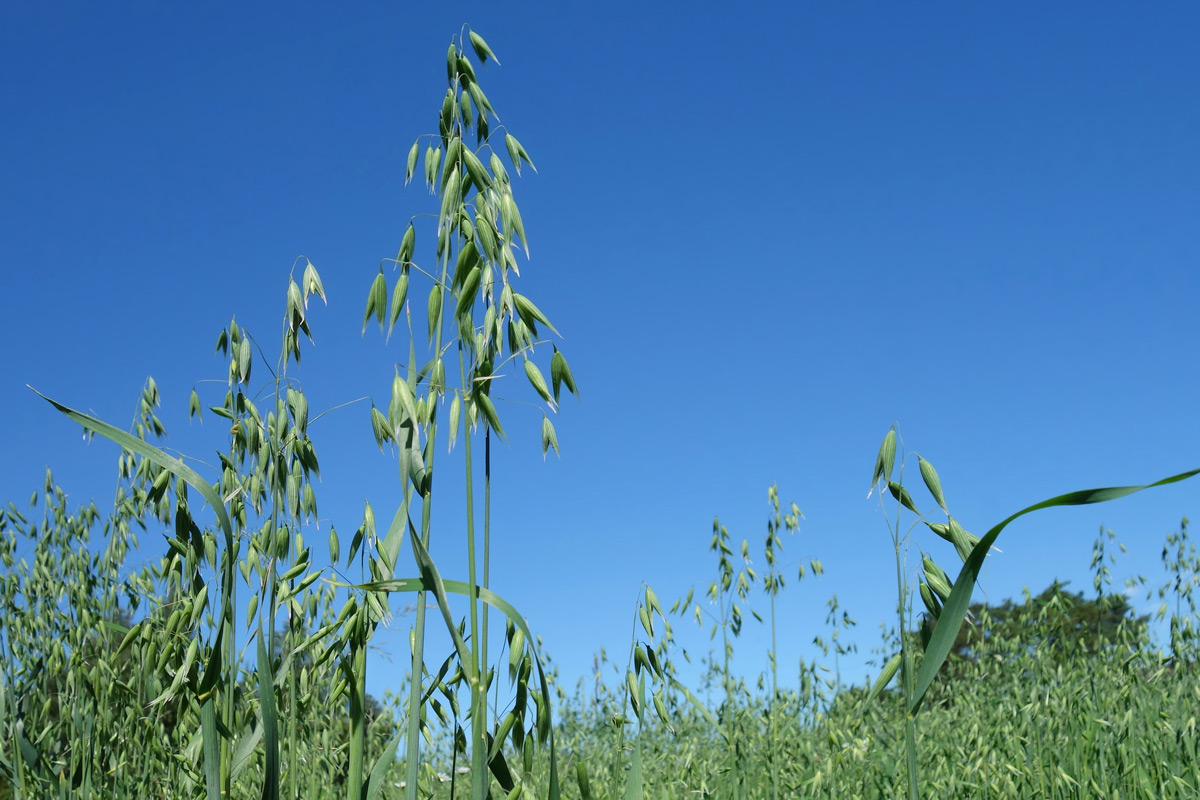
Oats (Avena sativa) belong to the grass family and count among the oldest crops in Central Europe. In the veg garden they play a double role, because you can grow them as a green manure to improve the soil or for a grain harvest. Originally from western Asia, oats spread through the Celts and Germanic peoples across northern Europe and were a staple food until the potato arrived.
Unlike other cereals, oats don't flower in ears. They form a characteristic open panicle that spreads in all directions and bends elegantly downwards as it ripens. The hollow stems reach 60 to 150 cm depending on the variety. Organic growers value oats highly because, as a so-called break crop, they offer no suitable host for many typical cereal diseases and so interrupt disease cycles in the soil.
As a green manure oats have plenty to offer: their root system loosens compacted soil layers, the fast, dense growth suppresses weeds effectively, and they capture surplus nitrogen before it leaches into the groundwater. Grown in a mix with legumes such as vetches or peas, oats act as a supporting crop that the climbing partners can pull themselves up on.
Planting & harvest times of Oats
Direct sowing from Early January to Late December. Transplant to bed from Early January to Late December. Pre-grow about days before transplanting, approximately between Early January and Late December.
Green manureDirect sowing from Early January to Late December. Transplant to bed from Early April to Mid September. Pre-grow about days before transplanting, approximately between Early April and Mid September.
Sow and plant Oats
Oats go into the bed by direct sowing only. Sow spring oats as early as possible, from late February through to April. As a cold germinator they get going at soil temperatures from 4 to 5 °C, and early sowing is very much what you want, because a late sowing leads to a weaker stand.
Sowing depth is 3 to 4 cm. Since oats need darkness to germinate, cover the seed with soil and then firm the area lightly so the seed-to-soil contact gives you even emergence. For broadcast sowing reckon on roughly 150 to 200 g of seed per square metre. Sown in rows, a spacing of 15 to 20 cm between rows is enough.
For green manure you can sow oats from April to the end of August. An autumn sowing as a frost-killed winter cover still works until around the end of September, provided the plants have enough time to build up sufficient biomass. In a mix with vetches or peas, reduce the seed rate of both partners proportionally.
Location and soil
Of all the cereals, oats make the fewest demands on soil and site. They grow best in full sun but cope with partial shade too. Light to medium soils are ideal, though oats have no trouble on heavy clay either. They even tolerate slightly acidic conditions with a pH between 5.0 and 7.0.
They appreciate even soil moisture but also handle short dry spells. Oats feel most at home in temperate climates with enough rainfall. As a light feeder they need no special fertiliser, least of all as a green manure.
Good and bad companions of Oats
Peas are one of the best neighbours for oats in a mix. The oats act as a supporting crop, giving the pea shoots something to hold on to and keeping the stand from collapsing. In return, the peas fix atmospheric nitrogen in the soil, which the oats benefit from as well. Such mixed stands keep aphid populations in check efficiently because they encourage hoverflies.
Broad beans also work superbly alongside oats. In organic farming this combination has proved itself especially in dry years, because the partners can balance each other out when one comes under stress.
Lentils combine well with oats too, particularly on drier sites. The oats provide structure and suppress weeds at the same time.
Maize, on the other hand, is a poor neighbour. Both compete hard for light and nutrients, and maize encourages free-living nematodes in the soil that harm oats.
Predecessors and successors of Oats
In the crop rotation oats count as a break crop, because they are not a suitable host for many cereal diseases such as eyespot or take-all. Grain legumes like peas, broad beans or lentils make ideal preceding crops, as they leave nitrogen in the soil and interrupt the reproductive cycle of cereal pests.
Almost every vegetable crop benefits from following oats: hungry feeders such as cabbage, squash, tomatoes or maize make use of the improved soil structure and the nitrogen released from the incorporated biomass. Root vegetables like carrots, parsnips or beetroot appreciate the deep rooting that oats leave behind in the soil.
Do avoid oats after oats. Growing them back to back builds up cereal cyst nematode in the soil and causes stunted growth. Plan a break of at least two years. You also shouldn't sow oats directly after maize, since maize can encourage fusarium levels and free-living nematodes in the soil.
Varieties
With oats there is a basic distinction between husked oats and naked oats. In husked oats the grain stays enclosed in the hulls and has to be dehulled after harvest. Naked oats shed their hulls during threshing on their own and are therefore better suited to processing in your own kitchen.
For green manure any commercial spring oat variety will do. But if you want to harvest grain, take a closer look at the varieties: Apollon is a yellow husked oat with reliable yields in organic growing. Bison scores with short, sturdy growth and good mildew resistance. For processing grain at home it's worth looking at naked oat varieties such as Saul or Elbany.
Care and fertilising
Oats are the most undemanding cereal there is. Clear weeds before sowing or shortly after, because once the plants have come up well they suppress weeds on their own through their fast, dense growth.
Watering is only needed during prolonged dry spells in the germination phase. After that oats manage fine. As a green manure you can skip fertiliser completely. The biggest practical problem in cultivation is lodging, meaning the stems buckling over in wind or from too lush growth. In a garden without mineral fertiliser this rarely happens.
If you're using oats as a green manure, work them in before the seed ripens, around 6 to 8 weeks after germination, when the biomass is at its maximum but still lush and green. After incorporating, allow at least 4 to 6 weeks for rotting before the following crop goes into the ground. From an autumn sowing, oats are killed off by temperatures below minus 8 °C and form a protective mulch layer that you can simply hoe in come spring.
Diseases and pests
Oats are considerably tougher than other cereals, but there are still a few problems worth knowing about. Oat loose smut (Ustilago avenae) is a seed-borne fungal disease: infected panicles form black-brown masses of spores instead of grain. For green manure that's irrelevant, since you're not harvesting any grain. If you're growing oats to eat, use certified seed and resistant varieties.
Powdery mildew (Blumeria graminis) shows up as a white, floury coating on leaves and stems, mainly in warm, dry weather. Sturdy varieties like Bison are noticeably more resistant.
The most important pest is the cereal cyst nematode (Heterodera avenae), which causes patches of stunted growth. This nematode builds up in the soil above all when oats follow oats, which is why a break of at least two, better three years matters so much. In mixed cultures with legumes, aphid populations also collapse faster than in pure stands, because beneficial insects such as hoverflies can multiply better there.
Harvest and processing
As a food grain, oats are ready to harvest from mid-August, once the grains have reached a moisture content of around 14 %. Waiting too long increases the risk of the grains sprouting on the stem. Husked oats still have to be dehulled after threshing, which is barely feasible in the garden without special equipment. Naked oats, by contrast, can be processed straight after threshing and cleaning, which makes them far better for home use. As a green manure, cut or mulch the oats shortly before or at the start of flowering, when the biomass is greatest and the carbon-to-nitrogen ratio is still favourable for quick rotting. Dried oat grains keep for several years stored cool and dry. Paper bags or breathable containers are best.