
Asparagus is a perennial plant that stays in the same spot for 8 to 15 years and can be harvested annually. Botanically, Asparagus officinalis belongs to the asparagus family and originally comes from the warm regions of southern Europe and western Asia. The Romans already cultivated it systematically and brought it across the Alps to central Europe. The plant forms a sturdy underground rhizome (rootstock), from which the prized shoots emerge in spring. Above ground, a bushy, finely branched foliage develops in summer, reaching 60 to 150 cm in height with needle-like cladodes. Asparagus is dioecious, meaning there are male and female plants. The males are more productive and longer-lived, which is why modern varieties are often all-male. Female plants produce small red berries in late summer that are mildly toxic. For the home garden, green asparagus is a much better choice than white asparagus. You can skip the laborious earthing-up of ridges entirely, the flavour is more robust and the content of health-promoting compounds is higher. Asparagus has a diuretic effect and stimulates the metabolism. Growing it does require some experience, though: you can only start harvesting from the third year onwards, and the soil needs thorough preparation.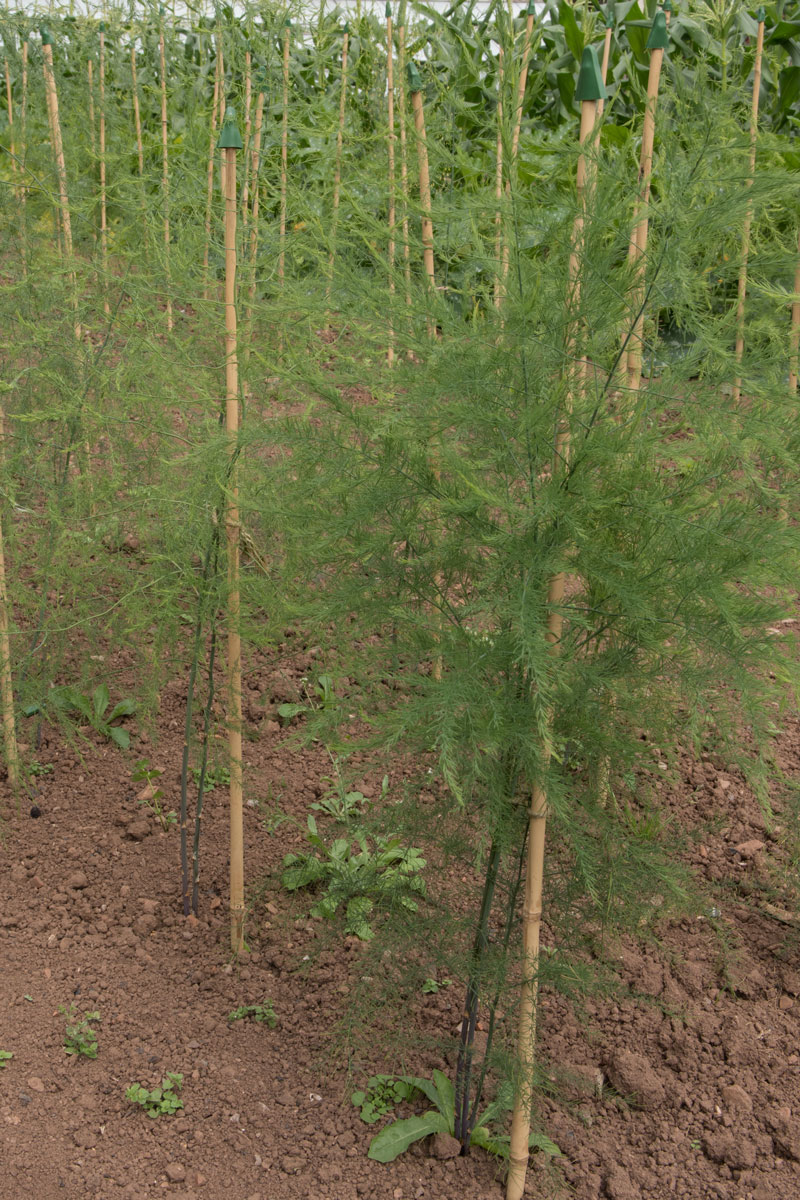
Peter Turner Photography/Shutterstock.com
Facts and figures
Planting & harvest times of Asparagus
Transplant to bed from Late March to Mid May. After a growing period of 730 days, harvest can begin around Mid April and continues until Mid June.
Plant Asparagus
In the home garden, asparagus is best planted using one-year-old rhizomes (known as crowns), which you can get from specialist suppliers. Growing from seed is possible but adds at least an extra year and isn't worthwhile for most people.
The best time to plant is between late March and mid-May, once severe ground frosts are no longer expected and the soil temperature has reached at least 12 °C. For planting, dig a trench 30 to 40 cm deep and about 45 cm wide. Cover the bottom with a 10 to 15 cm layer of well-rotted compost or manure. Shape small mounds on top at 35 cm intervals and place one crown on each, carefully spreading the roots out in all directions. For green asparagus, the rhizomes should sit about 10 to 15 cm below the soil surface; for white asparagus, 20 to 25 cm. Then gradually backfill the trench. Row spacing for green asparagus is 100 to 150 cm.
Ideally, prepare the soil one to two years before planting with green manure and compost. A north-south orientation of the bed ensures even sun exposure. Reckon on 8 to 25 plants per person, depending on how much you want to harvest.
Location and soil
Asparagus needs a fully sunny, warm and ideally sheltered spot. The soil must be deep, loose and well-drained. Light, humus-rich sandy soils or sandy loams work best. The topsoil layer should be at least 40 to 60 cm deep and free of stones and larger roots.
Waterlogging quickly leads to root rot. Green asparagus is a bit more tolerant and can cope with medium-heavy, slightly loamy or gravelly soils. You can improve heavy soils by working in sand.
Good and bad companions of Asparagus
Dwarf French beans and peas are among the best neighbours for asparagus. As legumes, they fix atmospheric nitrogen in the soil and supply this heavy feeder with exactly the nutrient it needs most. A practical tip: sow dwarf French beans every 40 cm next to the asparagus mound in spring, and they'll be in full harvest by the time the asparagus season ends.
Lettuce and kohlrabi also work brilliantly, as these shallow-rooted plants use the upper soil layers while the deep-rooted asparagus draws its nutrients from further down. Cucumbers, dill and parsley are good companions too. Tomatoes use different soil layers and can help protect each other from pests. Pot marigolds and French marigolds promote soil health and keep pests at bay. Place companion plants so they don't get in the way of the asparagus harvest — only between every other row.
Alliums and potatoes are considered poor neighbours.
Predecessors and successors of Asparagus
Since asparagus is a permanent crop that stays in the same spot for 8 to 15 years, it falls outside the normal crop rotation and is treated as a special culture.
Never plant asparagus after carrots, potatoes or beets. These crops can harbour the soil fungus Rhizoctonia, which severely damages the asparagus storage roots. After clearing an old asparagus bed, the most important rule applies: never plant asparagus on the same plot straight away. The recommended break is at least 10, ideally 20 years, as root remnants can remain in the soil even a decade after clearing and Fusarium fungi will hamper the growth of new plants.
Varieties
Modern F1 hybrid varieties offer significantly higher yields and better disease resistance compared to older varieties. All-male varieties are more productive and longer-lived than mixed-sex varieties. If seed sovereignty matters to you, go for open-pollinated varieties like 'Huchels Alpha' or 'Ariane' — you can propagate these from seed yourself, though it takes a bit more patience.
For white asparagus, 'Gijnlim' is a proven all-round variety that sprouts early and is Fusarium-tolerant. 'Cumulus' impresses with uniformly thick spears and good asparagus rust resistance. If you have heavier soils, 'Rapsody' is a solid choice. The open-pollinated variety 'Huchels Alpha' is well-suited for organic growing and develops a fine, nutty flavour.
For green asparagus, 'Schneewittchen' has established itself as a classic, producing uniformly green spears with a delicate taste. 'Primaverde' is an all-male hybrid with early harvests and high yields. If you fancy experimenting, there are purple varieties like 'Burgundine', which is particularly good for eating raw — though the purple colour sadly disappears during cooking.
Care and fertilising
Asparagus is a heavy feeder and needs well-planned nutrition throughout its entire lifespan. In the first two years after planting, it mainly needs nitrogen and trace elements. From spring onwards, apply an organic slow-release fertiliser, with a second application in June. Diluted nettle liquid feed works brilliantly as a supplementary fertiliser during the growing season, but don't use it during the harvest weeks. From the third year, work plenty of compost or manure between the rows.
When it comes to watering: keep it regular but don't overdo it. About 5 litres per square metre per week is enough as a baseline, though you can give more during the hot harvest period. In the first year especially, the soil must never dry out. Rainwater is best — cold tap water can cause a temperature shock.
A layer of mulch from grass clippings or compost keeps the soil moist and loose and suppresses weeds. For white asparagus, from March onwards you mound loose soil about 35 cm high over the plants to form a ridge. Black plastic film over this ridge speeds up warming. For green asparagus, you can cover with fleece instead and bring the harvest forward by about two weeks.
In autumn, cut the yellowed foliage down to ground level. This is crucial: don't put the foliage on your own compost heap, as asparagus beetles and rust spores can overwinter in it. Then cover the bed with compost or mulch for winter protection.
Diseases and pests
Asparagus rust (Puccinia asparagi) is the most common fungal disease. From mid-May, yellow-orange spots appear on leaves and stems, later turning reddish-brown to black. Yield losses can reach 30 per cent or more. The most important countermeasure: consistently remove and dispose of old foliage in autumn, as the spores overwinter there. Resistant varieties like 'Cumulus' or 'Rapsody' offer additional protection.
Fusarium wilt (Fusarium oxysporum f. sp. asparagi) is particularly insidious because it cannot be treated. Affected plants sprout poorly, the roots rot and turn black. Loose soil with good drainage and Fusarium-tolerant varieties are the only prevention. Sticking to the long cropping break is the single most important protective measure here.
Among the pests, the asparagus fly (Platyparea poeciloptera) is the most dangerous enemy. Its larvae bore into the spears, which then curl and wilt. Crop protection nets and sticky traps help in the home garden. The asparagus beetle (Crioceris asparagi) and the twelve-spotted asparagus beetle (Crioceris duodecimpunctata) feed on shoots and foliage. Beneficial insects like ladybirds and parasitic wasps help against pests.
Harvest and processing
Patience is part of the deal with asparagus. You can only start harvesting from the third year, and then only for about four weeks at first, so as not to exhaust the plant. From the fourth to fifth year, six to eight weeks of harvesting are possible. The traditional end of the harvest season is 24th June, Midsummer's Day. After that, leave all shoots to grow. Even before the harvest ends, leave at least three to five strong spears per plant to develop into fern. The feathery asparagus foliage isn't decorative — it's essential photosynthesis area. Over the summer, the plant uses it to replenish its underground storage roots; the more green foliage, the better the starting point for next year. In autumn, once the foliage has turned yellow and dry, cut it down to ground level. Green asparagus is simply cut at ground level with a sharp knife once the spears are 15 to 25 cm tall and the tips are still tightly closed. The best time for this is early morning, when the sugar and flavour content is at its peak. In June, asparagus can grow up to 15 cm per day, so you sometimes need to check twice a day. Leave spears that are too thin — they strengthen the plant. For white asparagus, use an asparagus knife to cut 25 to 30 cm deep into the ridge as soon as fine cracks appear in the soil surface. Process freshly harvested asparagus on the same day if possible. White asparagus keeps for two to four days in the fridge wrapped in a damp cloth. Green asparagus is best stored upright in a glass of cold water.