
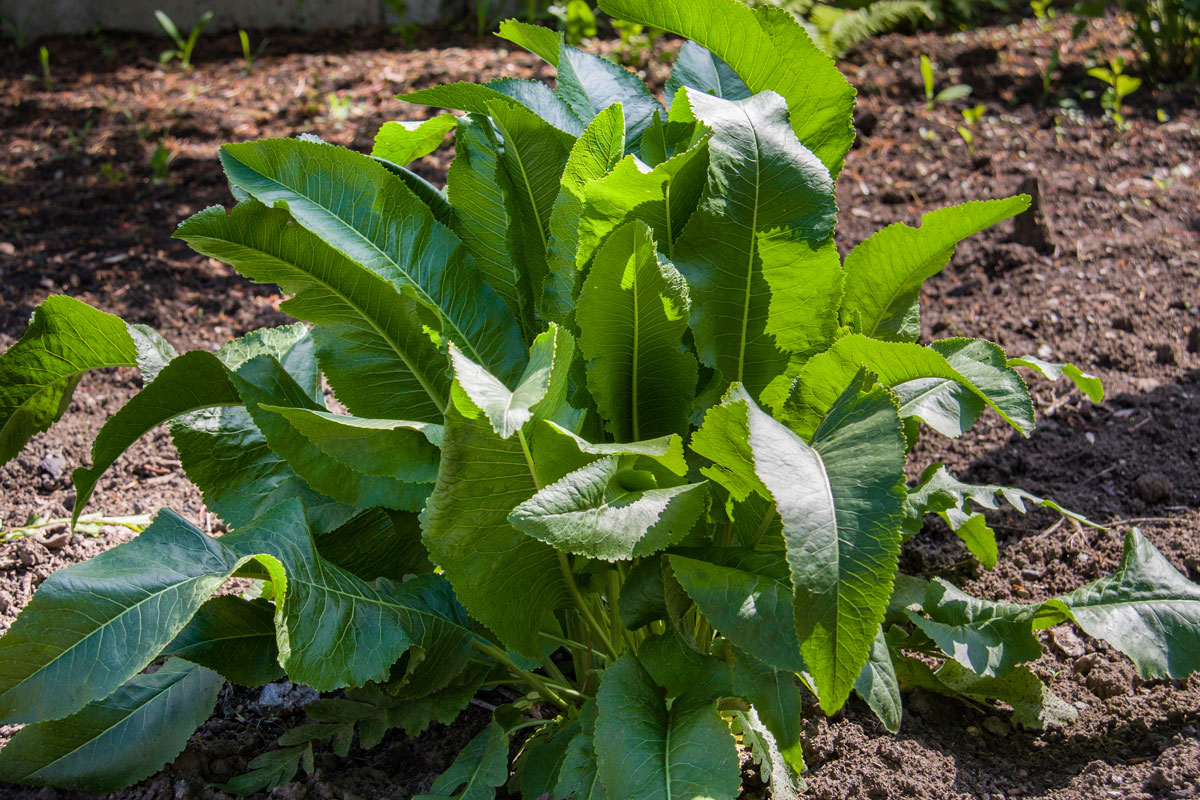
Horseradish, known as Kren in Bavaria and Austria, is a hardy perennial from the cabbage family, which makes it a relative of cabbage, radish and mustard. It forms large, coarse leaves and a thick white taproot whose heat only comes out once you grate it. The plant grows to about a metre tall and is fully hardy. It hardly ever sets seed, so you propagate it from pieces of root, known as sets or thongs. Horseradish is one of the oldest crops in our gardens and escapes easily into the wild. Along paths and stream banks it often still marks the spot where a garden stood decades ago.
Facts and figures
Planting & harvest times of Horseradish
SpringTransplant to bed from Mid March to Mid May. After a growing period of 165 days, harvest can begin around Early September and continues until Late March next year.
AutumnTransplant to bed from Early September to Late October. After a growing period of 390 days, harvest can begin around Early September and continues until Late December next year.
PerennialTransplant to bed from Mid March to Late October. Harvest begins around Early September and continues until Late December, starting from year 2.
Plant Horseradish
You almost never grow horseradish from seed. Instead you use root cuttings, also called sets or thongs. These are the strong side roots that branch off the main root and come up at harvest time. Good cuttings are about 30 cm long and at least as thick as a pencil. Cut them straight across at the top and at a slant at the bottom so you don't mix up which way they grow. Plant them in autumn or in spring from early April. Lay the cuttings at an angle, always the same way up as they grew, in well-loosened soil enriched with compost, with the top end sticking out about 3 cm. Leave 70 to 80 cm between rows and 40 to 50 cm within the row.
If you plant in autumn, the harvest only starts in autumn of the following year and runs until spring of the year after that. Grove only plans this as far as December of the following year.
You can also give horseradish a permanent spot in the garden. If you leave small pieces of root in the ground when you dig it up, each one sprouts into a new plant the next spring. That way the horseradish stays in its corner and comes back by itself every year. This saves work, but it spreads over time and is then hard to get rid of. So plant it at the edge of the garden or contain the roots with a root barrier.
Location and soil
Horseradish grows in almost any soil, but it only forms good, sturdy roots in deep, humus-rich soil that stays evenly moist. On light sandy soil it loses flavour, and on heavy clay it quickly turns woody. It likes a pH between 6 and 7.5 and can't cope with waterlogging. Full sun is ideal, though it puts up with partial shade. Horseradish doesn't do well in a pot on the balcony.
Good and bad companions of Horseradish
Horseradish usually stays in the same spot for several years and spreads underground. That's why it has few permanent neighbours in the veg bed. It's best placed along the edge or in a corner of the garden.
Its classic partner is the potato. Sister Christa Weinrich plants horseradish on small mounds at the corners of the potato patch, and in Germany, France and North America it has a reputation for protecting potatoes against Colorado beetles and potato diseases. Nobody has tested this, but as a companion at the edge of the bed it does the potatoes no harm.
Horseradish is a poor neighbour for parsnips. Its vigorous roots compete with them for space and the parsnips stay smaller. Don't sow garden cress right next to it, as cress is said to hold back the growth of nearby plants. Rocket attracts flea beetles just like horseradish does, so growing them side by side makes the problem worse. Other brassicas next to horseradish are fine, but keep them apart in your crop rotation.
- Practical tip for this pair
- Allelopathy, growth inhibition
- Competition for light, water, nutrients, root space
- Shared pest is attracted or multiplies
Predecessors and successors of Horseradish
Horseradish is a brassica and shares clubroot with cabbage, radish and rocket. After other brassicas, wait four years before you plant it, and the same applies the other way round. If you grow it on a larger scale, leave it on one plot for two years at most and then give that ground a four-year break. For a few plants at the edge of the garden you don't need a strict rotation.
Peas and beans make good preceding crops, and Sister Christa Weinrich also recommends them as a follow-on crop once you've lifted the horseradish. Avoid crops that build up verticillium wilt in the soil, such as tomatoes, aubergines, cucumbers, strawberries, sunflowers and mint. Opinions differ on potatoes: as a well-fed root crop they count as a good preceding crop, but they also spread wilt.
When you lift the horseradish, dig out every piece of root thoroughly. Any bit left behind sprouts into a new plant in spring, gets in the way of the next crop and carries diseases over.
- Nitrogen release
- Nitrogen release
- Nitrogen release
- Nitrogen release
- Nitrogen release
- Nitrogen release
- Nitrogen release
- Nitrogen release
- Nitrogen release
- Nitrogen release
- Shared soil-borne pathogen
- Shared soil-borne pathogen
- Shared soil-borne pathogen
- Shared soil-borne pathogen
- Shared soil-borne pathogen
- Shared soil-borne pathogen
- Shared soil-borne pathogen
- Shared soil-borne pathogen
- Shared soil-borne pathogen
- Shared soil-borne pathogen
- Shared soil-borne pathogen
- Self-incompatibility
- Shared soil-borne pathogen
- Shared soil-borne pathogen
- Shared soil-borne pathogen
- Shared soil-borne pathogen
- Shared soil-borne pathogen
- Shared soil-borne pathogen
- Shared soil-borne pathogen
- Shared soil-borne pathogen
- Shared soil-borne pathogen
- Shared soil-borne pathogen
- Shared soil-borne pathogen
- Shared soil-borne pathogen
- Shared soil-borne pathogen
- Shared soil-borne pathogen
- Shared soil-borne pathogen
- Shared soil-borne pathogen
- Shared soil-borne pathogen
- Shared soil-borne pathogen
- Shared soil-borne pathogen
- Shared soil-borne pathogen
- Shared soil-borne pathogen
- Shared soil-borne pathogen
- Shared soil-borne pathogen
- Shared soil-borne pathogen
- Shared soil-borne pathogen
- Shared soil-borne pathogen
- Shared soil-borne pathogen
- Shared soil-borne pathogen
- Shared soil-borne pathogen
- Shared soil-borne pathogen
- Self-incompatibility
- Shared soil-borne pathogen
- Shared soil-borne pathogen
- Shared soil-borne pathogen
- Shared soil-borne pathogen
- Shared soil-borne pathogen
- Shared soil-borne pathogen
- Shared soil-borne pathogen
- Shared soil-borne pathogen
- Shared soil-borne pathogen
- Shared soil-borne pathogen
- Shared soil-borne pathogen
- Shared soil-borne pathogen
- Shared soil-borne pathogen
- Shared soil-borne pathogen
- Shared soil-borne pathogen
- Shared soil-borne pathogen
- Shared soil-borne pathogen
Varieties
There are hardly any true horseradish varieties. Gardeners grow regional strains instead, such as Bavarian, Hamburg, Spreewald, Baden or Styrian horseradish. They differ in root size, heat and how firm the flesh is. Styrian grows vigorously and is hot and firm, Bavarian and Baden horseradish taste milder, and Spreewald is very hot. Many strains are prone to white rust and viruses, so buy healthy plants or root cuttings from a healthy stock.
Care and fertilising
Horseradish needs steady moisture to form good roots. Water especially after planting and in August and September, when the roots are thickening. In good garden soil a layer of well-rotted compost each year is enough, about 3 litres per square metre. Don't use fresh manure, as it makes horseradish prone to disease. For straight, smooth roots, uncover the top of the root in June and again in July, snap off all the side shoots except the strongest one and cover it back up with soil, ideally on an overcast day.
Diseases and pests
In a small garden horseradish usually stays healthy. Problems mainly come up when it sits in the same spot for years or when you keep propagating from diseased plants.
The most serious disease is verticillium wilt, which German growers call horseradish blackening. The fungus lives in the soil, gets in through the roots and turns the vascular tissue brown. When you cut through the root, you see dark dots or a ring. The only defence is prevention: use healthy root cuttings, keep it away from potatoes, tomatoes, strawberries and cabbage, and leave no root remains of diseased plants in the bed. Viruses also find their way in through root cuttings and aphids. Turnip mosaic virus shows up as pale ring-shaped spots, and cucumber mosaic virus makes the leaves turn yellow in patches.
In cool, damp weather white pustules appear on the leaves. That's white rust. Brown leaf spots usually come from Alternaria or Cercospora fungi, which overwinter on old leaves. Remove affected leaves and don't propagate from diseased plants.
Flea beetles, including the yellow-striped horseradish flea beetle, and the shiny metallic horseradish leaf beetles chew holes in the leaves, especially in dry weather. Cabbage white caterpillars rarely do much damage to horseradish. Slugs and snails love horseradish, but it copes well with the damage, and you can easily pick them off from under its large leaves in the morning and evening.
Harvest and processing
Harvest starts when the leaves turn yellow in autumn, from late October to mid-November depending on where you live. You can keep harvesting all winter as long as the ground isn't frozen, but finish before the roots start to sprout again in spring. Always loosen the soil with a garden fork rather than just pulling on the plant, or it will snap. Keep the thin side roots as cuttings for next year and store them over winter in damp sand in a cool cellar. Horseradish is hottest when freshly grated, and the heat fades after ten to twenty minutes. Sprinkle it with lemon juice straight away so it doesn't turn brown. A cut root keeps for several weeks in the fridge wrapped in a damp cloth. Horseradish goes well with beef, fish and sausages, and grated together with tart apples it becomes Apfelkren, an Austrian apple horseradish. Its mustard oils are an old home remedy for colds. Don't eat more than about 20 g of fresh root a day, and children and pregnant or breastfeeding women are better off avoiding it altogether.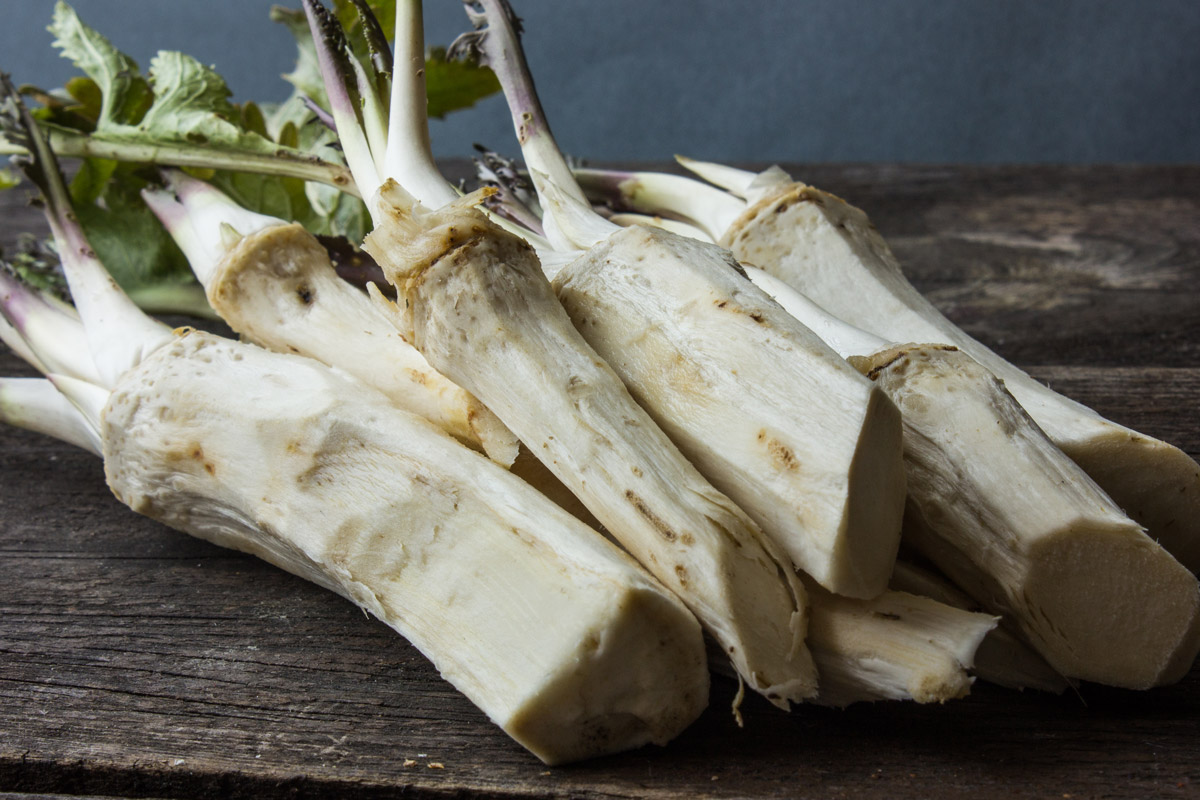
Open the bed planner Try free for 7 days, web, iOS and Android