
Other names
Chinese celery, leaf celery, smallage
Botanical name
Apium graveolens var. secalinum
Family / Genus
Apiaceae / Apium
Plant category
Herbs
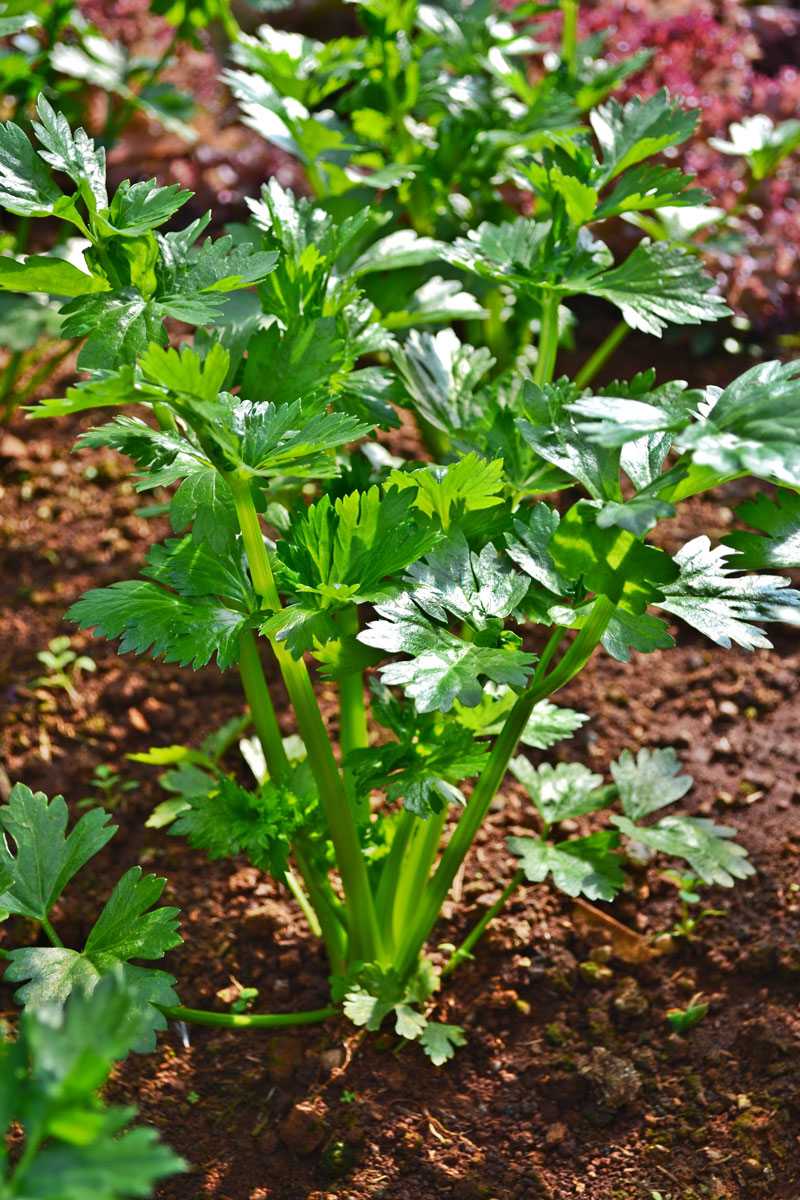
moo_mon/Shutterstock.com
Facts and figures
Light requirements
Sun / partial shade
Nutrient requirements
Medium feeder
Difficulty level
Easy
Culture (according to Gertrud Franck)
B - late
Culture (according to Sister C. Weinrich)
Companion crop
Growing period
120 days
Row spacing
30 cm
Plant spacing
25 cm
Growth height
20 - 40 cm
Sowing depth
1 cm
Germination temperature (minimum)
15 °C
Germination temperature (optimal)
18 - 20 °C
Germination type
Light
Pre-growing period
60 days
Planting & harvest times of Cutting celery
1
2
3
4
5
6
7
8
9
10
11
12
Pre-grow
Transplant
Harvest
Transplant to bed from Mid May to Mid July. Pre-grow about 60 days before transplanting, approximately between Mid March and Mid May. After a growing period of 120 days, harvest can begin around Mid July and continues until Late October.
Good and bad companions of Cutting celery
Very good neighbours
Broccoli
Celery right next to broccoli is said to stop cabbage whites from laying eggs. Best plant them alternately in the same row.
Evidence quality: good
Evidence: Long-standing companion planting practice (e.g. Gertrud Franck, Schwester C. Weinrich)
Reasons:
- Pest control through scent or camouflage
Cauliflower
Celery is said to keep cabbage whites off cauliflower, and cauliflower to keep celery rust off celery. Best planted alternately in one row.
Evidence quality: good
Evidence: Long-standing companion planting practice (e.g. Gertrud Franck, Schwester C. Weinrich)
Reasons:
- Pest control through scent or camouflage
Kale
Celery among the kale is said to keep cabbage whites away. Best planted alternately in the same row.
Evidence quality: good
Evidence: Long-standing companion planting practice (e.g. Gertrud Franck, Schwester C. Weinrich)
Reasons:
- Pest control through scent or camouflage
Good neighbours
Cucumber
Evidence quality: moderate
Evidence: Long-standing companion planting practice (e.g. Gertrud Franck, Schwester C. Weinrich), Tradition agrees across several language regions
Leek
Evidence quality: moderate
Evidence: Long-standing companion planting practice (e.g. Gertrud Franck, Schwester C. Weinrich), Derived from plant family or pathogen, pair not directly documented, Tradition agrees across several language regions
Melothria
Celery is considered a good neighbour for cucumbers. For the related Melothria this is only carried over; it sprawls vigorously and often does better on its own.
Evidence quality: limited
Evidence: Long-standing companion planting practice (e.g. Gertrud Franck, Schwester C. Weinrich), Derived from plant family or pathogen, pair not directly documented, Tradition agrees across several language regions
We found conflicting sources. This is our current assessment.
Bad neighbours
Predecessors and successors of Cutting celery
Good predecessors
Beetroot
Lasting effect: 3 years
Broad bean
Lasting effect: 3 years
Bush bean
Lasting effect: 3 years
Chickpea
Lasting effect: 3 years
Lentils
Lasting effect: 3 years
Pea
Lasting effect: 3 years
Pole bean
Lasting effect: 3 years
Runner bean
Lasting effect: 3 years
Soya bean
Lasting effect: 3 years
Swiss chard
Lasting effect: 3 years
Bad predecessors
Carrot
Rotation break: 4 years
Celeriac
Rotation break: 4 years
Cutting celery
Rotation break: 4 years
Dill
Rotation break: 4 years
Hamburg parsley
Rotation break: 4 years
Parsley
Rotation break: 4 years
Parsnip
Rotation break: 4 years
Sunflower
After sunflowers the risk of sclerotinia rot rises in cucumber, pepper, celery and tomato.
Rotation break: 3 years
Very bad predecessors
Celery
Rotation break: 4 years
Good successors
Beetroot
Lasting effect: 3 years
Broccoli
Lasting effect: 1 year
Evidence quality: moderate
Evidence: Long-standing companion planting practice (e.g. Gertrud Franck, Schwester C. Weinrich)
Cauliflower
Lasting effect: 1 year
Evidence quality: good
Evidence: Advisory service, research institute, Long-standing companion planting practice (e.g. Gertrud Franck, Schwester C. Weinrich)
Cucumber
Lasting effect: 1 year
Evidence quality: good
Evidence: Specialist book
Honeydew melon
Lasting effect: 1 year
Evidence quality: good
Evidence: Specialist book
Kale
Lasting effect: 1 year
Evidence quality: moderate
Evidence: Long-standing companion planting practice (e.g. Gertrud Franck, Schwester C. Weinrich)
Melothria
Lasting effect: 1 year
Evidence quality: moderate
Evidence: Specialist book, Derived from plant family or pathogen, pair not directly documented
Red cabbage
Lasting effect: 3 years
Romanesco
Lasting effect: 3 years
Swiss chard
Lasting effect: 3 years
Watermelon
Lasting effect: 1 year
Evidence quality: good
Evidence: Specialist book
White cabbage
Lasting effect: 3 years
Bad successors
Carrot
Rotation break: 4 years
Cutting celery
Rotation break: 4 years
Dill
Rotation break: 4 years
Fennel
Rotation break: 4 years
Hamburg parsley
Rotation break: 4 years
Parsley
Rotation break: 4 years
Parsnip
Rotation break: 4 years
Very bad successors
Celery
Rotation break: 4 years
Diseases and pests
Susceptible to
Cucumber mosaic virus
Stem nematode(low susceptibility)
Open the bed planner Try free for 7 days, web, iOS and Android