
Garlic chives bring a mild, fresh garlic flavour to the garden, from spring right through to autumn. The plant originally comes from south-west China, where it grows wild in mountainous areas beneath shrubs. In Asia it has been a kitchen staple for thousands of years, while over here it's still a bit of an insider tip – but one that's gaining more and more fans. This hardy perennial grows in clumps and produces flat, strap-shaped leaves that reach between 30 and 80 cm tall depending on the variety. From July to September, pretty white flower umbels appear, attracting bees and butterflies in droves. Every part of the plant is edible: leaves, flowers, buds and even the small bulbs above the root. In Japan the plant is called Nira, in Korea Buchu and in China Jiucai. Garlic chives are extremely winter-hardy and tolerate temperatures down to around minus 20 degrees. In winter the foliage dies back, but the plant reliably sprouts again in spring. Every three to four years you should divide the clumps to rejuvenate them.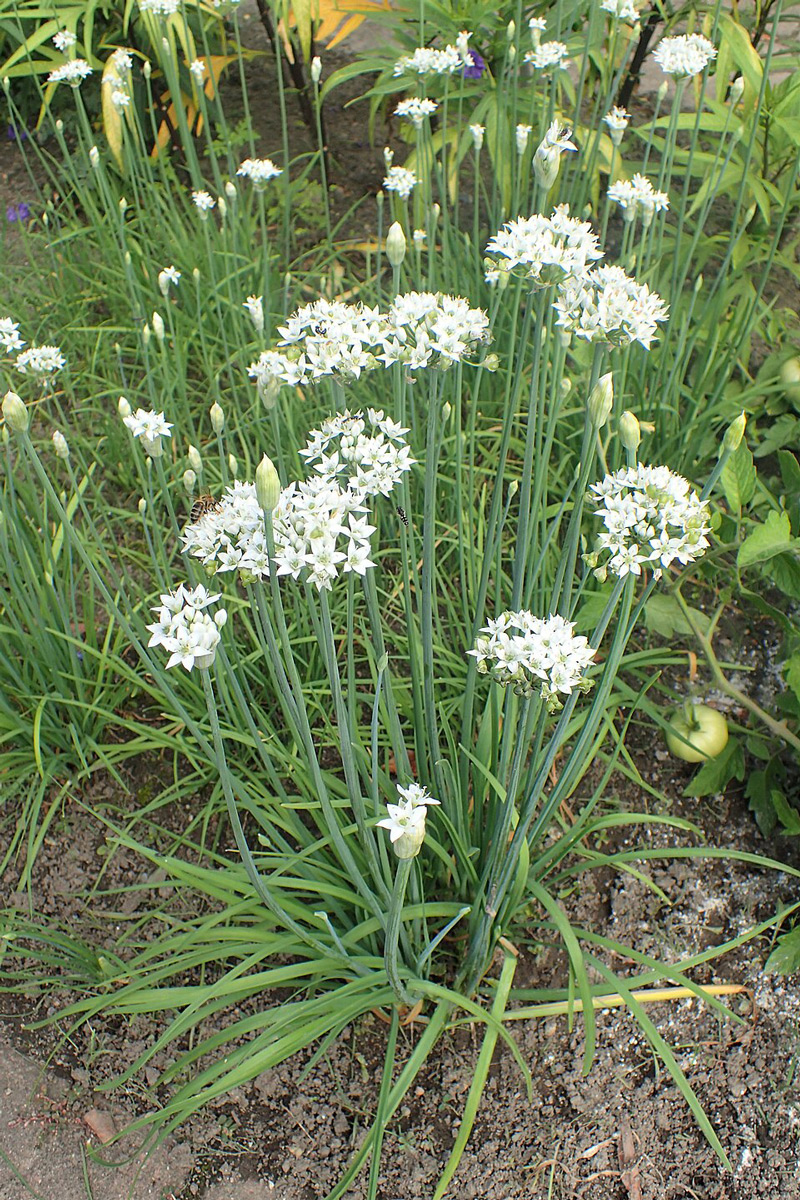
Krzysztof Ziarnek/CC-BY-SA 4.0
Facts and figures
Planting & harvest times of Garlic chives
Direct sowing from Early April to Late August. Transplant to bed from Mid May to Late June. Pre-grow about 75 days before planting out, approximately between Early March and Mid April. After a growing period of 60 days, harvest can begin around Early June and continues until Late October next year.
Sow and plant Garlic chives
You can start garlic chives indoors or sow them directly into the bed. For indoor sowing, place around 10 to 15 seeds in a pot from late February to mid-April and keep it on a windowsill at about 20 degrees. Once they've germinated, you can divide the clumps so that four to five seedlings stay together. From mid-May, when there's no more risk of frost, the young plants can go outdoors.
Direct sowing works from April to August. Place the seeds about 1 to 2 cm deep in the soil, water well afterwards and keep consistently moist. Germination takes up to 28 days.
You can easily propagate existing clumps by division. Simply dig them up in spring or late summer, carefully split them into two or three pieces and replant them at least 30 cm apart. In the first year the plants grow rather slowly, but from the second year onwards they really take off.
Location and soil
Garlic chives like it sunny to partially shaded and prefer a warm, sheltered spot.
The soil should ideally be rich in humus and nutrients, consistently moist but never waterlogged. Waterlogging is actually the biggest risk for this otherwise very robust plant. A bit of sand in the soil improves drainage. Working in a good helping of compost before planting is enough as fertiliser.
Good and bad companions of Garlic chives
In companion planting, garlic chives behave similarly to garlic and drive away many pests from their neighbours. Since they normally stay in the same spot for several years, they don't move around the beds but keep a fixed position for years.
They pair particularly well with strawberries, as both plants are perennial and garlic chives can protect strawberries from fungal diseases. They also make a good companion for tomatoes, for example when these are grown in a greenhouse and don't change position as often.
Carrots complement garlic chives nicely, as the allium scent keeps carrot fly at bay. Cucumbers, parsnips and lettuce also get along fine as neighbours. For these plants, however, other alliums that also change position every year are a better match.
Beans and peas as direct neighbours are a bad idea, as legumes and alliums inhibit each other's growth. All types of brassicas don't like garlic chives next to them either. You should also avoid planting other alliums like chives or leeks directly alongside, as this encourages diseases such as leek rust and onion fly. Asparagus is likewise considered a poor partner.
Predecessors and successors of Garlic chives
As a perennial, garlic chives normally stay in the same spot for several years. If you're setting up a new location or moving the plant, though, you should pay attention to crop rotation. Keep at least four years' distance from other alliums such as chives, leeks, onions or garlic, so that pathogens and pests don't build up in the soil.
Legumes like peas and beans make excellent predecessors, as they leave behind nitrogen-rich soil and share no pests with alliums. Cucurbits such as cucumbers, courgettes or squash are also good predecessors, because they leave the soil nice and loose. Potatoes, on the other hand, are poor predecessors, as they can encourage similar pathogens.
Varieties
The range of garlic chive varieties is growing slowly but steadily. They mainly differ in height, leaf width and flavour intensity. 'Knolau' is a robust standard variety that reaches up to 50 cm tall and delivers reliably good yields. If you're looking for something more compact for a balcony or smaller beds, 'Kobold' is a great choice – a variety with thin, aromatic stems. 'Monstrosum' goes in the opposite direction and can reach up to 80 cm tall.
For broad, thick stems there are varieties like 'Fat Leaf' or 'Kiss me', where the name 'Kiss me' is a playful nod to the lack of bad breath. Numerous other varieties come from East Asia, some of which have a very mild flavour.
Care and fertilising
Garlic chives are really low-maintenance. Outdoors, rainfall is usually enough – you only need to water deliberately during prolonged dry spells or when temperatures exceed 30 degrees. Best to water in the morning or evening so the wet leaves don't scorch in the midday sun. When growing in pots, check more often and make sure there are drainage holes.
After a good hard cut-back, a small extra dose of liquid fertiliser can boost regrowth. Don't fertilise in winter.
Keep the bed weed-free, as young plants in particular can easily be crowded out by weeds. A layer of mulch made from grass clippings or wood chips helps suppress weeds, retains moisture and protects the roots. Regular harvesting encourages fresh growth and delays flowering. If you don't want uncontrolled self-seeding, remove the flower heads in good time – garlic chives can spread quite a bit otherwise.
Diseases and pests
Downy mildew (Peronospora destructor) is the most common fungal disease in garlic chives, especially during cool, damp summers. You'll spot it by pale, oval patches on the leaves, later developing a grey-violet coating. To prevent it, water only in the morning, ensure good air circulation and remove affected leaves straight away. Spraying with horsetail tea strengthens the plant's defences.
Leek rust (Puccinia allii) shows up as orange pustules on the leaves, mainly in August and September during warm, humid weather. Cut back heavily affected leaves and don't put them on the compost. Horsetail tea also helps here as a preventive measure.
The onion fly (Delia antiqua) can become a problem, especially with young plants. A crop protection net placed right after sowing is the best defence. This is also why you shouldn't plant garlic chives directly next to other allium species – it only attracts the flies even more.
Harvest and processing
Garlic chives are a continuous provider. Outdoors you can harvest from March or April right through to November, and on a windowsill even year-round. Once the stems are 15 to 20 cm long, cut them with sharp scissors about two finger-widths above the ground. Always leave a few leaves so the plant can recover. The more often you harvest, the more vigorously it regrows. Not just the leaves are edible – the flowers, buds and small bulbs are too. The fresh flowers make a lovely garnish in salads, and you can use the bulbs like spring onions. Freshly cut garlic chives only keep for two to three days in the fridge.