
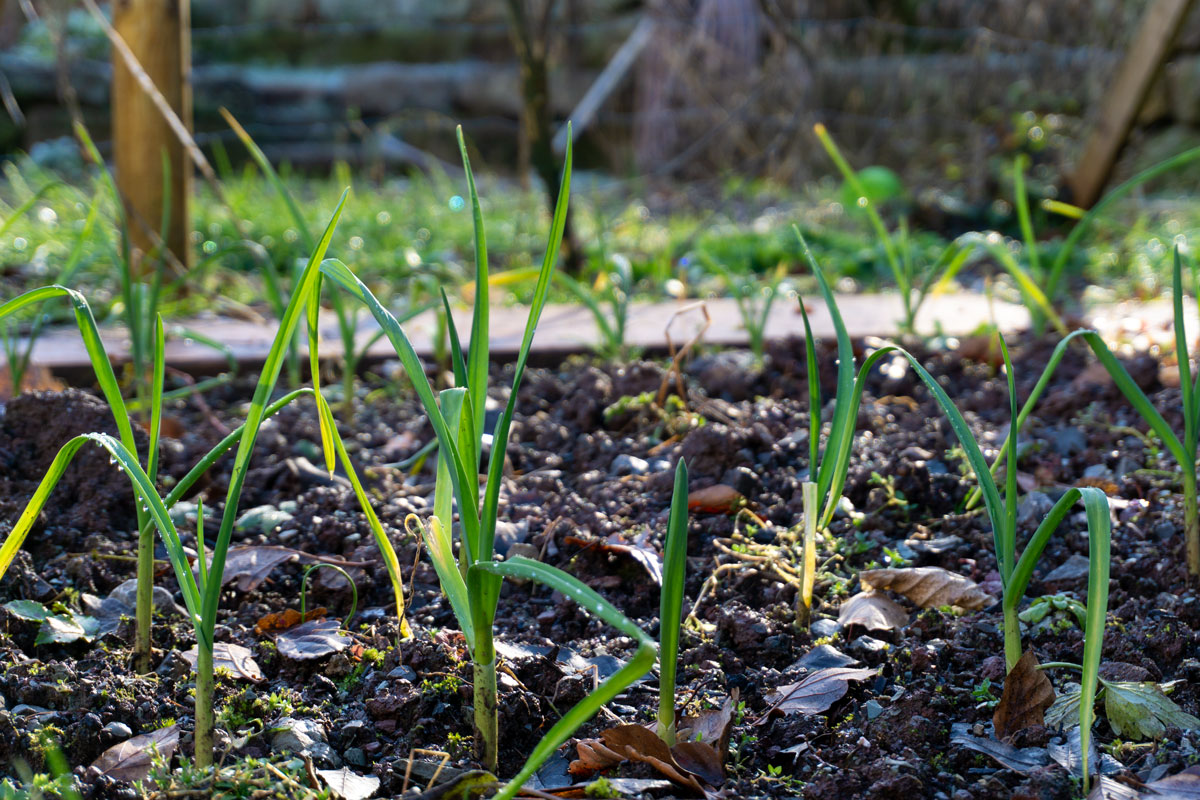
Garlic has been a kitchen staple for thousands of years. Its flavour is indispensable for countless dishes all around the world.
It also does well as a medicinal plant. It helps prevent cardiovascular diseases by lowering blood lipid levels, including some cholesterol values. It lowers blood pressure too. It has antibacterial properties and is traditionally used to relieve cold symptoms.
Facts and figures
Planting & harvest times of Garlic
SpringDirect sowing from Mid February to Mid March. After a growing period of 150 days, harvest can begin around Mid July and continues until Mid August.
WinterDirect sowing from Early September to Late October. After a growing period of 285 days, harvest can begin around Mid June and continues until Late July next year.
Spring 2Direct sowing from Mid March to Mid April. After a growing period of 150 days, harvest can begin around Early July and continues until Late July.
Winter 2Direct sowing from Early October to Late October. After a growing period of 240 days, harvest can begin around Early June and continues until Late June next year.
Sow Garlic
Spring and winter: Planting cloves
Spring 2 and winter 2: Planting bulbils
You can propagate garlic either by planting cloves or by planting bulbils. Planting cloves is quicker, but the bulbs tend to stay smaller and the plants are a bit less robust. You'll use up to 20% of your harvest for planting cloves. Bulbils come free of charge. Both methods work in spring or autumn, depending on the variety.
You plant cloves either from March to April and harvest in July of the same year, or from September to October and harvest from June the following year. Those autumn-planted bulbs tend to be a bit larger than the spring ones.
When you plant bulbils, they form so-called rounds in the first year and only develop into proper bulbs in the second year. The plants are more robust and produce larger bulbs.
For spring planting, set the bulbils from early March to the end of April at a depth of 5 cm, spaced 10 cm apart if you want to leave them in the ground until the rounds have turned into bulbs. If you plan to dig up the rounds and replant them, space them 3 cm apart. With the first option, the bulbs are ready the following July. With the second option, they're ready at the same time — you just need to replant them in October at a final spacing of 10 cm.
For autumn planting in October, the spacing is the same. If you leave the rounds in the ground, the bulbs won't be ready until June two years later. If you dig them up, they're also ready two years later, but you need to replant them in the autumn of the following year.
For me, it's a clear choice to plant bulbils in spring. Whether you leave them in the ground depends on whether they can stay in the same spot the following year. Your laziness will thank you.
Location and soil
It prefers loamy, humus-rich soil in full sun. An airy spot is actually a good thing — it keeps the garlic fly away.
Good and bad companions of Garlic
Good neighbours for garlic are strawberries, carrots, tomatoes, cucumbers, lettuce and beetroot. Planted between strawberries, it keeps spider mites away. Other alliums, peas and beans are bad neighbours.
- Pest control through scent or camouflage
- Pest control through scent or camouflage
- Shared pest is attracted or multiplies
- Shared pest is attracted or multiplies
- Shared pathogen, spreads through proximity
- Shared pest is attracted or multiplies
- Shared pest is attracted or multiplies
- Shared pest is attracted or multiplies
- Shared pathogen, spreads through proximity
- Shared pest is attracted or multiplies
- Shared pest is attracted or multiplies
Predecessors and successors of Garlic
Good preceding crops are legumes such as peas and beans, and also cereals and potatoes. Leave four years before you grow other alliums in the same spot. After the July harvest, lamb's lettuce or mustard work well as a green manure. Better not to sow peas straight afterwards, because garlic can carry stem nematodes.
- Nitrogen release
- Nitrogen release
- Nitrogen release
- Nitrogen release
- Nitrogen release
- Nitrogen release
- Loosens soil, improves soil structure
- Weed suppression for the next crop
- Nitrogen release
- Nitrogen release
- Weed suppression for the next crop
- Shared soil-borne pathogen
- Both host the same nematode species
- Shared soil-borne pathogen
- Both host the same nematode species
- Self-incompatibility
- Shared soil-borne pathogen
- Both host the same nematode species
- Shared soil-borne pathogen
- Both host the same nematode species
- Shared soil-borne pathogen
- Both host the same nematode species
- Shared soil-borne pathogen
- Both host the same nematode species
- Shared soil-borne pathogen
- Both host the same nematode species
- Shared soil-borne pathogen
- Both host the same nematode species
- Weed suppression for the next crop
- Weed suppression for the next crop
- Weed suppression for the next crop
- Weed suppression for the next crop
- Weed suppression for the next crop
- Weed suppression for the next crop
- Shared soil-borne pathogen
- Both host the same nematode species
- Shared soil-borne pathogen
- Both host the same nematode species
- Self-incompatibility
- Shared soil-borne pathogen
- Both host the same nematode species
- Shared soil-borne pathogen
- Both host the same nematode species
- Shared soil-borne pathogen
- Both host the same nematode species
- Both host the same nematode species
- Shared soil-borne pathogen
- Both host the same nematode species
- Shared soil-borne pathogen
- Both host the same nematode species
- Shared soil-borne pathogen
- Both host the same nematode species
Care and fertilising
Garlic is a medium feeder. It appreciates a bed well enriched with compost. Watering with nettle tea or something similar does it good too. Apart from that, hoe carefully a few times, keep it weed-free, or mulch with grass clippings.
Diseases and pests
Harvest and processing
You can harvest garlic when roughly two-thirds of the foliage has turned yellow or flopped over. Push a digging fork into the soil next to the plant and carefully loosen the ground. Best done in dry weather. Let the plants dry for a few days in an airy spot afterwards — either spread them out or hang them up in bundles. Bulbs that have already split open don't store as well and should be used first. Otherwise, garlic keeps for up to 8 months in a dark, cool place like a cold cellar.
Open the bed planner Try free for 7 days, web, iOS and Android