
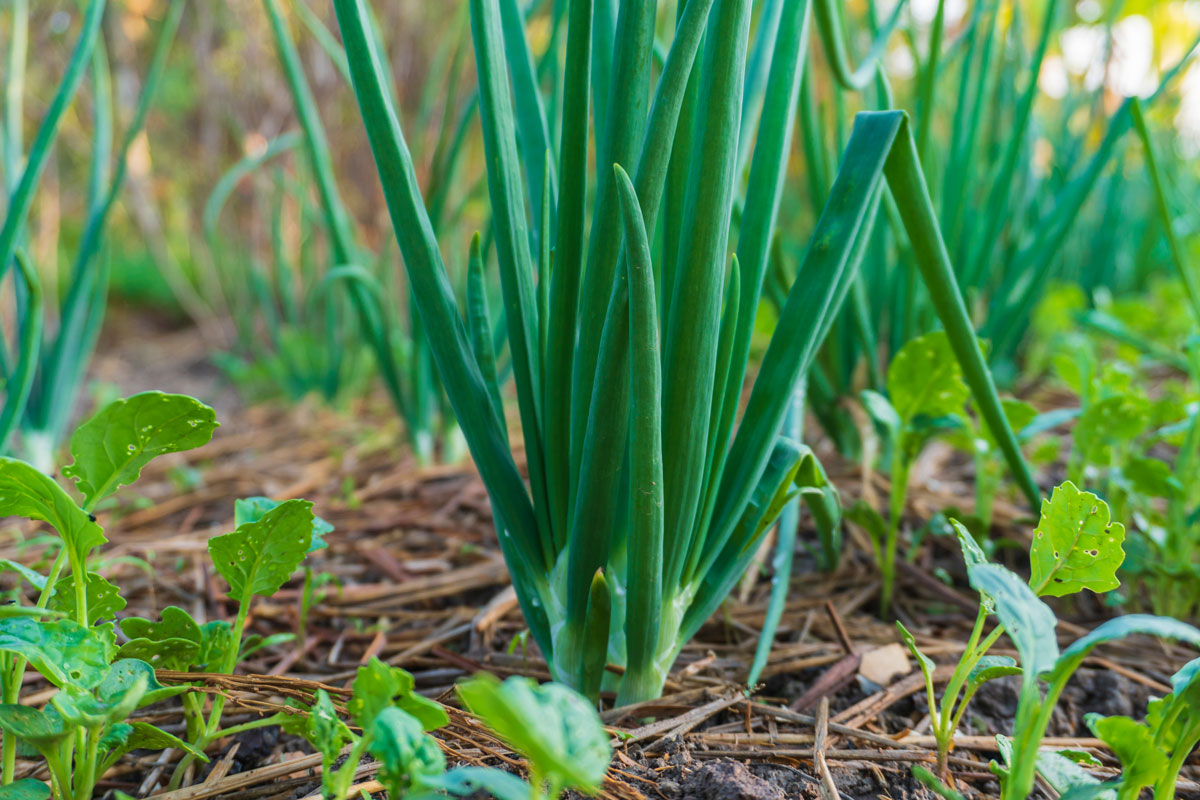
The spring onion is essentially a perennial and forms clumps over time. You should divide these every 3 to 4 years.
In beds, it's often grown as an annual and moves through the garden with the other plants over the years, frequently proving to be a good neighbour.
Facts and figures
Planting & harvest times of Spring onion
SpringDirect sowing from Early March to Late June. After a growing period of 45 days, harvest can begin around Mid April and continues until Late October.
AutumnDirect sowing from Early August to Late October. After a growing period of 240 days, harvest can begin around Early April and continues until Late June next year.
PerennialDirect sowing from Early March to Late May. In the first year, harvest can begin after a growing period of 45 days and continues until Late October. From the second year on, harvest can begin as early as around Early February.
Good and bad companions of Spring onion
Spring onions go well with beetroot, lettuce and parsnips, and planting them among strawberries is an old companion planting tip. Plenty of gardeners also put them next to carrots, though a net works far more reliably against carrot fly. Keep them away from beans and peas, as both grow poorly beside them. Don't plant other alliums right next to them, because they attract the same pests, such as onion fly and leek miner fly.
- Pest control through scent or camouflage
- Practical tip for this pair
- Practical tip for this pair
- Practical tip for this pair
- Practical tip for this pair
- Shared pathogen, spreads through proximity
- Shared pest is attracted or multiplies
- Shared pathogen, spreads through proximity
- Shared pest is attracted or multiplies
- Shared pathogen, spreads through proximity
- Shared pest is attracted or multiplies
- Shared pathogen, spreads through proximity
- Shared pest is attracted or multiplies
- Shared pathogen, spreads through proximity
- Shared pest is attracted or multiplies
- Shared pathogen, spreads through proximity
- Shared pest is attracted or multiplies
- Shared pathogen, spreads through proximity
- Shared pest is attracted or multiplies
Predecessors and successors of Spring onion
Spring onions need a loose bed with few weeds. They do well after tomatoes, May turnips or a green manure that dies back over winter. Leave at least four years before following other alliums or spring onions again, because downy mildew and stem nematodes survive a long time in the soil. After peas and beans, wait two years, since they get hit by stem nematodes too. If you grow your spring onions as a perennial, divide the clump every two to four years and move it to a fresh bed.
- Weed suppression for the next crop
- Weed suppression for the next crop
- Weed suppression for the next crop
- Weed suppression for the next crop
- Weed suppression for the next crop
- Weed suppression for the next crop
- Both host the same nematode species
- Both host the same nematode species
- Shared soil-borne pathogen
- Both host the same nematode species
- Shared soil-borne pathogen
- Both host the same nematode species
- Shared soil-borne pathogen
- Both host the same nematode species
- Shared soil-borne pathogen
- Both host the same nematode species
- Shared soil-borne pathogen
- Both host the same nematode species
- Both host the same nematode species
- Both host the same nematode species
- Both host the same nematode species
- Shared soil-borne pathogen
- Both host the same nematode species
- Shared soil-borne pathogen
- Both host the same nematode species
- Self-incompatibility
- Shared soil-borne pathogen
- Both host the same nematode species
- Both host the same nematode species
- Both host the same nematode species
- Shared soil-borne pathogen
- Both host the same nematode species
- Shared soil-borne pathogen
- Both host the same nematode species
- Shared soil-borne pathogen
- Both host the same nematode species
- Shared soil-borne pathogen
- Both host the same nematode species
- Shared soil-borne pathogen
- Both host the same nematode species
- Both host the same nematode species
- Both host the same nematode species
- Both host the same nematode species
- Shared soil-borne pathogen
- Both host the same nematode species
- Shared soil-borne pathogen
- Both host the same nematode species
- Self-incompatibility
- Shared soil-borne pathogen
- Both host the same nematode species
Diseases and pests
Spring onions are tough and rarely fall ill. The pests most likely to bother them are onion fly, leek miner fly and leek moth. A fine insect-proof net keeps the flies and moths out. Against soil-borne diseases, a wide rotation with a four-year gap to other onion family crops helps.
Harvest and processing
You can grow spring onions as annuals — in that case, you pull the whole plant out of the ground.
Or you leave the perennial plant in place and just cut the green shoots, much like you would with chives. This way, you can start harvesting shortly after the first new growth appears.
Open the bed planner Try free for 7 days, web, iOS and Android