
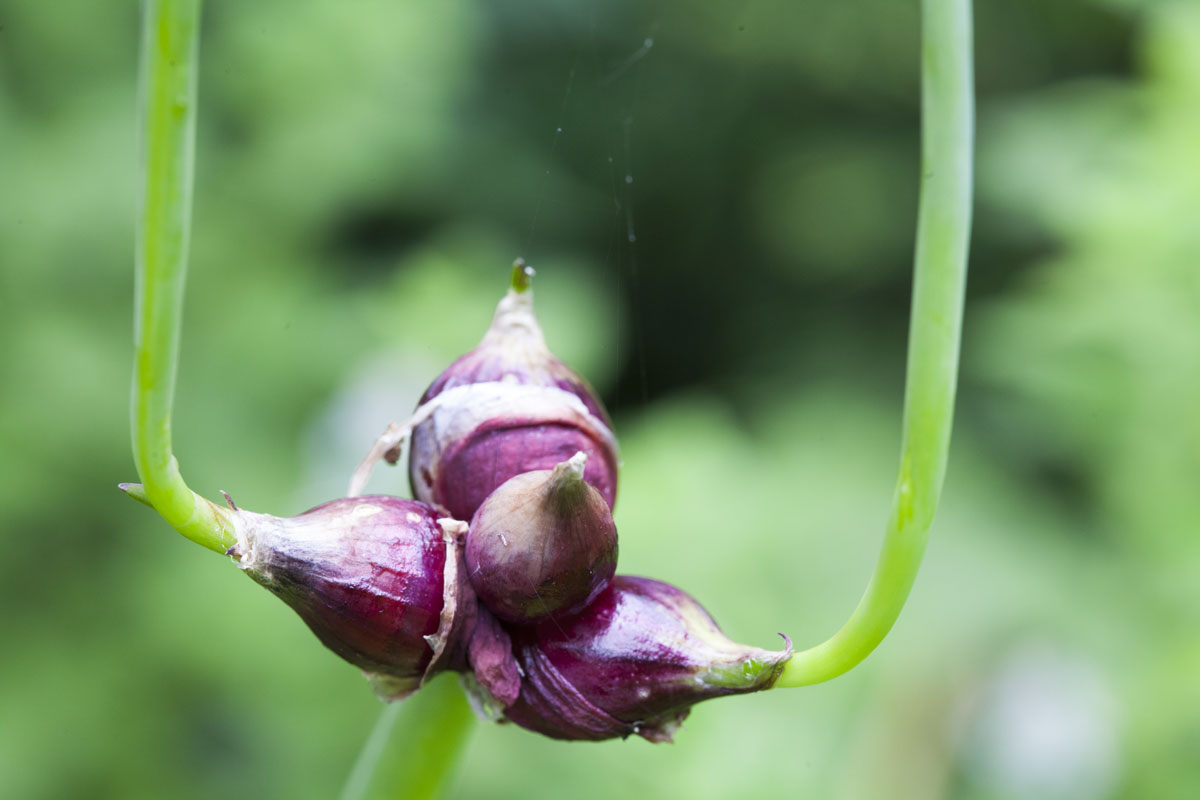
The perennial tree onion doesn't produce flowers but instead grows small bulbils directly in clusters. These sprout green shoots – onion leaves – which you can harvest straight away. Otherwise, new little bulbs grow at their tips again. Those are the tiers. Eventually the weight pulls them down to the ground, where the bulbs take root and form a new clump. That's where the name "walking onion" comes from.
Facts and figures
Planting & harvest times of Tree onion
Transplant to bed from Late February to Late March. In the first year, harvest can begin and continues until Late October. From the second year on, harvest can begin as early as around Late April.
Plant Tree onion
You can't propagate the tree onion from seed, because it doesn't form flowers and therefore no seeds either. Your only option is to plant the bulbils directly, setting them about 5 cm deep with 30 cm spacing. This works well in a pot too, and the drooping tiers look rather striking.
Location and soil
They thrive in almost any soil, as long as it's not too wet. They prefer a sunny spot.
Good and bad companions of Tree onion
Don't plant it next to other alliums. Otherwise the onion fly and the leek moth simply move from one plant to the next.
Strawberries, lettuce, tomatoes and carrots all do well beside tree onions. Whether carrots and tree onions really keep the flies off each other is far from certain, so a vegetable net is the more reliable option.
Tree onions don't get on with beans and peas as neighbours, something gardeners in Germany, France and England all agree on.
- Pest control through scent or camouflage
- Shared pest is attracted or multiplies
- Shared pest is attracted or multiplies
- Shared pest is attracted or multiplies
- Shared pest is attracted or multiplies
- Shared pest is attracted or multiplies
- Shared pest is attracted or multiplies
- Shared pathogen, spreads through proximity
- Shared pest is attracted or multiplies
Predecessors and successors of Tree onion
The tree onion stays in the same spot for three to four years. After that you plant a few bulbils in a new bed. Leave at least four years before it follows itself or any other onion relative, otherwise onion smut and stem nematodes build up in the soil.
Peas and beans suffer from the same stem nematodes, so allow two years between them and the tree onion. After potatoes you get a loose bed with few weeds, and that suits it well.
- Loosens soil, improves soil structure
- Weed suppression for the next crop
- Weed suppression for the next crop
- Both host the same nematode species
- Both host the same nematode species
- Shared soil-borne pathogen
- Both host the same nematode species
- Shared soil-borne pathogen
- Both host the same nematode species
- Shared soil-borne pathogen
- Both host the same nematode species
- Shared soil-borne pathogen
- Both host the same nematode species
- Shared soil-borne pathogen
- Both host the same nematode species
- Both host the same nematode species
- Both host the same nematode species
- Both host the same nematode species
- Shared soil-borne pathogen
- Both host the same nematode species
- Shared soil-borne pathogen
- Both host the same nematode species
- Shared soil-borne pathogen
- Both host the same nematode species
- Self-incompatibility
- Both host the same nematode species
- Both host the same nematode species
- Shared soil-borne pathogen
- Both host the same nematode species
- Shared soil-borne pathogen
- Both host the same nematode species
- Shared soil-borne pathogen
- Both host the same nematode species
- Shared soil-borne pathogen
- Both host the same nematode species
- Shared soil-borne pathogen
- Both host the same nematode species
- Both host the same nematode species
- Both host the same nematode species
- Both host the same nematode species
- Shared soil-borne pathogen
- Both host the same nematode species
- Shared soil-borne pathogen
- Both host the same nematode species
- Shared soil-borne pathogen
- Both host the same nematode species
- Self-incompatibility
Care and fertilising
You don't need to feed them. As light feeders they get by on very little. Harvesting regularly keeps the plants growing well and healthy. Every three or four years you should split the clumps and replant them somewhere else to prevent disease and soil fatigue.
Diseases and pests
The tree onion is tougher than the common onion, but it can catch the same diseases and pests. The onion fly causes the most trouble: its maggots feed inside the hollow leaves, which then flop over. Insect-proof netting in spring keeps the fly away.
If your tree onion grows weaker over the years, a virus spread by aphids is often behind it. Take bulbils only from strong plants and move them to a new spot.
Harvest and processing
You can harvest both the fully grown shoots and bulbs growing in the ground and the ones growing up in the air. You can pickle the bulbils like pearl onions. And the young, still small bulbils with their leaves – just toss them in the pan like spring onions. You can do all of this from spring right through to autumn.
Open the bed planner Try free for 7 days, web, iOS and Android