
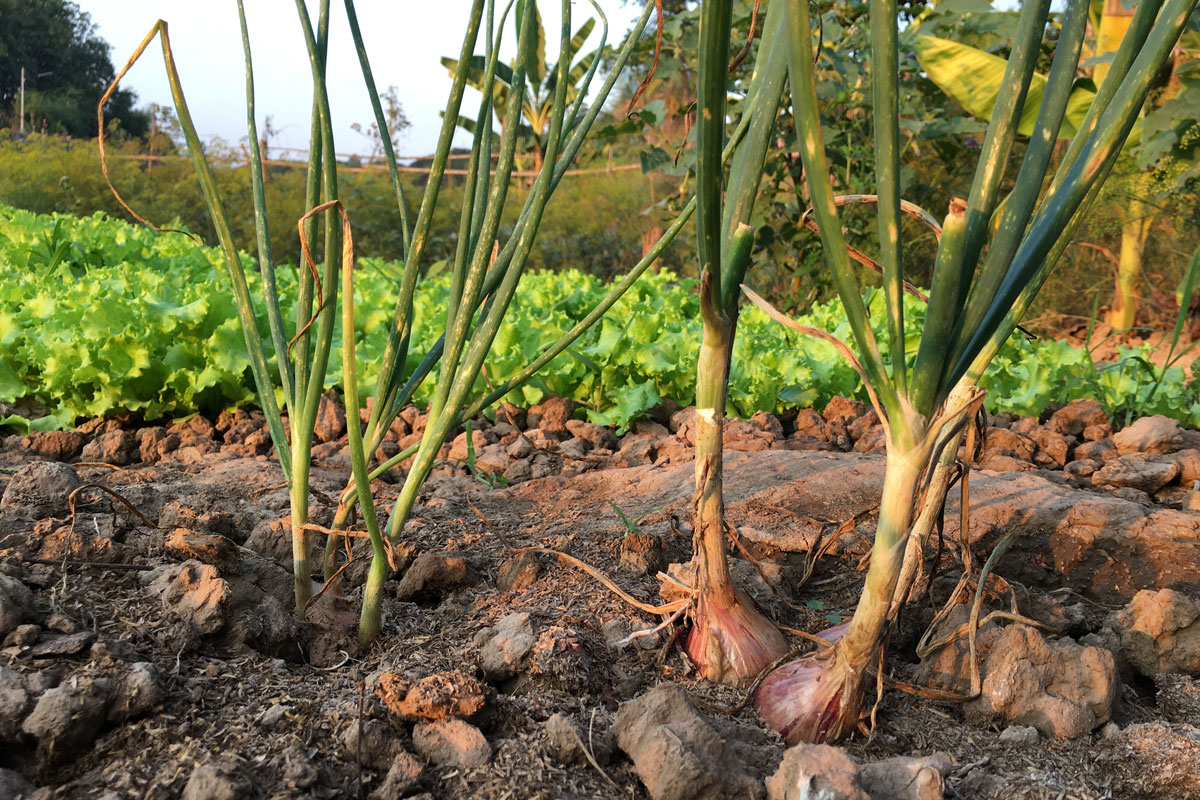
The shallot is the small, refined sister of the onion. Less pungent and more delicate in flavour.
Facts and figures
Planting & harvest times of Shallot
SpringTransplant to bed from Late February to Late March. After a growing period of 120 days, harvest can begin around Early July and continues until Late July.
AutumnTransplant to bed from Early September to Mid November. After a growing period of 300 days, harvest can begin around Early July and continues until Late July next year.
Plant Shallot
Shallots are mainly propagated using sets, as they rarely flower in our climate and therefore don't produce seeds.
The sowing depth given refers to the depth at which you plant the sets. The tip should just be visible above the soil.
Good and bad companions of Shallot
Shallots go well with carrots, beetroot, lettuce, parsnips and dill, and they belong among the strawberries. Keep them away from beans and peas, as they often stay small next to those. Don't put other members of the onion family right beside them, because they attract the same pests.
- Practical tip for this pair
- Practical tip for this pair
- Pest control through scent or camouflage
- Practical tip for this pair
- Practical tip for this pair
- Practical tip for this pair
- Practical tip for this pair
- Practical tip for this pair
- Practical tip for this pair
- Practical tip for this pair
- Practical tip for this pair
- Shared pest is attracted or multiplies
- Shared pest is attracted or multiplies
- Shared pest is attracted or multiplies
- Shared pest is attracted or multiplies
- Shared pest is attracted or multiplies
- Shared pathogen, spreads through proximity
- Shared pest is attracted or multiplies
- Shared pest is attracted or multiplies
Predecessors and successors of Shallot
Shallots are light feeders and need no fertiliser. Don't plant them straight after legumes or brassicas, or there will be too much nitrogen in the soil and they'll store badly. A weed-free bed is ideal, for example after tomatoes, May turnips or a green manure that dies off over winter. After other alliums, leave a four-year gap.
- Weed suppression for the next crop
- Weed suppression for the next crop
- Weed suppression for the next crop
- Weed suppression for the next crop
- Weed suppression for the next crop
- Weed suppression for the next crop
- Both host the same nematode species
- Too much nitrogen for a sensitive successor
- Too much nitrogen for a sensitive successor
- Too much nitrogen for a sensitive successor
- Both host the same nematode species
- Too much nitrogen for a sensitive successor
- Too much nitrogen for a sensitive successor
- Too much nitrogen for a sensitive successor
- Too much nitrogen for a sensitive successor
- Shared soil-borne pathogen
- Both host the same nematode species
- Too much nitrogen for a sensitive successor
- Shared soil-borne pathogen
- Both host the same nematode species
- Shared soil-borne pathogen
- Both host the same nematode species
- Too much nitrogen for a sensitive successor
- Shared soil-borne pathogen
- Both host the same nematode species
- Too much nitrogen for a sensitive successor
- Shared soil-borne pathogen
- Both host the same nematode species
- Both host the same nematode species
- Too much nitrogen for a sensitive successor
- Too much nitrogen for a sensitive successor
- Both host the same nematode species
- Too much nitrogen for a sensitive successor
- Too much nitrogen for a sensitive successor
- Too much nitrogen for a sensitive successor
- Both host the same nematode species
- Too much nitrogen for a sensitive successor
- Too much nitrogen for a sensitive successor
- Shared soil-borne pathogen
- Both host the same nematode species
- Self-incompatibility
- Too much nitrogen for a sensitive successor
- Shared soil-borne pathogen
- Both host the same nematode species
- Shared soil-borne pathogen
- Both host the same nematode species
- Too much nitrogen for a sensitive successor
- Both host the same nematode species
- Both host the same nematode species
- Shared soil-borne pathogen
- Both host the same nematode species
- Shared soil-borne pathogen
- Both host the same nematode species
- Shared soil-borne pathogen
- Both host the same nematode species
- Shared soil-borne pathogen
- Both host the same nematode species
- Shared soil-borne pathogen
- Both host the same nematode species
- Both host the same nematode species
- Both host the same nematode species
- Both host the same nematode species
- Shared soil-borne pathogen
- Both host the same nematode species
- Self-incompatibility
- Shared soil-borne pathogen
- Both host the same nematode species
- Shared soil-borne pathogen
- Both host the same nematode species
Diseases and pests
Shallots are tougher than onions, but they can catch the same diseases: downy mildew, onion smut, onion fly and leek miner fly. Healthy sets, an airy spot and a wide crop rotation keep trouble away. A fine insect net keeps the flies off.
Open the bed planner Try free for 7 days, web, iOS and Android